‘When you have nothing better to do, write a story’: an old iPog saying.
I am stuck in the departure lounge of Heathrow for the next 8 hours thanks to Flybe, COVID hangover and Brexit – in that order if you want a chronology. In weightage terms, the order would, most likely, be reversed. In any case, here I am sat (‘sitting’ for the punctilious) opposite Harrods Food Hall, wondering if the £12 that Flybe compensated us with would buy me anything there. I haven’t checked but I doubt it. If the Caviar and Seafood House right behind me is an indication of food prices at Heathrow, probably not – on the menu is a lobster dish for £65 and with a dash of caviar thrown in, that would be £75, thank you very much. I didn’t ask if I could just have the caviar without the lobster. I don’t want to make trouble even before I reach my destination. It has, however, made me ponder over an existentialist conundrum: if someone didn’t eat fish but ate eggs, could that person eat caviar, considering caviar is fish (Sturgeon) eggs!
Quite a pointless question, of course. But it’s a good way to pass time. Only another seven hours to go.
-
The cure for boredom
-
Eyes that don’t see
When we were in primary school, we read stories in Malayalam each of which invariably ended with a strong moral lesson. It was as if the only purpose of a story was to teach you something worthwhile. If it didn’t, it had no business in a text book. They were probably right, considering the purpose of school is to impart lessons. (There must be a place for pointless stories as well. Something that doesn’t harangue you, a tale sufficient in itself for the telling of it.)
I will concede that in the long run, these lofty stories help you to navigate life and survive reasonably unscathed. The proviso is of course that you understand the lesson.
Often one remembers the moral and forgets the story. Something that has remained with me is the adage, ‘It’s not enough to have eyes, one must also see.”
My phone was running out of juice. Fortunately, my charger was in my cabin bag. However, every charging station in the airport terminal was full. People were queuing with their phones for a bit of charge. They might as well be queuing for drinking water, if you go by the expression on their face: parched, desperate. Some people were sprawled on the floor having plugged their instruments into low points on the wall.
I too was desperate as I couldn’t contemplate being without my phone until I reached my destination. Eventually, I found a free plug point and made a beeline for it. It was at the other end of the terminal but that was ok as I had all the time in the world.
Having successfully got 80% charge on my phone, I triumphantly returned to my seat. My wife was beginning to get impatient and asked me where I had gone. When I told her about the elusive charging points and my successful mission to find a free plug point, she points to a plug point tucked away between my seat and the adjacent one!
The moral of this story? Yes, of course, if you have eyes, you should also see. But the stronger moral I think, is ‘Look under your nose before you search in the neighbour’s house.’ -
Taman Negara

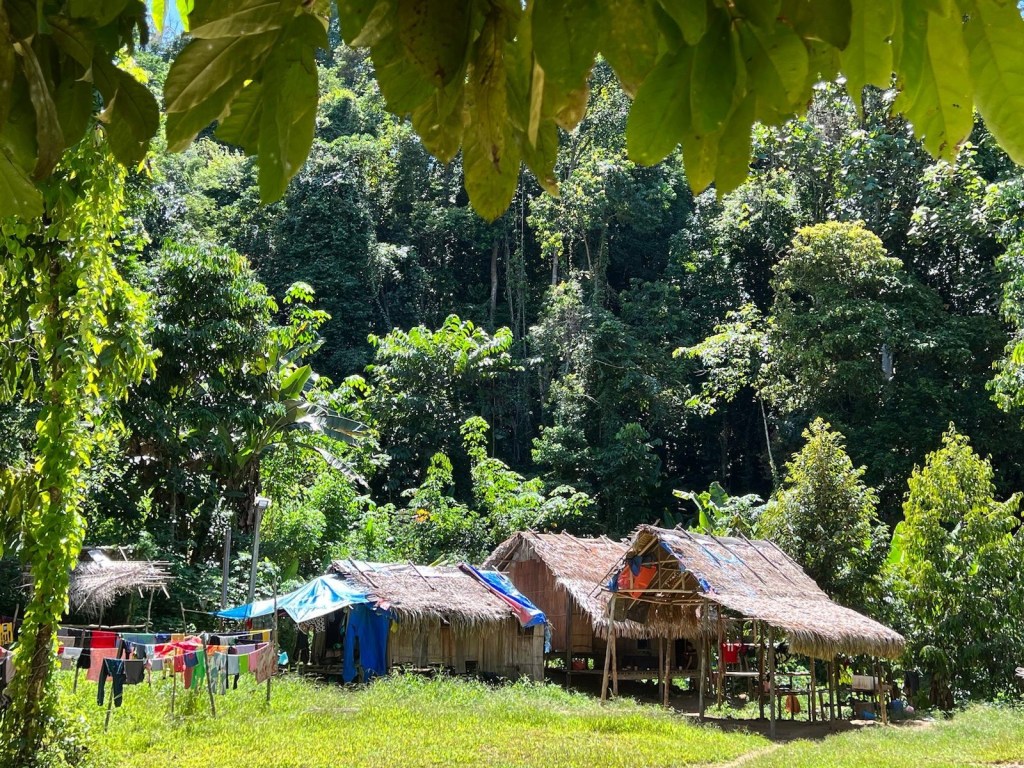
Tribal village in Taman Negara I am familiar with the forests of Western Ghats, India’s mountain range running like a spine from central India to the tip of the peninsula. In November 2024, I discovered Taman Negara, the Malaysian rainforest – Western Ghats on steroids.
When I was 26, I had travelled to Thekkady, a wildlife resort in Kerala. A lonely official wearing khaki sat staring with a ledger at a table in a tent pitched on the bank of the river. Curious, I approached the man and struck up conversation with him. He was a forest protection official, granting permits for entering the forest.
“On foot?”
I was incredulous at the thought that the forest department would allow ordinary people like me to walk inside the forest teeming with wild animals.
“Yes on foot, with a guide,” he responded.
Reading the fear on my face, he added helpfully,
“There’s a group of twenty Americans who have signed up for the tour tomorrow. Do you want to join?”
That clinched the deal. Safety in numbers. I signed a bond for two Indian Rupees, absolving the forest department of any liability if I were unfortunate enough to become a tiger’s lunch or an elephant’s football. The official supplied some statistics – apparently in the last ten years only two persons were attacked by wildlife. Very reassuring, statistically speaking, I thought.
The next morning, trying not to dwell on the nightmares that woke me , I headed for the tent by the river. Did I come to the wrong tent? It was nearly 6 am and the tour was to start at six. The only person loitering outside the tent was a young man wearing a lungi (sarong) at half mast and plastic sandals. He smiled and introduced himself,
“Hello, I am Babu, your forest guide.”
“Where is the rest of the group?” I asked.
“Oh! The Americans have cancelled. It’s just you and me.”
There goes the safety in numbers concept. Maybe it was the foolish recklessness of youth, or an exaggerated sense of invincibility – also an artefact of youth, I did not cancel.
We walked into the depth of the forest. Although it was a bright and sultry day, the forest was cool and dark. The thick canopy of the rainforest blocked the sun. A carpet of dead leaves covered the forest floor. It was like walking on a mattress. The guide, not very talkative by nature, made little conversation with me and I enjoyed the solitude. My fear of being attacked by wildlife dissolved gradually. I must have started whistling – I was so relaxed. Then all of a sudden, he turned to me and said,
“If a wild elephant should chase you, try and run downhill. Elephants gain speed when they run uphill.”
I experienced the primordial fear of the prey when I heard his words. I stopped whistling and looked around expecting a tusker to come charging at me from any direction. It was flat land, no downhill slopes. I began to hear the eerie cries of monkeys, resounding birdsong, the constant hum of cicadas. I was listening to the forest rather to my own whistling. The guide continued in his silent walk and I, shaken out of my complacence, followed.

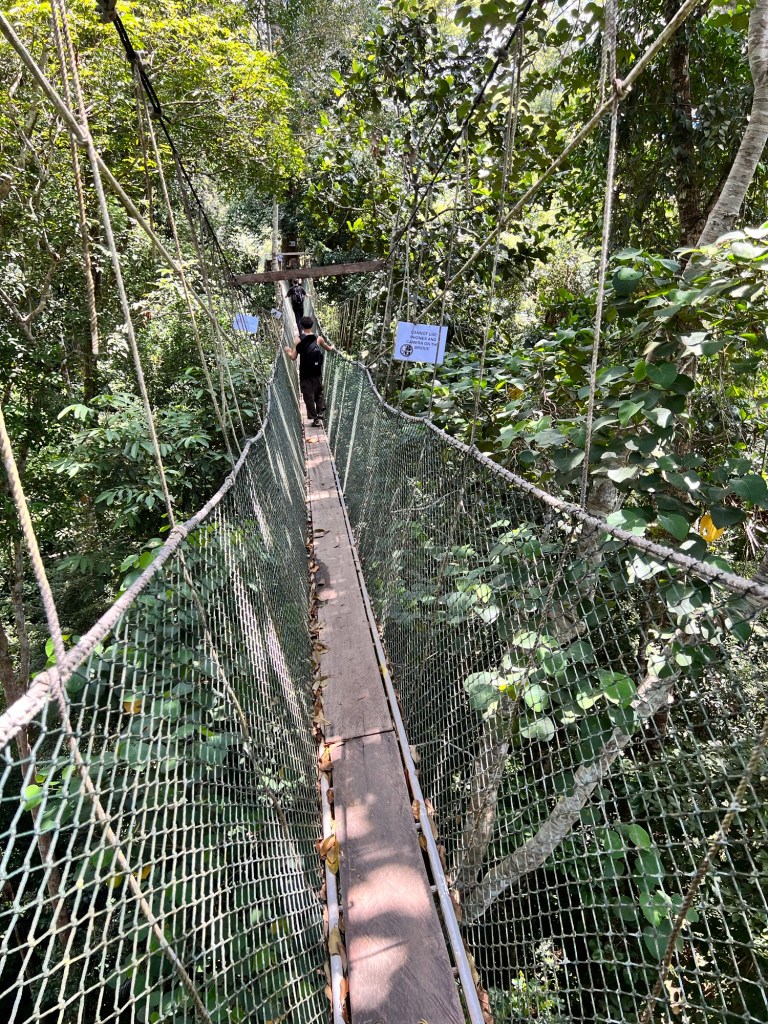
The experience in Teman Negara was quite different. You are restricted to a path cordoned off on either side. It is certainly good for the forest not to allow tourists to go traipsing around. But the sense of danger and adventure was lost. It was a sterile experience. The rope walkways, all part of the tourist trail, take you up to levels above the trees until you’re looking down at the canopy of ancient trees. All very exciting but in a packaged kind of way.
For me, personally, there was nothing new. So, I didn’t take photographs of big ants carrying big leaves or marvel at the incessant chirping of the cicadas or gasp in wonder at gushing streams. I just felt at home and relished the exercise.

We visited a tribal village and it was all very authentic. The chief demonstrated the technique of blowing little arrows through a blow pipe and starting a fire with twigs. I am not a big fan of viewing people in a showcase, as if they are exhibits in an anthropological museum. However, it did serve a purpose, perhaps to give the tourists a glimpse into something exotic, all in the space of one day.

Mosli Adi, the guide (calls himself ‘Mushroom’) -
Eclipsed by the rain

Everyone complains about the British weather. Rains all the time, we moan. If you ask me, it doesn’t rain here, it only leaks. Nevertheless, it has an uncanny knack for preventing the sighting of eclipses, spoiling a game of cricket …
If you want to see real rain, come to tropical Kerala. There the downpour lasts days. It is intense, full of drama. People dare not step out without an umbrella unless they want holes on their head. They rather sit on an easy chair with a cup of tea and banana chips to watch the rain. The water gushes down from gutters built into roofs, splashes the gravel covered ground, presses down the trees, frightens the birds into silence. The sound of water meeting the roof tiles and the hard cemented courtyards – like the crescendo of wedding drums marking the solemn exchange of garlands. Only, the drum beat lasts through the day, the night, and the days following. Spontaneous rivulets coming together in little streams rush to find the lowest level, cascade down streets, down fields, under culverts, until they meet the roiling river, the uprooted trees, all travelling at a terrific pace taking some of the earth with it, colouring the water the brown of a milky cup of tea, incessant, unstoppable. It roars like a lion and sings like a koel – real rain.


-
The talking robot
There are two types of people: the type who are polite to Alexa, Siri and similar others, and my type who treat them with mild contempt. My wife and I have this ongoing debate along the lines of,
“It’s only a machine. Why waste your breath?”
“You can still be polite. What do you lose?”
We have not resolved this argument.
For example, my wife goes,
“Alexa, please switch on the light; Alexa, tell me what’s fata morgana, please; Alexa, thank you very much.”
My interaction is similar, but I miss out the pleases and thankyous.I have a reason.
Way back in 1997, I was a PhD student/Research Assistant at the Department of Computer Science, University of Sheffield (DCS). Our group had several students working in robotics and we even had a full-fledged robot, Murphy. Other groups worked in speech recognition and natural language processing (NLP). I used to follow their research with keen interest. Making a computer respond to and understand spoken language is extremely hard, like trying to put toothpaste back in its tube, the pundits said at the time. Alexa and others have come a long way since then, as we know.
One Saturday morning, I took my family to a science fair at Doncaster, a nearby town. There was this robot installed in one of the stalls, all swivelling head and blinking eyes and flashing lights. It’s info sheet claimed the robot was able to talk and respond to you just as if it were another human being. I was impressed. What’s all the fuss at DCS then? I wondered. Here’s a robot which claims to pass the Turing Test (when, judging by its response in a conversation, you can’t make out if it’s a machine or human.)
There was a sign pinned on the robot: ‘Talk to me.’ That was my cue to put it to a rigorous test. Let me say my academic curiosity got the better of me before you say, ‘how naïve.’
The conversation with the robot went like this:
“Hello, good morning.”
” Good morning, sir. I am Mary, what’s your name?”
“I’m Gopi.”
“Are you enjoying the day?”
“Oh yes. Very much. Particularly impressed by your speech recognition and NLP abilities.”
“N.L… ? Hmm, thank you very much Gopi.”We had an intelligent conversation touching on politics, the problems of the world and how to solve them, the weather and everything else.
To say I was impressed would not begin to express the amazement and admiration I felt for Mary’s creators who had cracked the NLP problem completely. Here was a full blown, almost sentient, robot who could understand spoken language and speak just like any other human being. How could this be while my colleagues at DCS struggled on with rudimentary phrases?
Then I had an idea. My family, including my 8 year old boy, had moved on to other stalls bored of my protracted interaction with Mary. Out of the blue, I told Mary,
“Fuck off.”
Now, I am not a vulgar man. I rarely use four letter words unless I am in the company of close friends. This was an academic exercise. I wanted to know how Mary the sentient machine would react.
A young woman in her late twenties tore out from behind the curtain. Her otherwise pretty face was contorted with anger. She was holding a microphone with a long cable attached to Mary.
“You … you … you told me to …,” she stuttered, half sob, half shout.
She would have hit me had my expression not been a mixture of disbelief, shock and disappointment.
My disdain for machines who pretend to understand human language, stems from that day at the science fair. I refuse to say please and thank you to Alexa and her ilk.
-
Video bell
Are you a good liar? If not don’t buy a video doorbell. There is a reason for why I say this.
All of us live our lives by assessing the risks of actions we intend to take, whether it is crossing a road or choosing a life partner. When someone suggested I purchase a video doorbell, my first thought was: ‘that’s a great idea.’ However, when I started analysing future scenarios, I wasn’t too sure.
Mr Thief rings the bell. I am not home. In fact I am abroad.
“I have a parcel for you.”
“Ah! Please leave it with the neighbour.”
“Why don’t you open the door and take it?”
“I am not home.”
“I see. Maybe I can return tomorrow with the parcel?”
“No. I won’t be back tomorrow.”The thief is now smacking his lips, hatching a plan. Time is his ally. He is looking around, gauging the doors, scanning for cameras, generally taking stock. He is momentarily distracted.
“When will you be back?”
“Two weeks Monday.”
“OK. Cool.”Cool, indeed.
Some of you must be wondering, why I am giving away all the information to a stranger. The thing is, I don’t know what else to do. I find it hard to lie. Not because I am the paragon of Truth, but because I always get caught when I lie. So, for a long long time now, I haven’t lied to anyone. I am also very generous with information. If I don’t tell you every last detail, I somehow feel I am being devious, disingenuous.
Consider the same scenario. I am abroad but don’t want to disclose my whereabouts. I have a go at telling porkies.
‘Ring-Ring’. Mr Thief, carrying a package, is at my door.“I have a parcel for you.”
“Please leave it with the neighbour.”
“Why don’t you take it yourself?”
“I am in the shower.”
“I will wait. It’s raining. Your parcel will get wet.”
“Nooo. Please leave it with the neighbour.”Thief returns after 5 minutes.
“Your neighbour’s not home. Where are you?”
“In the shower.”
“ok, no worries, I’ll wait.”“No no.”
“Sir, are you in your own shower or somewhere else?”
“Hmm … Aaaah … I am not home.”
“OK. I can come back tomorrow.”
“Nooo.”
“So, you are not back tomorrow?”
“Hmmm … aaahh …No. I am abroad. Back in two weeks.”
“Coool.”I can’t lie.
I am, therefore, still considering if I should install a video doorbell. Will it convert me – an honest, straightforward man – into a devious, lying, crook?
-
SWVG (Southampton and Winchester Visitor Group)
Last Friday was my first day of teaching English at the SWVG (https://swvg-refugees.org.uk). I was waiting for C, the coordinator of volunteers, to assign me a student. Mingling with the crowd, I eavesdropped on conversations. Afghans, Egyptians, Syrians, Pakistanis, Kurds … milled around. A veritable United Nations of the desperate seeking refuge in my city. Volunteers, almost all of them white women, flitted from table to table. Around my table, an Iranian was speaking to an Iraqi. I asked them what language they were conversing in. Farsi, one of them responded. A new learning point for me. I had always thought Iraqis spoke only Arabic. In the 10 minutes or so I spent around the table, I got a brief peek into the tribulations of asylum seekers.
Then a woman came around with leaflets and spoke to everyone around our table about forthcoming events. She addressed each person individually. My turn was last.
“We have this nice walk in the New Forest,” she said, quickly adding, “SWVG will pay your train fare.” I just couldn’t resist it. I pretended I was struggling to understand. Deep inside, in some obscure alley of my psyche, I was offended that I was mistaken for an asylum seeker. And then I was offended at myself for being offended.
I felt as if I had driven into a cul-de-sac and my reverse gear had failed. I didn’t know what to do or how to come clean, now that I had started. So, I continued my act.
Pointing at a map of the New Forest, I asked the lady,
“This Lundoon?”
“No, this is Southampton, not London!”A few minutes more of this game and I was contrite that I was teasing an innocent person, a fellow volunteer who was giving up her time for others. I came clean, and the lady, bless her, wasn’t upset with me. She was wearing a mask. It couldn’t hide the smile in her eyes.
To avoid further confusion, I asked C to find me an SWVG ID card.
The funny thing was, the ID card made no difference!
An academic from a local University came to our table next and asked if I would like to attend a colouring-in session on 27 October. I quickly fessed up that I’m a volunteer teacher and not an asylum seeker. He was quick-witted enough to respond,
“That’s fine. All are welcome.”All the confusion and the philosophical conundrums about identity and belonging dissolved after I was assigned my first student. It was a pleasure to teach her- her enthusiasm was catching. She asked if she could have lessons 7 days a week! We settled for two.
-
A young man in an old person’s skin
The guiding principles of my life are to be found in the prose poem ‘Desiderata’ by Max Ehrmann.

Among other things, it says,
“Take kindly the counsel of the years,
gracefully surrendering the things of youth,”A recent incident demonstrated I was not adhering to this principle.
Last week I received two envelopes from Barclays Bank. One contained a debit card and the other a pin number.
“Dear Dr Chandroth,” said the letter, “You’re ready to go online … All you need to do now is sit back and enjoy an easy way to bank online.”
What’s special about this? I hear you ask. The thing is, I never opened a bank account in Barclays. I have no dealings with Barclays, never had.
I called the bank. It was late evening on Saturday. The recorded message said I should call back during weekdays unless I was reporting fraud.
A young (sounding) woman with an Indian accent dealt with me.
“I apologise for the inconvenience, Dr Chandroth,” she gave me the usual spiel.
She went on to record all my personal details including date and place of birth, finally assuring me that the fake account would be blocked and I needn’t worry anymore. Then she asked if there was anything else she could help with.
“How is it possible for someone to open an account in my name? Don’t you verify their bona fides?” I asked her in a calm voice.
“Dr Chandroth, fraudsters target vulnerable and elderly people,” she replied quite casually.
Now, there was no reason for me to get upset. But truth be told, I was livid. Elderly? Vulnerable? Me?! I have never thought of myself in those terms. One’s reaction when caught off-guard reveals a lot about one’s true character. Her words touched a nerve or two.
“I am not vulnerable. I have a PhD in Computer Science. I cycled 70 kms just last week! How many kms can you do? I am not some doddering old geezer. What is vulnerable is your bank’s security, not me!” I ranted at her.
“I am so sorry sir. I didn’t mean you are old and vulnerable. Age is just a number,” the poor woman was distraught and probably said things outside her script just to mollify me.
I too am sorry, young lady, for my intemperate outburst. I am probably three times your age. Of course, you consider me elderly and by definition, vulnerable. I promise to improve and – to ‘take kindly the counsel of the years.’ But I will be damned if I surrender the things of youth.
Now where is my OAP freedom travel pass? I will ditch my bicycle today and go for a bus ride just to calm my elderly nerves.
-
Salsa Sally
My Salsa instructor Sally,
brims with grace and style;
She flexes and twists, like a vertical snake,
and flows like a river fragile.Struggling to follow her gyrations,
I’m decrepit with wear and tear,
Like a block of wood I move,
I’m a pathetic shuffling bear.So what? a voice consoles,
you’re educated, even bright.
You may be clumsy, a dancer sans clue,
But you have brains, you’re erudite.And she? the voice continues,
possibly a failed student affair.
She may be a danseuse lithe,
She is but shallow with a brain full of air.Until the day I saw her name,
headlined in the morning paper,
Dr Sally Hasburg, Professor of Physics,
prize winning Salsa dancer. -
Oh Lebanon!
“One who generalises, generally lies,” was a life-lesson imparted to me by my eldest brother when I was a boy. As I travelled the world for fifteen years as a young marine engineer, the wisdom of this aphorism was repeatedly validated. I realised that we are too quick to form an opinion about entire nationalities and ethnic groups based on our interaction with a handful of people from these groups. Thankfully, over time, I learned to treat each person as an individual and not as the representative of a larger unseen group.
Sometime in the early 90s, my ship called at Tripoli in Lebanon (not to be confused with Tripoli, Libya.) The ship’s agent, the link between the ship and the outside world, arrived on board as soon as the gangway was down.
“Captain, please – for God’s sake – always go ashore in groups of five or more,” he instructed. Then holding an imaginary pistol to his temple, he said, “You could be shot if you walk around on your own.”
On hearing this, my mental calculus ran thus:
Perhaps there was a stray incident or two when some lone sailors got caught in the crossfire of the civil war that had ended at the beginning of the decade. The agent was extrapolating those incidents to arrive at a generalisation. That couldn’t be right. I will take my chances.
While working on ships, I generally went ashore on my own other than on the few occasions when my family was with me. I have nothing against company. But I struggled to keep up with the carousal of the typical sailor on shore leave. I was a misfit in this department and have always been fascinated by diverse cultures, preferring to immerse myself in the social milieu of the country I was visiting. My modus operandi in a foreign port normally followed a pattern:
- Find a local taxi driver with some conversational English skills
- Ask the price for touring the city for two hours and agree to it without bargaining
- Ask the driver to go to the following places in town
- The highest point
- Locality where the poor live
- Locality where the wealthy live
- The most important place of worship
- Town centre and other places of interest.
As I looked around for a taxi, a man approached me. He put his hand in his trouser pocket as if to withdraw something. I was sure my end was imminent and was wishing I had heeded the agent’s advice to avoid traveling alone. Fortunately, the thing the stranger extracted from his pocket was not a pistol, but a pack of cigarettes. He stuck a cigarette in his mouth in one fluid motion and struck an imaginary match, locking eyes with me in silent enquiry.
I found my English speaking taxi driver soon enough. Over the next couple of hours I absorbed Tripoli, its souks, minarets and ancient citadel. Ambling along after the tour, I noticed abandoned trains, some half destroyed, some intact. Entire families lived in them. I walked as close to the carriages as was possible without invading the privacy of its residents. The delicate, almost ethereal beauty of the women with eyes the blue-grey of the Mediterranean sea, remains with me to this day. I can still hear the peals of laughter of the children as they played hide and seek behind the wheels and springs of carriages. Although they were in tatters, shod in broken shoes, they wore the cheer of a carefree life. For a moment, I stood still to capture every detail on the canvas of my mind. I knew I could never forget that scene. It was a poignant sight, symbolising the travails inflicted on a people by a long drawn out civil war – as if they were preparing to restart a journey that had stalled many years ago.
I reached the town as the muezzin’s melodious call to prayer and the setting sun rendered the
evening a shade melancholic. However, the people smiled and nodded at me in the streets. A
small café that hired out hookahs to its customers, looked particularly inviting. I walked in. Although I don’t understand Arabic, the owner and waiters made me welcome with broad smiles and oft-repeated hand to heart gestures.I ordered a hookah and sweet coffee. The aroma of fragrant tobacco melded with the bonhomie in the café. Food started appearing on the table although I hadn’t ordered any.
Someone fished out a chessboard from behind the counter and we played a couple of games while a lilting Lebanese tune filled the space. All the while, total strangers interrupted with suggestions of better, more strategic moves. They were treating me as one of their own. Soon, it turned dark. I prepared to settle the bill and walk back to my ship. But the owner wouldn’t
take my money.“No, no, friend! No money!” he said solemnly with his palm to his chest. He gestured that I should wait, brought his battered car around and asked me to get in, miming his intention to drop me off at my ship.
We drove past the train coaches with dim flickering lights and improvised chimneys emitting thick black smoke into the moonlit night. I imagined the women I had seen earlier, toiling in
their makeshift kitchen. The canopy of brilliant stars on that clear night
was stretched like a protective cocoon over the train people. I felt safe and knew that I too was protected. No sniper was waiting to gun me down.