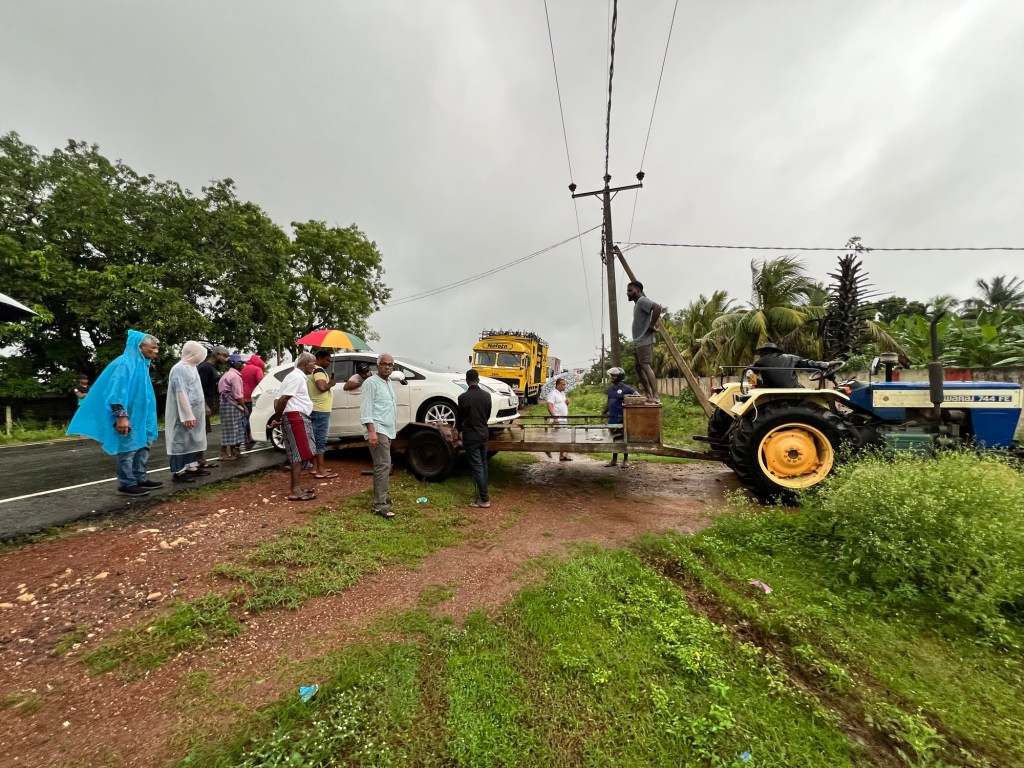
I spoke too soon yesterday about the well drained roads. But I guess there’s a limit to how much water the land is capable of handling. The road to Anuradhapura between Kilinochi and Vavuniya was flooded – they said there could be a metre of water – stranding us for nearly 5 hours. I didn’t imagine a whole chapter would have to be devoted to the journey. Rescued from the floods, as we were speeding towards Anuradhapura, I remember the events that transpired in the five hours we struggled to get across.
Some 30 km south of Killinochi, a long line of vehicles parked to the side of the road didn’t augur well for us. We quickly realised our day was going to be long and the short distance remaining to our final destination suddenly seemed much longer. Tractors with attached trailers were doing brisk business ferrying vehicles across. The decision for us was simple: we agreed to pay what it took to be taken across. We were captive customers.
So, we found a tractor and trailer and with several people shouting directions at the hapless driver, he drove the car precariously up two narrow ramps on to the trailer. But the car’s rear wheels did not clear the ramp. Maybe reverse on to the trailer, someone suggested. Lots of shouting and hoo haa later, scraped car bottom and defeated shakes of heads, we realised our car was indeed too long. We tried two more trailers but with the same result. (I must carry a tape measure the next time.) A long trailer was the only feasible option. There was none around at the time.
Our driver took instructions from his employer and decided to try a route that circumvented the flooded section on the main road. The thought did occur to me that had the new route been clear, there would surely have been a scramble in that direction. However, not wanting to dampen hopes, I kept my thought to myself. Logic and elementary physics didn’t play much of a role in the desperate scramble to get away.
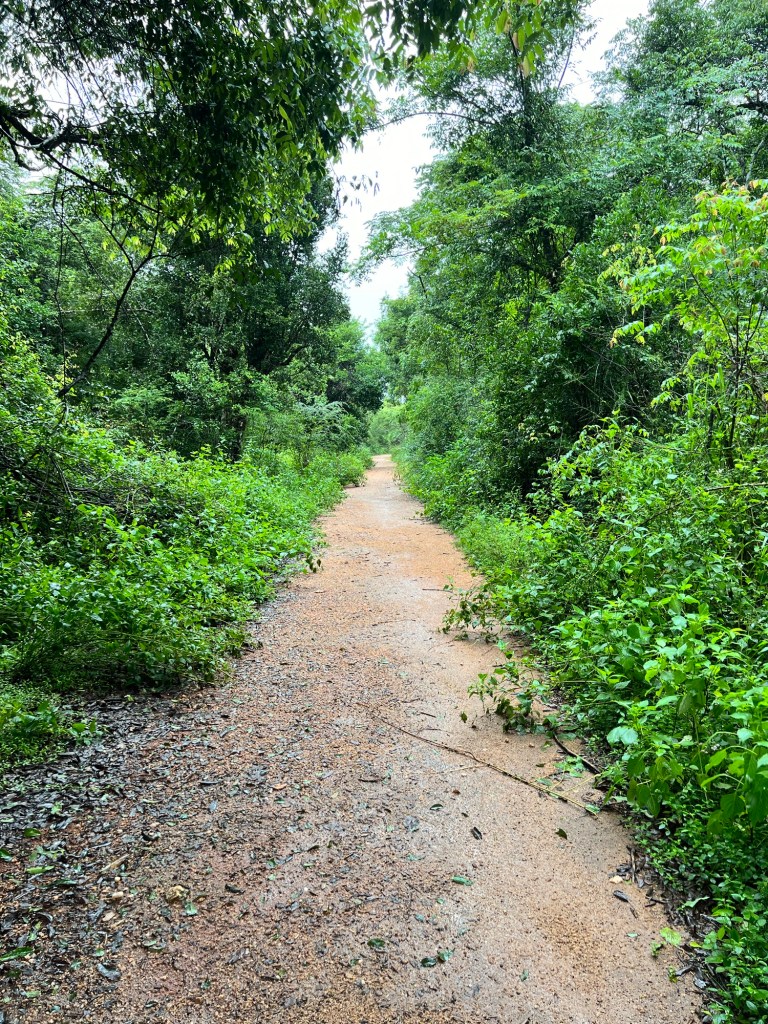
We drove along a muddy track into deep jungle and I quickly connected the dots. This was exactly the area where the Tamil Tigers had hidden during the civil war. We were deep in the forests extending from Killinochi to Vavuniya. I was told by someone in the ‘know’ that the forests didn’t exist anymore. But how wrong he was! He obviously had only travelled along the main roads and never had to navigate around a flooded patch.
Serendipity, what else! I rejoiced internally that I got to experience a bit of the jungle where some decades ago the tigers had indulged in guerrilla warfare. Externally, I maintained a worried expression. Frankly, I didn’t care when I reached my destination. Our current adventure was sufficiently stimulating.
We soon discovered a stranded truck ahead of us. The flooding was worse in the direction we were heading. Turning around, we headed for the main road. And then the car made a loud scraping noise. A protective shield under the car had partially detached itself. Over the next half hour the driver tried to fix it. Finally he laid on the ground and deftly manoeuvred the cover back in place with a stick. Meanwhile, I scanned the jungle for wild elephants and the ghosts of Tigers. We were soon back on the main road, hungry and exhausted. The line of desperate vehicles grew longer, rain came down heavier and water levels rose further.
We were impressed by the calm and disciplined behaviour of the stranded drivers and their passengers despite their travails. They walked around discussing the matter at hand in a mixture of Sinhala and Tamil. No raised voices, no queue jumping, no fighting, just stoic acceptance of the situation and a lot of hopeful upward glances for any signs of the rain letting up. Man lives by hope, as they say.
Children and some compassionate adults rescued stranded fish from the road and deposited them back in the water. Most people smiled!
Then out of nowhere came a tractor with a long trailer and offered to take us across for 5000 Lankan rupees – some £14! As we crossed, the thought occurred to me that whatever we understand about global warming and the disasters waiting for us around the corner, whatever we may say about the drowning planet that our grandchildren would inherit, however much we empathise with the loss of homes and livelihood of those at the cold front, the true impact of global warming genuinely comes home only when it actually happens to us. Like the gradual creeping in of the symptoms of a chronic desease, it comes ever so slowly, but come it surely does.
The rain was relentless, non-stop, as if it were a permanent state of weather. Yet, the roads remained well drained allowing us to continue our discovery unhindered. We were the only tourists probably because of the rain but also because Jaffna is not on the average tourist’s itinerary. I am surprised it is not, considering its history, both recent and distant.
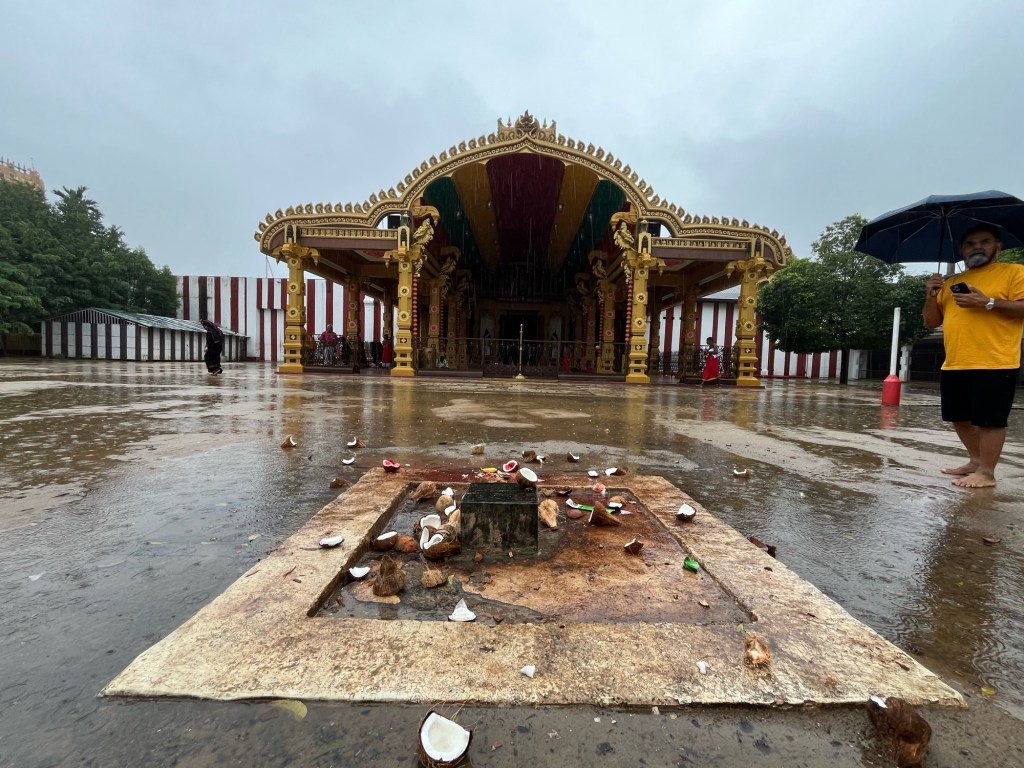
The Nallur Kandaswamy Kovil, originally built in 982 AD, destroyed by the Portuguese Taliban, sorry colonialists, and rebuilt in 1732, was our first stop. I went there not to pray to Murugan son of Siva, but because it was the site where Thileepan, a Tamil Tiger fasted to death for the Tamil cause. There’s no shrine to him, at least none that found its place in the annals of the tourism department. Everyone in Jaffna wants to forget the civil war, and that can only be a good thing.
Shorts were not permitted inside the temple and neither were upper body garments. One had to cover the knees and bare the chest (this is a restriction only for men, so don’t get excited – the lascivious amongst you – this is a temple to God not a nudist beach). Fortunately, a shop outside lent vethis (a type of sarong) to the devout free of charge. I draped it over my shorts and played the part. Smearing my body with holy ash, I emulated the devotees who milled around chanting Oom and folding hands in complete supplication to the gods. Even though I had lost my faith as a child, I would be lying if I said I didn’t experience a sense of wellbeing inside the temple, perhaps vicariously, but experience something I did, however briefly.
We headed to Point Perdro, Sri Lanka’s northernmost point. The rain and wind lashed and howled turning umbrellas inside out and defeating the waterproof guarantee of my shoes. The sea raged on, roaring and frothing as if not wishing to be outdone by the the rain. In compensation, we had the whole place to ourselves and enjoyed, rather perversely, not having to vie with tourists for selfies at vantage points. Point Pedro was ours alone. And I did experience that sense of awe and reverence once again, this time by the overwhelming power of nature on display.
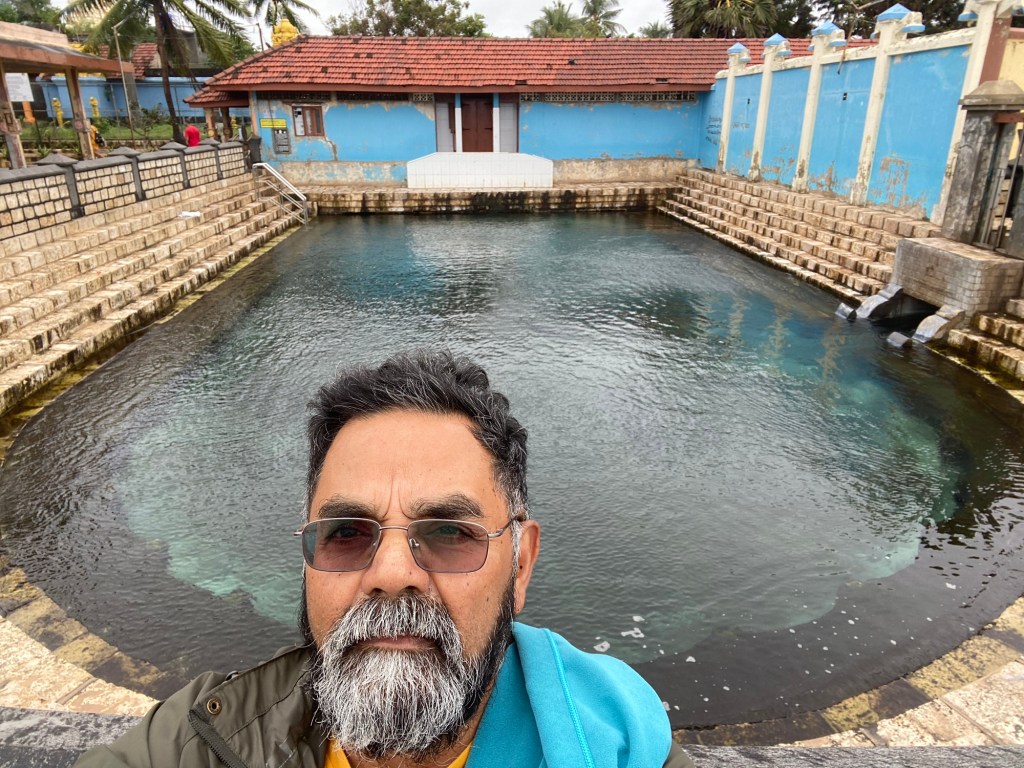
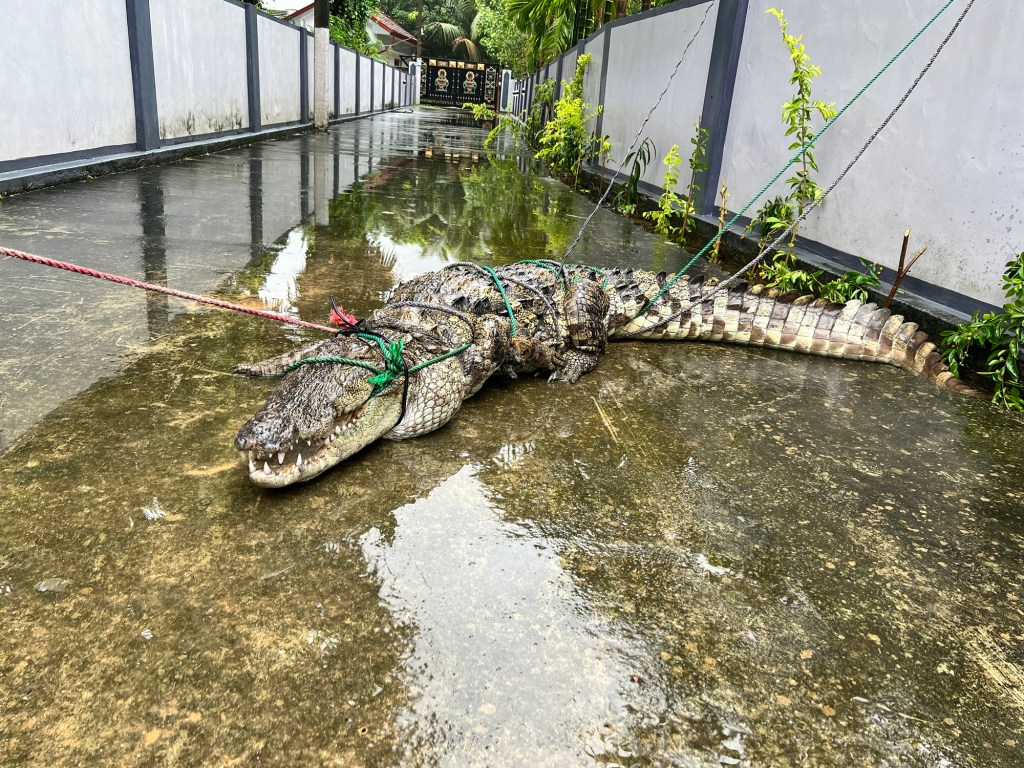
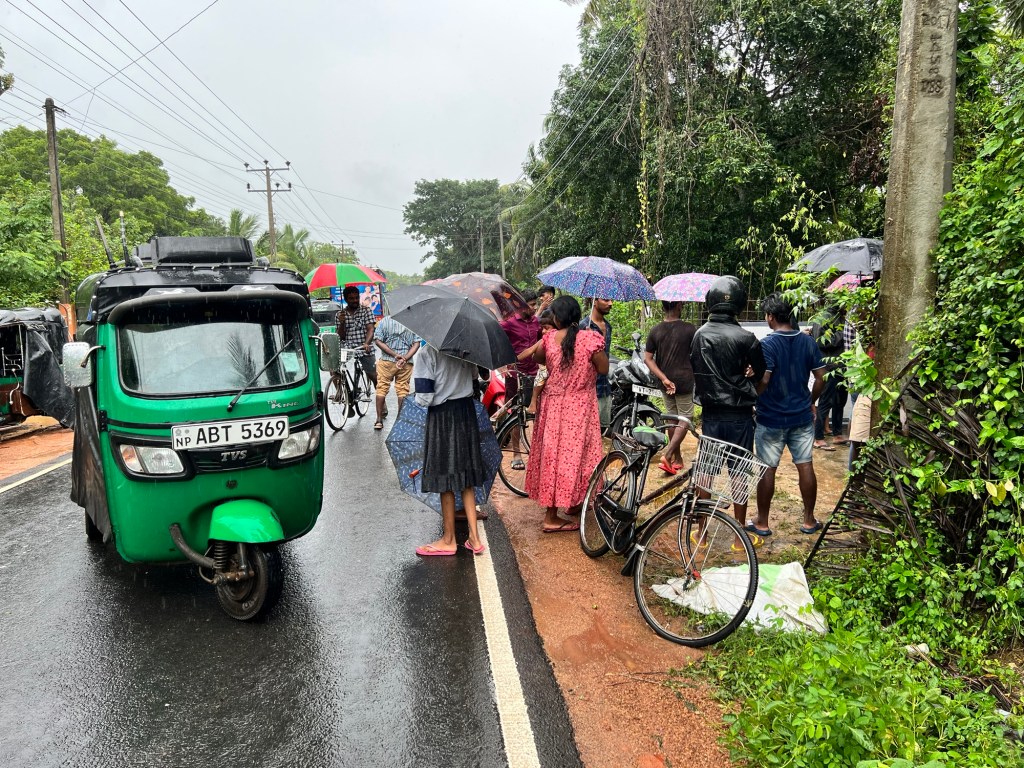
Keerimalai was the next stop. A ‘bottomless well of fresh water springs’, it is the place which cures ailments if you immerse yourself in the pristine water right next to the sea. On our way there, we saw a crocodile on the road. It had strayed out of the river and was captured by the villagers. It lay there defeated while a crowd gathered in front of our eyes. People, all instant reporters, spread the news with their phones. Tuktuks, multicoloured umbrellas and toddlers firmly deposited on parents’ shoulders jostled with each other to catch a glimpse of the poor creature. I resisted an urge to pat the helpless animal and whisper some comforting words. The last thing I wished for was a selfie with a tethered crocodile. It must have sensed my empathy for it blinked and moved its tail in response.
Kankesanturai port was our original destination in Jaffna district when we planned to travel here from India by ferry. However, the monsoon season put an end to those plans. We reached there eventually by road. The rain stopped briefly as we were finishing lunch. It was as if the gods had relented a bit for our benefit. We could actually go outside without raincoats and look across Palk Strait in the direction of Thanjavur in Tamil Nadu, India.
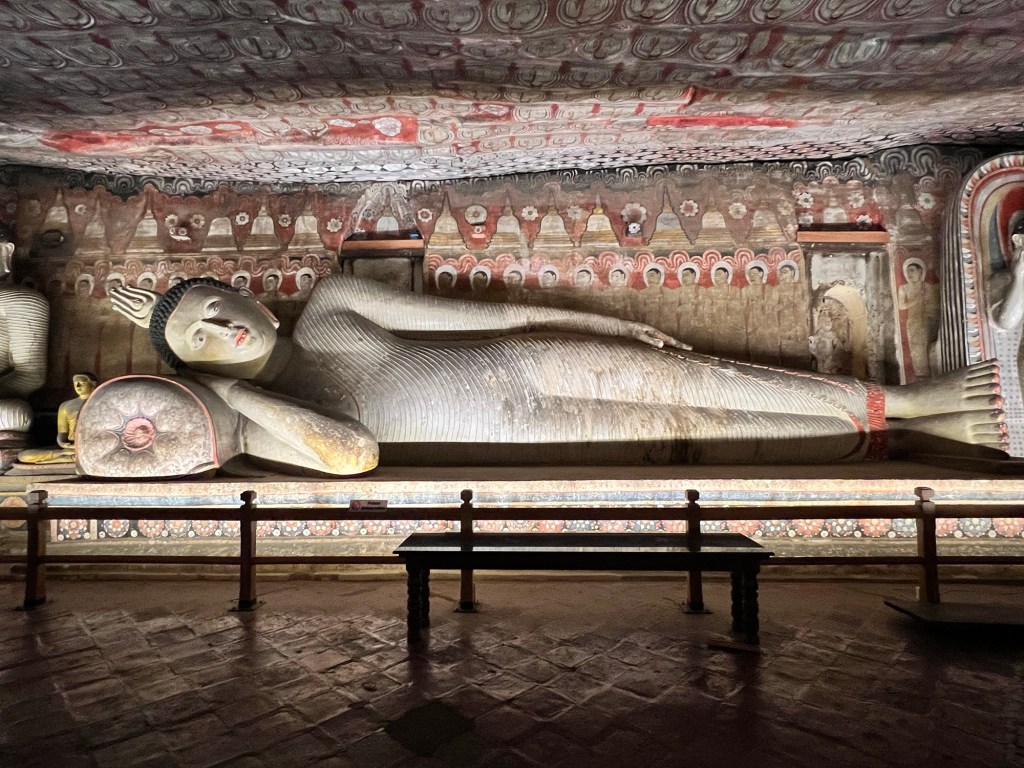
We continued to Dambakola Patuna where a sapling of the bodhi tree beneath which Siddhartha Gautama achieved enlightenment to become the Buddha, was brought from India in 250 BCE. Theri Sanghamita, the sister of the bodhisattva who introduced Theravada Buddhism to Sri Lanka, transported the sapling in a boat or so the posters informed me and to reinforce it there was a model of the boat floating about in the area. Just standing near the tree, to partake the sheer spiritual and historical significance, I felt immensely privileged.
Our final stop was Jaffna Fort, built by the invading Portuguese stolen by the invading Dutch and stolen again by the invading British. It was handed back to the Sri Lankans in 1948. Despite all the invasions, the fort has bravely withstood the ravages of pillage, plunder and civil war. In that sense it has served a purpose and borne silent witness to centuries of colonial crime.
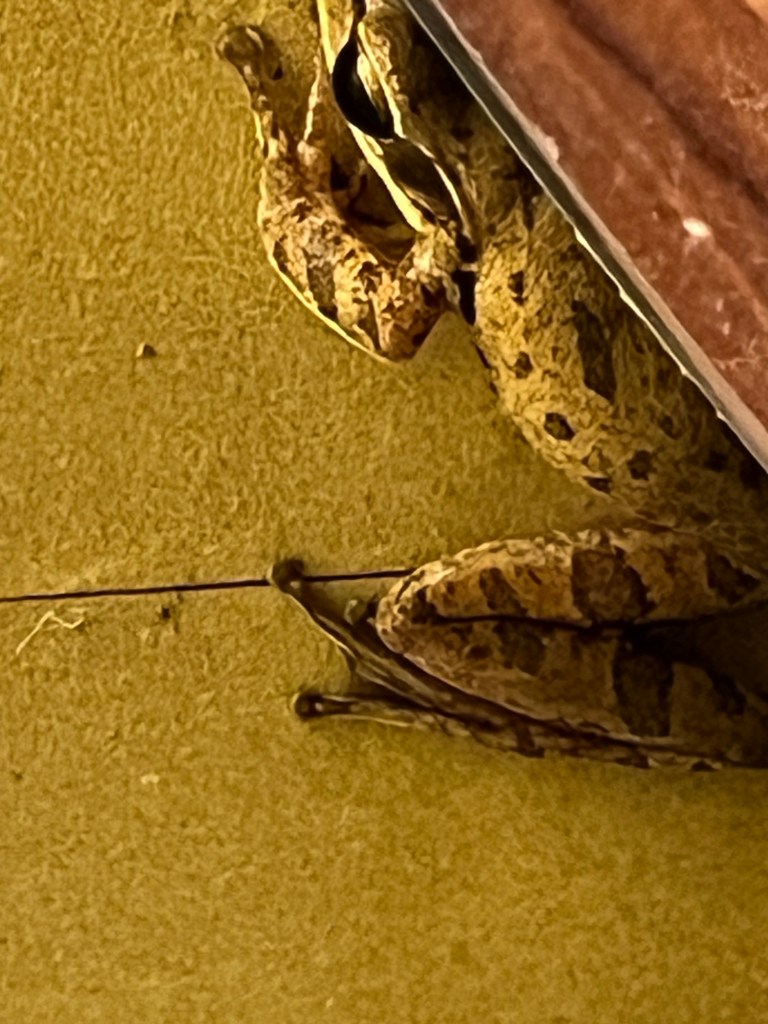
We were glad to be back in our dry accommodation but not before picking up a couple of beers which we drank to the background music of Hindustani classical music by Kumara Gandharva overlaid by the incessant croaking of frogs. The music we could switch off but not the frogs which kept up the din until dawn. It sounded like they were chanting Muruga Muruga Muruga or was it just my guilt manifesting itself for pretending to be a believer amongst those of true faith?
We arrived at Jaffna airport in a turbo propelled plane from Chennai. The northeast monsoon had set in and a cyclonic storm was in play. A row of airport staff welcomed us with colourful umbrellas and we passed from the shelter of one umbrella to the next until we got into the bus. The immigration officer could not reconcile my newly grown beard with the clean shaven look in the passport. He glanced repeatedly from my face to my passport and back at my face until I began to feel dizzy. After establishing that I hadn’t come to settle down in Sri Lanka on a permanent basis, he let me through.
I had purchased an eSIM that allowed data usage. In theory I could call our driver but in practice, I had to walk around outside the airport among the small cluster of taxis until I spotted a driver who looked as anxious as me scanning the faces for his Indian British customer.
The drive to our accommodation was eventless until our car stopped dead in the middle of the road. From the rear seat, I asked the driver why he had stopped.
“Mutton!” he said.
Craning my neck, I saw a black and white goat in the middle of the road. If he stayed there long enough, the distinction between goat and mutton would only be academic.
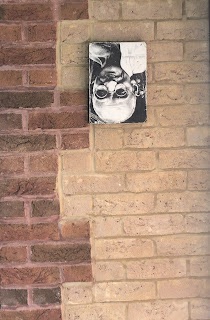
Yesterday, I removed the portrait of Gandhi from my wall and hung it upside down. The black and white photograph was purchased in Lima, Peru, some 25 years ago when I roamed the world as a marine engineer. There is an inscription in Spanish at the bottom of the portrait. It translates to, “The truth must manifest in our words, thoughts and actions”. The implication of upturning the portrait on the wall has turned my life upside down too. Why am I being so dramatic?
Growing up in India, I basked in the God like aura of this great man. He was beyond politics, almost every Indian town has a road named after him, a Gandhi statue is the standard adornment to public squares, and one cannot escape the ubiquitous Gandhi portrait with his trademark glasses smiling beatifically from the walls of every government building. Such is the esteem he is held in that we never mentioned his name without the honorific ‘Mahatma’ or the respectful suffix ‘ji’. It was either Mahatma Gandhi or Gandhiji for us, never Gandhi on its own. When I was 15 years old, my father offered me 100 rupees to read Gandhi’s autobiography, ‘The Story of My Experiments with Truth’. I don’t remember much of it. However, the fundamental beauty of the concepts of truth and ahimsa (non-violence) remained with me. Gandhi was my idol and I strived all my life to follow his principles.
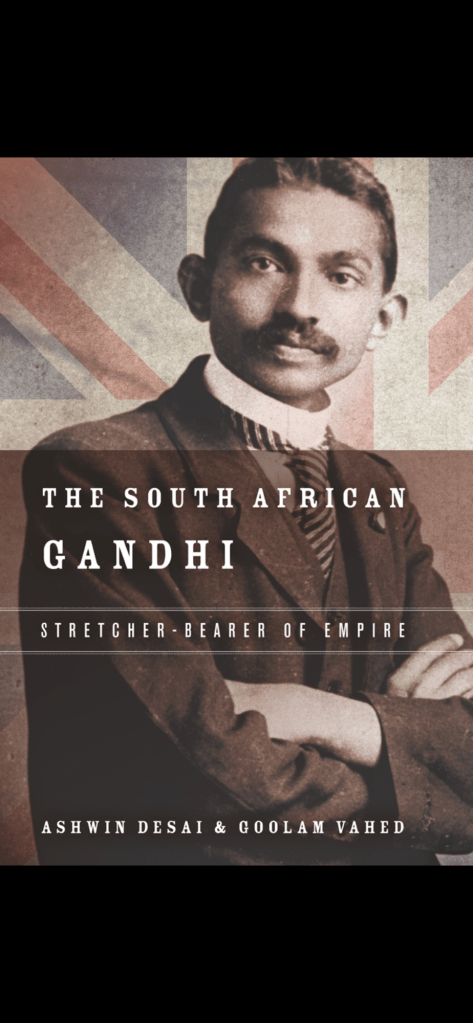
Everything changed for me with the murder of Geroge Floyd and the worldwide agitation that followed. I chanced upon an article on the BBC website, “Was Gandhi a racist?” The article was about a controversial new book[1] by two South African academicians of Indian ethnicity. Reading the book was equivalent to falling into a bottomless chasm. The edifices of my life came tumbling down, Gandhi’s antics in South Africa and his approach to race relations shocked and appalled me. His unrestrained contempt for the native African population left me reeling in disappointment. I had never, even remotely, suspected that Gandhi was a racist. Or was I being too harsh in my 21st century judgement of the value systems of the late 19th and early 20th centuries? I hope to resolve this question here. But before that, let me quote below from the ‘South African Gandhi …’.
… both the English and the Indians spring from a common stock, called the Indo-Aryan … A general belief seems to prevail in the Colony that the Indians are little better, if at all, than savages or the Natives of Africa … the Indian is being dragged down to the position of a raw Kaffir.
The above was his attempt to establish the Indian’s Aryan connection in an open letter to the Natal parliament on 19 December 1893.
I could fill pages with similar quotes. I could write tomes about the slaughter of thousands of Zulus by the British and the atrocities committed by the colonial administration, so much so that even Churchill, who was notorious for his white supremacist views, remarked that the South African government was the hooligan of the Empire. However, I must not digress and will address the question at hand: Was Gandhi a racist? Has he a rightful place on my wall?
It is easy to judge the past through today’s prism. Homosexuality was considered abnormal until recently. Would I be right to criticise someone who lived in the 19th century for their homophobic views? Perhaps not. However, my problem is not with the offensive words that Gandhi used or even his failed attempts to ingratiate himself with the colonialists to secure favoured status for Indians within the Empire. The suffering and disenfranchisement of 85% of the population of South Africa should have appealed to the better sense of a truly great soul, a Mahatma. Instead he dismissed them as sub-human and, for over two decades, never found common cause between the African and the Indian. He also held the indentured Indian labourer to be inferior (ibid “dumb and helpless”) to the more educated traders and other Indian professionals. Essentially, his interests were narrow in scope and his ambit was severely restricted by his prejudiced views. But then, we all evolve and change and I should give him a chance to redeem himself.
Now we examine Gandhi’s life post South Africa – from 1914 until his assassination by Hindu fundamentalists in 1948. Never once, neither in his autobiography nor in any of his prolific writings, did he display any contrition for his antipathy towards the native African. In his autobiography[2], he mentions the Zulu rebellion in passing, and nursing the wounded “ ‘uncivilized’ “ Zulus during the Anglo Zulu wars. I am indeed intrigued by the quotation marks around ‘uncivilized’, as if it was not his own view. A disingenuous Mahatma indeed!
The suffering of the native African was an aspect he never discussed. He did not for once collaborate with them or form a joint opposition to the horrendous crimes committed against both Indians and Africans by the Government of the Union of South Africa. Instead, he left South Africa after 21 years, having achieved a controversial ‘victory’ for the Indian community and secured their status as second-class citizens, marginally better than that of the native African.
I am disappointed to no end that my hero has fallen off his pedestal. I will leave him upturned until (if) he redeems himself through other biographies I am yet to read. I learned from him that the Truth must manifest in my actions. To tell the truth, I’m mighty pissed off with him for now.
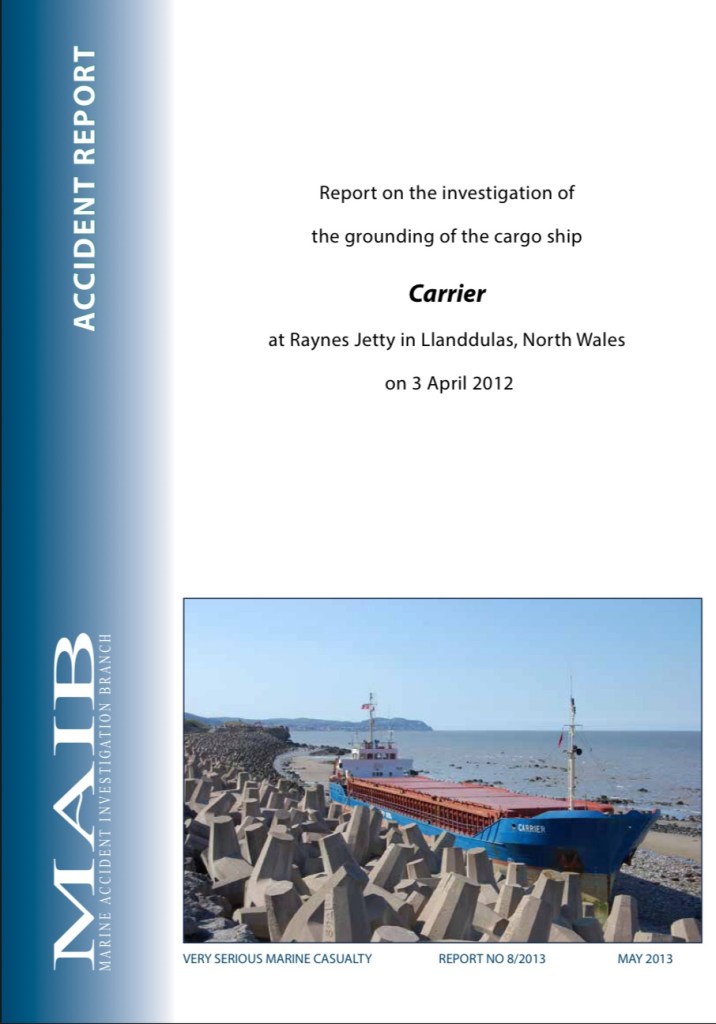
Some years ago, I was in Llandudno, North Wales, on an accident investigation. A ship had been washed ashore and broken up in the storm. All twenty crew were picked out of the icy water and airlifted to safety by the coastguard. They were Polish nationals and spoke very little English.
We hired a meeting room in a local hotel. Interviewing the traumatised crew, one by one, with the help of an interpreter was exhausting. After five interviews, I decided to get some fresh air. Walking around in the garden outside, I saw one of the crew members smoking a cigarette under a tree. He was the large able-bodied seaman (AB) with a walrus moustache, the second witness I had interviewed that morning. I distinctly remembered his moustache.
I was aware the ship owner was arranging a bus to repatriate them to Poland. Walking over, I made conversation,
“You go home tomorrow?”
“You what?” he looked puzzled. Language problem, I figured.
Poking him in the chest with my index finger, I spoke slow and clear.
“You,” I said pointing east (in the general direction of Poland), “go – home – HOME. Go home bus.”
I mimicked a bus driver driving a bus with its low-set steering wheel. Getting carried away with my charade and remembering an Indian state transport bus of the 70s, I squeezed an imaginary rubber horn with my right hand while continuing to steer deftly with my left.
“Pom Pom.”
He looked at me in bewilderment. It was as if he didn’t trust his eyes and his ears. PTSD, my well-honed sense of empathy advised me. I too would feel the same if my ship had broken up into pieces. I didn’t give up and for further clarity, used the double-shift gear stick to move up a gear or two. No comprehension- not yet.
Just then, a woman approached us. The ‘AB’ turned to her and said,
“See if you can help him, Lucy. He doesn’t speak much English and I haven’t the foggiest idea what he’s trying to tell me.”
And just as I was beginning to understand the situation, the real AB with the walrus moustache walked past us shouting at someone on his phone in Polish.
Cutting off one’s nose to spite one’s face is an expression that I think aptly describes the attitude of those who are happy about the loss of the Democrats. Yes, they deserved a bloody nose and I’m glad they have been defeated for pursuing their policy of blind support for the genocide in the Middle East. This may hardly be the reason why they lost though. The Americans indulging in their customary navel gazing voted against more local issues like inflation.
I tremble in fear at the prospect of another four years of Trump. I’m glad I’m not American. But it will impact all of us.
A Palestinian person I spoke to last week said, “Trump will stop the war.” I have no such hopes or rather I don’t think he will resolve the Palestinian issue in their favour. Remember what he did with Jerusalem? He might just gift the whole of Gaza to the Israelis. A drowning man should not look at a crocodile to save him. He may not drown but will be eaten.
Those of you who know me well also know that circumstances conspire against me often – just for a laugh, nothing sinister. I’m just watching these little episodes carefully. Their frequency hasn’t increased. If plotted on a temporal base, they should appear to be periodic events. Or so I console myself.
I was running late for a training course on understanding trauma. As it often happens to me, the final stretch of the road leading to my destination had some traffic issues. I reached at 1332 when the course was due to start at 1330. The parking lot was empty. Strange, it did occur to me. But I was already late and didn’t wait to ponder the reasons. The door to the venue was locked and no ringing of the bell or banging on the door produced any sign of life. Not a soul. A cemetery at midnight would be more lively (with all its resident souls). Whipping out my phone and finding the joining instructions, I discovered I was exactly one week too early.
On reaching home, I put my hand on my shirt pocket to retrieve my favourite pen. I, being a diligent student, always carry a notebook and pen to class. This pen is special, magical. I’m still trying to figure out how it works. It has red, blue and black selections plus a pencil. You hold the pen vertically, look at the colour you want and as if by telepathy, when you press down the button on top you get the colour you’re looking at! I bought it in George Town, Malaysia in 2023.
My pen was missing. Trauma. I pulled off my sweatshirt and discovered my pocket was missing as well. Thinking back .. while I was crawling in traffic, I had picked up the pen from the glovebox and put it in my pocket without remembering that the shirt I was wearing had no pocket. It stayed trapped between the pocketless shirt and sweatshirt until I got out and ran to the locked door of the training venue. It probably escaped as I was getting out of the car.
I didn’t have the heart to drive the 6 miles from home back to town but didn’t want to lose my pen either. Any other pen, I wouldn’t have given it a second thought. Come Monday it would be found and kept by some stranger. More trauma for me and the pen. This is when I realised I could delegate the job. My son was picking up my wife from the library in town that afternoon. They could easily swing by the training venue and look for it. This is what they did and found the pen lying forlorn and deserted in the lonely parking lot.
As the cliché goes, all is well that ends well. I have this strong feeling that it’s not going to end well for me in the final reckoning. But as long as I can remember enough to write a coherent story, I’m fine. Bring them on, I say, to the conspiring orchestrator of memory lapse events. The episodes that accompany them seem worth it, for now.
When Paru bought the box of combs at the local jumble sale, she was not bargaining to have her life turned upside down. The six combs, all brand new, were laid out in a velvet lined box with its own golden hinges and dainty latch. She wanted the box, badly. The combs, she wasn’t too keen. In fact, she never used combs. She had a lovely brush for her wavy black hair.
Art by Parvathi Mohan
Some of Paru’s uncles were bald, not egg bald yet but getting there on a fast train. She could count on her fingers the hair remaining on their head. Ok, maybe fingers and toes. There’s a thought. She could gift the combs to her uncles and keep the box. Definitely, a good investment of her pocket money. Her mind was made up.
The stall owner was an old woman with skin wrinkled like a well-worn shoe. She was dressed in a black silk gown. Granny was old. She looked like Granny’s granny. Her hair was not grey or silver but a brilliant white, the colour of new snow. It didn’t look real. But if it were a wig, why would it be white? Her frail body was bent, the shape of a cashew nut.
The woman’s eyes were two little suns shining from her oval face. Dad had once showed Paru how to set fire to paper using a magnifying glass in the sunlight. The woman probably hid a magnifying glass behind each eye. She could burn anything she looked at.
Paru glanced around for mum. She was at a book stall a few metres away. Why was she always buying books? Dad was the same. Every wall in their house was taken up with bookshelves, every corner had a shelf of – what else – books, even the kitchen table had a semi-permanent pile. At last, mum was walking in her direction. Thank God. She will stop the comb seller from turning her ten-year old daughter to cinder.
“How much is this please?” Paru asked, trying not to show her fear.
“Just a fiver for you, my dear,” the woman smiled.
Her voice did not match her looks. Paru expected it to sound sandpapery to go with her blazing eyes and eagle beak nose. But it had the soft ring of wind chimes.
Mum arrived just in time and set about examining the combs. She plucked their fine teeth like a harp, bent them every which way, knocked them against the tabletop. It was as if she were the world’s foremost expert on combs.
Finally, she declared, “Genuine buffalo horn.” Paru handed the woman her pocket money for the month. The woman locked the box and handed it to her. Still holding the key in her hand, she whispered in her ear, “Paru, you will travel to interesting places!”
What! How did she know her name? What interesting places? But she didn’t dare ask.
Then handing the key over, she said, “I am Cecilia. Look after them.”
*
Every night, before going to bed, Paru unplaited and brushed her long, soft hair.
“It will start sweeping the floor soon,” mum joked sometimes.
Later that evening, Paru took the combs out of their box and studied them. Running her fingers along their handles, she felt some embossed letters. They were hard to read, however hard she squinted. Thinking quickly, she fetched the magnifying glass from dad’s study. Each comb had something different written on them. She felt like a detective from mum’s TV serials. She carefully copied the words on a piece of paper:
She had no idea what some of these words meant. But she wasn’t going to give away her secret to anyone, not even to her parents. Cecilia should have given her more information. Just then, a cunning plan occurred to her. She sneaked downstairs and fixed the list on the fridge door with a magnet. That evening, mum asked her,
“Paru, are they teaching you ecosystems at school?”
“No, mum. I copied the words from somewhere,” she replied truthfully. Then suppressing a fake yawn, and putting on a by-the-way-I-am-not-interested-in-this-stuff look, she asked,
“Mum, what are ecosystems?”
Her parents smiled at each other, looking pleasantly surprised. Although both were Environmental Science teachers, this was the first time Paru had shown any interest in the subject.
“Ecosystems are complex, interconnected…” Dad started but stopped himself midway.
“Why don’t we watch a film on Ecosystems?” he said.
Almost jumping up from the sofa and forgetting all about the not-interested look she had put on a minute ago, she said,
“Please can we watch it now?”
Paru was awestruck by the variety of life on Earth. She was fascinated by how everything fitted together like a giant jigsaw puzzle. The Earth itself was a living story book far more exciting than any fairy tale. Cecilia’s words, “look after them”, came back to her. Did she mean the polar bears, zebras, and multicoloured parrots? How could a ten-year-old look after all of them?
Paru was impatient to get back to her room and investigate further. But she didn’t want her parents to suspect anything and come knocking at her door. She gobbled her dinner and brushed her teeth. At exactly nine o’clock, her official bed time, she kissed her parents good night and disappeared into her room.
Opening her box of combs, Paru sat in front of the large mirror in her room. She untied her hair and let it cascade over her right shoulder. Choosing the comb marked FOREST, she started combing in long downward strokes. Within a short time, she was using it like an expert. Her mind wandered. She thought of her friends at school, the jokes they told each other, the pranks they played on their classmates. All the while, she continued to comb. Long, elegant strokes.
Something strange was happening, something that felt unreal. She could see her hair but not her face or the rest of her body. Shrubs and trees were shooting up from each strand of hair. Big eyed frogs croaked from boulders. Bright, feathered parrots with red beaks shrieked. Koels sang perched on tall bamboo trees. A waterfall crashed down in one corner. Fish of all shapes and colours swam in little ponds carpeted with water lilies. Monkeys swung from branches. Every strand of hair on her head had transformed into something else. It was as if she had disappeared and all that was left was the black comb moving by itself. Up down, up down. She was inside a tropical forest. The air was warm and humid. Paru was part of the ecosystem! Yes. She was enjoying her trip, as Cecilia had predicted.
But wait, who was that giant at the edge of the forest? And why was she wearing Paru’s pyjamas? Why! It was Paru herself. It was as if she had entered a miniature world, a bit like Gulliver in Lilliput. She decided to enjoy the adventure while it lasted although she knew it was only a pleasant dream. There could be no other explanation.
It was only by chance that she noticed some men prowling about with rifles. She didn’t like the look of them. Fortunately, none of them could see her although she was standing right next to them. She watched them run towards the waterfall. There were six of them and were surrounding a huge elephant. Its tusks nearly as long as its trunk, it was a magnificent animal with large fan ears. Then, one of the men took aim and fired. He missed by a few centimetres. A million birds, startled by the gunshot, flew squawking from the trees. The elephant raised its trunk and trumpeted so loud that the trees shook. It charged up the mountain. The men chased after it.
Paru knew she had to act. With a sweep of her indexfinger, she knocked down all the men as if they were pawns on a chessboard. She broke a length of vine from a tree, tied them up in a bundle and left them on top of the tallest tree.
Her arm was beginning to hurt. She stopped combing. Suddenly, the forest disappeared. So did the baddies with their rifles. No elephants, no monkeys, no birds – nothing. She was sitting in front of the mirror, black comb in hand, long hair over her right shoulder. The reflection in the mirror was as it should have been. Just an ordinary little girl sitting in an ordinary little room. It was well past her bedtime and Paru dived under the duvet.
She woke up late next morning wondering about the most amazing dream of her life. She went down for breakfast and just couldn’t wait to tell her friends at school. Just then she glanced at the TV. Breaking news, scrolled the headlines, “Six illegal ivory poachers tied up and left on a tree.”
Someone intending to visit the UK for the first time asked me for some tips on British etiquette. This is what I came up with.
Dear Raj,
My advice to you is – be yourself and you will be fine. However, since you ask, I will jot down some thoughts accumulated over a quarter of a century on this island.
While here, lubricate your sentences with a copious dose of ‘thank you’s and ‘sorry’s’. It is your fault if you bump into someone. It is still your fault if someone bumps into you – say sorry promptly. The only exception is when you are involved in a motoring accident – when you never say sorry because if you do, the other party’s insurance company will take you to the cleaners.
If you plan to drive, forget about the horn. The horn is only blown to rebuke someone’s bad driving. It is equivalent to slapping someone or poking them in the eye. Forget all those ‘Horn OK Please’ signs on the back of those exasperating lorries. The horn is the appendix of British motoring. You can manage quite well without it. Avoid it like the plague except when you want to prevent an accident. Flashing your lights has the opposite meaning to what you are used to. So, don’t use your lights to transmit your intentions to go through, because the other vehicle will come charging at you and then even the loudest horn won’t save you.
If you see a street sign saying ‘No return within 2 hours’, it means you are not allowed to come back and park your car in the same spot within a 2 hour window. It does not mean you are prohibited from returning to your car for two hours. It is very cold here now, so this tip is quite timely for you. I used to read The Guardian cover to cover sitting on an icy park bench, until I figured this one out!
Talking of tips, you will see ‘No tipping’ signs in some remote areas. This has nothing to do with restaurants or taxis or porters. This is not about baksheesh. They are talking about fly-tipping which means don’t dump your old sofa and other unwanted stuff there just because no one is looking. Take them to a skip or better still show some Indian ingenuity and repair them.
If you pass through a door, keep it open for the next person. No harm in holding it open and waiting for someone to catch up. Don’t overdo it or else they will think you have lost it. It’s all about gauging the distance.
Don’t spit on the road. In fact don’t even spit in the sink (wash basin) of a public toilet. Definitely, don’t blow your nose or gargle into the sink. If you must clean out your mouth after a meal, use a toothbrush, but you could be mistaken for a hobo if you are unlucky.
Blowing your nose in to a tissue or handkerchief is acceptable, but not suctioning it back in or sniffling. Throw the tissue in a bin if you can find one. As a general rule, do not litter. Carry your rubbish with you until you find a litter bin. However, don’t deposit your litter in a wheelie bin on the kerb. Don’t ask me why, but people get very upset if you do. You may see litter abandoned around park benches. This is a new phenomenon and I am still trying to get my head round to how this habit has crept in.
You will see some youth in large cities vomiting and urinating on a Friday night after a few too many pints on a night out. Don’t emulate them. By all means, visit pubs while you are here. They are the temples of this country, but again there are pubs and there are pubs. Some you don’t want to be found dead in, others you may not come out alive from. Be guided by the locals.
If you visit an office or library to seek clarification on any point, do not ask the same question of several officials; be discreet if you must. Otherwise, they will be quite upset. Every rule is not interpreted according to one’s religious or political leaning. So, really there is no point in asking more than one person, the same question. You will receive the same answer, more or less. Do not over complicate any scenario. Present your case in logical steps and not in random sequence or in flashback mode. Keeping the nuances and subtleties for another day will go a long way in achieving your objective. Chaos is not dealt with efficiently here.
Do not stare and do not make unnecessary eye contact with people. If you do, either wish them good morning/afternoon/evening or just smile. Most people are friendly and will reciprocate. Elderly/middle aged people are the safest among strangers to ask for directions. If someone advises you to go North, don’t turn around and go South. Have the courtesy to at least go round the block, if you don’t believe them.
Never jump queues and never ask anyone if you can get into the front of a queue. Do not cling to the person ahead of you in a queue; maintaining such physical contact with strangers will mark you out as a perv. Do not show any affection to children other than your own or those known to you. Pat a strange child tenderly and you are a paedo, smack a feral uncontrollable monster and you will be had for assault on a minor.
Shake hands when introduced to people. You may see some people doing a cheek to cheek air kiss with those of the opposite sex – this is only for those who know each other. When you part company with someone don’t shake hands repeatedly and say ‘bye’ several times. Don’t linger, just go.
Do not turn up unannounced at anyone’s residence. If invited to someone’s house for a meal, always carry a bottle of wine and flowers if a woman is involved. Offer to remove your shoes when you enter their house. Your coat will normally be taken by your host, to be returned intact when you depart. This is also common practice in good restaurants; don’t leave wallets and phones in the coat. It is considered rude if you don’t buy a round of drinks at the bar. You need your wallet more than the impoverished waiter who stored your coat.
If you go to a shop, wait for your turn to be served. The shopkeeper and his customer will react as if you have insulted their mothers if you butt in. Shop keepers don’t multi task. If you cannot wait for your turn, say why you are butting in – try, “I am sorry to interrupt, but my train is about to leave and …”
While on the train, do not ask to borrow newspapers or magazines from fellow passengers. Don’t even think about pulling out the centre page of the newspaper just because its owner may still be reading the front page. Do not join in random conversations just because you know the right answer. Minding one’s own business is up there with cleanliness in its proximity to God.
On the train you will not find palmists or astrologers with prescient parrot assistants, musicians with one string fiddles, illegal insurance agents masquerading as comb and pen salesmen, samosa sellers, pimps, hooch vendors, blind beggars with 20/20 vision, con women with fake pillow bellies requiring money from you for their imminent delivery, card sharks, magicians or quacks selling libido inducing gecko oil. Nothing! In fact your train journey will be uneventful, if you keep yourself to yourself. Don’t look for excitement on the train. One last thing: please don’t offer your lunch to fellow passengers.
Don’t talk over others in meetings; never point at people and refer to them as “he” or “she”, but always take their name. So, don’t say “As he said …”, but say, “as Mike/Mary said …”. If you don’t remember their name say “I am sorry, but I forget your name”. Even if the person is sitting next to you, the use of the third person pronoun is proscribed. Use of first name is not considered rude or over familiar behaviour. As a rule of thumb, except for the very first time, address people by their first name always.
Don’t get carried away when people say ‘Brilliant’, ‘Excellent’, “you are a star” and so on. This is a country of superlatives. However, beware of the “not” prefix; especially the lethal “not brilliant” phrase which basically means “rubbish” and not one grade below brilliant as I discovered to my consternation in my early days as a mature student in Sheffield University.
Beware of the general propensity to indulge in role playing. When someone says, “I wouldn’t do it if I were you”, don’t be perplexed. They just mean, “Don’t do it”. If you ask someone to look after your bag while you go shopping in the airport duty free and she says,’I would take it with me’, she is not telling you that she would run away with your bag the moment you turn your back, but only that in these terror filled days, one should never leave their bags in any one else’s care.
The Glaswegian accent adds a layer of complexity to everything else. When a woman gets into the lift with you and says “Sex please”, she simply wants to go to the sixth floor. She is not the local nympho looking for her daily fix. Similarly, on the plane when they talk about “sex emergency” exits, do not get overly excited and gawk at the doors. The strength of the Glaswegian accent has a strong negative correlation with the level of education of the person concerned.
So, until you pick up the accent, avoid the proletariat of Scotland or as the snobs in England call them, the ‘plebs’. Don’t even stray to places like Fraserborough in Aberdeenshire. They speak Doric there and transfer its particular inflexion into English, sorry Scottish. ‘Tha’ll dee’ they will tell you when they mean ‘That will do’. You have been warned. The Western Isles, Orkeny, Shetland are all exquisite places with scenery from another world, but it is recommended you get to grips with the rest of Scotland before you venture further. Beware of midges and the bad weather. If one doesn’t get you, the other will.
Do not participate in jokes about gays, lesbians, transgenders, transsexuals, Irish, Black and Ethnic minorities, the elderly or any minority group for that matter. As a rule, if you want to tell a joke to a group, work on the inclusivity principle which means the joke should not be at the expense of anyone in the group. Don’t discuss religion or politics with casual acquaintances. ‘I cannae help you’ if you then get in to trouble, as they say in Glasgow.
You will hear many new expressions, half of which you will not understand. Keeping a steady smile on your face can mask your incomprehension. Expressions such as “last but not the least”, “Tom, Dick and Harry”, and “Wild goose chase” are last century speak. Avoid them. Keep your ears open for some very creative and apt expressions. Deliberate distortion of the English grammar is not uncommon. Don’t be tempted to correct these. If someone says ‘I was stood/sat there’ just accept they mean ‘I was standing/sitting there’.
‘Prepone’ is not an English word and “thrice” does not mean three times unless you are Jane Austen. Note the perennial confusion between meantime and meanwhile. In the meantime is correct while in the meanwhile is wrong. Do not refer to your son as ‘my kid’ unless you want them to think you are talking about your pet goat. Watch out for the accents: Cockney, Geordie, Brummie, Yorkshire, Welsh, Scottish and a bewildering array of quaint accents enough to keep a phonologist employed for a lifetime and more. The closest to the Indian accent is the Welsh accent, in my opinion.Keep your sense of humour about you, always.
What else? Keep your sense of humour about you, always. All transgressions of common etiquette are forgiven if you know how to laugh, even when the joke is on you. Albert Camus said “human beings are the most absurd of God’s creations”. Etiquette is the creation of human beings.
A few years ago, I ended up inside a police van. We had hired a cottage in north Cornwall for the Easter holidays. On Easter Sunday, after a heavy downpour in the early hours, the weather changed. The sun emerged from behind the clouds warming the wet earth. It held the promise of a long and glorious day. Man, they say, lives by hope.
At around 7 AM, I decided to go for a walk in the nearby forest with Monty, our chocolate Labrador. Now, I say ‘forest’ to save face. It was just a thicket behind the Kilkhampton post office. The intention was to do an hour’s walk, and be back in time for breakfast. We walked into the woods following the sign-posted footpath. Monty chased after damp squirrels and splashed in the streams. I marvelled at the grand old trees and the verdant foliage. The delightful song of blackbirds welcomed the morning. We were having a smashing time, my dog and I. That was until we strayed off the footpath and got lost.
My sense of direction is not something I’m proud of. I’m painfully aware that my mental compass has a 180-degree error. I have spatial inversion syndrome, if such a condition exists. When I’m driving, my gut instinct invariably proves wrong. I turn left when I should have turned right. I go north when my destination is south. Landmarks and other useful information slip off my mental register like water on Teflon.
As I searched for the exit, some of the streams and fences were becoming all too familiar. I needed anything but a sense of déjà vu that morning. It felt as if we were trapped in the world’s most complex maze. Monty must have sensed it too, judging by his sideways glances at me. His big brown eyes pleaded, ‘Can we please go home? I’m hungry.’ We walked for a couple of hours. Those who know Cornwall also know that one cannot walk for hours in a north Cornish copse without reaching Devon or the sea; this was not the Amazon.
Then it started raining. It was not the usual drip drip of leaking clouds, but a late morning monsoon-like deluge. The rainwater cascaded down through the beech and oak trees. Little rivulets sprang up everywhere. My waterproofs and Gortex lined walking boots completely dishonoured their guarantee. I was soaked, all the way, top to bottom, outside and inside. I had neither phone nor wallet on my person as I had not planned to spend my day walking. Monty’s shiny coat was saturated, and he gave up on shaking himself dry. ‘What’s the point?’ he seemed to ask.
Eventually, after deliberately executing the opposite of what my gut was instructing, we found an exit. Emerging from the woods, we crossed a water-logged field and knocked on someone’s door. A pipe smoking farmer with an Abraham Lincoln beard and well-worn denim dungarees, opened the door. He was nice and dry and so was his home. The aroma of fresh coffee had never been so appealing.
‘We’re lost’, I said, ‘We need to get back to Kilkhampton’.
He pointed at the field I had just crossed. ‘Just go across there, go back into the woods, turn right where you cross the stream. When you see a stile, jump over and Bob’s your uncle. It’s less than half a mile, if that’.
I instantly recognised he wasn’t going to drive us to our cottage in his Land Rover, or offer me a nice mug of coffee, or provide us shelter from the incessant rain. Why would he? My place was practically next door.
‘Oh no! I am not going back into the woods, no way. Never!’ Having escaped the woods, Monty and I were like sailors off a sinking ship who had swum to an island of refuge. Farmer Abe was advising us to go back to sea. Thanks, but no thanks.
‘You could take the road then,’ he was clearly taken aback by my vehemence bordering on belligerence. ‘It will be a good couple of miles, though,’ he said and shut the door.
I took him literally. ‘Couple is two, few is three or four, several is five’, I remembered this from my school days. I didn’t realise that in Cornwall ‘a good couple’ was significantly different from the plain couple. My stomach ached from hunger. Monty resisted the tug on his lead and occasionally sat down to rest. We marched on, the regular squelch of my waterlogged footwear sounding like the drum-beat of an army in retreat.
We walked never ending spaghetti roads for the next hour and a half, finally reaching the A39. This narrow single-carriageway, snaking all the way from Devon in the north to Penzance in the south, has no footway and is not designed for dog walkers. I saw a camp site and asked some people for directions to Kilkhampton. My gut feeling told me it was just around the corner; I was concerned because I knew my gut was clueless.
‘It is a long way’, the camper appeared genuinely concerned, ‘quite a long way mate,’ he pointed in the direction of Devon. The trajectory of his pointing hand was quite steep confirming his estimation of the long distance. I was in deep trouble. Caravans, campervans, cars and coaches, spilling with holiday makers chased the mirage of the absent sun. I made some half-hearted attempts at thumbing down the vehicles. No luck. Who would want two wet mammals in their vehicle? We were walking on the wrong side of the road to avoid getting run over from behind. Even if someone had stopped, it wouldn’t have helped. At long last, I saw a police van approach. I dived dangerously in front of it, dragging Monty with me. The van, bless the Devon and Cornwall Constabulary, stopped for us.
‘Can we help you, sir?’ asked the friendly policeman in the passenger seat.
‘Oh, yes please! We got lost in the woods.’
Pointing north, I continued,
‘I need to get to Kilkhampton. Could you please give us a lift?’
‘We have a job in Bude’, he said indicating south. ‘Tell you what, though. You keep heading that way. We’ll be back shortly. If we see you still walking, we’ll give you a lift. How’s that?’
After some 45 minutes, several near misses, and repeated premonitions of the next day’s headlines of the Cornwall Times, ‘Man and his dog die in tragic accident on the A39’, I heard a loud honk behind me. The good policeman had kept his promise.
‘Hello again, sir!’ the constable smiled, ‘you won’t need the gym today, would you?’ It was still raining; he probably mistook my tears for rain water. His wit was wasted on me. Monty was dog-tired in the true sense of the expression. He just wanted breakfast. Opening the sliding door on the side, my saviour gestured for us to get in.
It was my first time inside a police van, having kept my nose reasonably clean all my life. The van was divided into three compartments: the front one for the driver and a passenger; the middle one where I sat with Monty; and a cage inside the boot. There was a vertical steel grill separating the cage from the rest of the van. Monty quickly settled down for a snooze on the floor after a few random barks aimed at the cage.
‘Oh,’ said the policeman, ‘there is a gentleman in the cage. Don’t mind him’.
As my eyes got used to the relative darkness of the van, I noticed a young lad in his late teens, black hoodie and all, hunched in a corner of the cage. I managed a weak ‘hello mate’. He didn’t acknowledge me and scowled at his finger nails.
The police dropped us at our cottage. I have often wondered what misdemeanour the youth had indulged in to be locked up in the boot of that police van. To this day, I think of the policeman’s sense of propriety with a sense of admiration – the propriety that compelled him to refer to his captive as ‘a gentleman in the cage’.