• The rope snake conundrum

    ‘When you see a rope and jump back in fear mistaking it for a snake, where did the rope go?’

    The question above was posed by Guru Freddy, formerly Fredrick van der Borght, a shipyard engineer from Belgium turned Guru, as we took a long walk through the city of Mysore in the summer of 1983. The thought did occur to me then that the question made no sense. However, my life’s conditioning did not permit me to challenge the wisdom of a Guru. In addition he was my father’s client. After years of struggle, Swami (later Guru) Freddy had managed to gain Indian citizenship. My father was his lawyer. That’s the background. But why am I raking all this up now?

    Recently, three curious incidents happened to me that made me rethink what Guru Freddy said to me some 40 years ago.

    1- On Monday, I attended a Pilates lesson at my local gym. As I returned to my recently acquired car, I noticed a large scratch on the front passenger side bumper. The parking bay to the damaged side was empty. The perpetrator had fled the scene. I stood there fuming, hollering vile expletives at the empty parking bay. Then I looked more closely at my damaged car. It was the same steel grey colour but it was not mine. It was not even the same make! On that day, my usual spot was taken and so I had parked elsewhere!

    2- I work with a voluntary organisation @SWVG teaching English to asylum seekers living in Southampton. I’m also the visitor for an Iranian man, call him Ahmed. A ‘visitor’ is like a local guardian or friend who would step in and help when necessary. It could be assisting to register with the doctor’s surgery, deal with a solicitor, write letters to the authorities and so on. Ahmed relies on my support.

    Entering the building last Friday, I scanned the bustling throng of asylum seekers for Ahmed but he was missing. His friend Mohsen was sitting around a table with some others. I asked him,

    “Where’s Ahmed today?”

    “He died yesterday,” replied Mohsen.

    “Died?!!” I felt weak like someone had punched me in the gut.

    Overwhelmed by the news, I muttered some incoherent remarks and finally managed,

    “But .. but how?”

    “I don’t know,” Mohsen said with a shrug.

    The conversation went back and forth for a minute or so. Then I saw Mohsen smile. It was a prank- his idea of a joke.

    3- Wednesday this week, I was relaxing in bed after a gruelling cycle ride. I was looking at something on the phone and a text message came in from my GP surgery.

    “Dear Mr Chandroth, This is a reminder for your appointment at 1720 …”

    I didn’t read further. It was 1715. I had 5 minutes to do the 10 minute journey. If not I’ll have to wait months before I get another appointment. Jumping out of bed, I changed my clothes and ran to my car in my flip flops. Driving like a maniac, I got there by 1725. I ran to the check-in computer, entered my dob etc., but instead of confirming, it simply said,

    “Cannot find your appointment.”

    I have missed it. I was too late. My memory is like a sieve these days. Damn! I then read the message again.

    “Dear Mr Chandroth, This is a reminder for your appointment at 1720 tomorrow.”

    Thinking about the three incidents, I had an epiphany: there was actually no difference between reality and perception. The damaged car, the death of Ahmed and the missed doctor’s appointment were real. The undamaged car, the live Ahmed and the next day’s appointment did not exist. They, like the rope that turned into a snake, had disappeared and substituted themselves with alternatives.

    While it is true that the new realities existed only briefly, it doesn’t take away from the fact that every emotion I felt during those moments were genuine. What if the moments had stretched to a few hours or even days? What if you never realised that the snake was, after all, just a piece of rope? Do we all experience versions of reality?

    I posed the rope snake conundrum to a friend. She in turn asked me a question that has very serious implications:

    “What if you saw a snake and thought it was a rope?”

  • The invisible light

    If someone should show you their selfie with the northern lights, ask them straight away if they actually saw it. This is a question that challenges our fundamental understanding of what it means to see. Any honest person worth their salt would think twice before responding to this question.

    Allow me to narrate a side story. You’ll soon see the connection.

    Back in 2017, we had a class reunion at Corbett National Park in Kumaon, the foothills of the Himalayas. We had organised a safari in the forest starting 5 am. Except for a handful of those who valued their sleep over tiger sighting, most of us braved the cold morning and boarded the four by fours organised for us. All the vehicles took different routes into the forest so as not too generate too much noise and scare away the animals. We spent hours trawling the forest, but saw nothing – no tiger, no elephant, not even a wild boar. We did see a couple of stray dogs but they were hardly wild. The animals had decided to boycott us and we came back tired, hungry and feeling rather foolish. I noticed a classmate walking around with a swagger and a smile while the rest of us moped about, shoulders slumped.

    I asked my smiling friend,

    “Looks like you saw a tiger?”

    “No. But I saw a man who saw a tiger,” he replied. I couldn’t help a sarcastic jibe and asked him if he got a photo of the man.

    “Oh! No. I forgot to do that,” he said, a rueful expression darkening his naïve, innocent face.

    On a similar vein, if you ask me whether I have seen the northern lights, I will look at you shifty-eyed, squirm in my seat and reply,

    “Well, I have a camera that saw it.”

    So here is the rub. A couple of years ago in the month of February, my wife and I visited Tromsø at the northern tip of Norway. We braved the cold, broke our bank, and dressed like mummies. Every inch of skin was protected from the cold howling wind by several layers of thermals and woollens. We travelled in a small van with some others, our flasks brimming with hot cocoa, and hearts with hope. The tour guide regaled us with warm Scandinavian stories and reassured us that the northern lights, when they do appear in the sky would be a life changing experience for us. It did happen yesterday, he assured us, and it happens almost all nights. So long as it doesn’t rain or snow. Then he said something that intrigued me. Looking up at the sky through the windscreen, he said,

    “There’s a Scandinavian saying – All cats look grey at night.”

    I didn’t understand the relevance then but I was soon to find out.

    The night was clear, stars canopied the sky, and the van was toasty. The street lights gradually disappeared as we sped out of town into the eery darkness of the countryside. Finally we stopped. Except for the black tarmac of the road everything else was white. There was no moon, just starlight reflecting off the snow. And there was snow everywhere, fresh snow like icing on a cake made out of frozen snow.

    We were asked not to use any flashlights or use the flash on our cameras because our eyes had to get used to the low light. So we trudged along the snow fields, further and further away from the road until we reached a dip in the valley where we waited … and waited … multiple mittens and socks and boots and balaclavas kept us fairly warm for a while but the cold eventually prevailed. We wriggled our toes and fingers to make sure they were still attached. Like astronauts on the moon we walked about aimlessly, necks craned upwards and talking in hushed whispers until someone told us we don’t have to whisper!

    Then,

    “There it is,” the guide pointed heavenward at a large bright white streak across the sky.

    I could detect a forced ring of enthusiasm in his voice. The tourists, though inwardly disappointed, joined in,

    “Wow! How lovely!” They echoed the guide’s half-hearted cheer.

    I’m someone who wants value for money. I didn’t travel to the North Pole to see a glorified cloud. I wanted to see the full spectrum or at least some of it.

    “But I only see white,” I complained. I had said what everyone else was too polite to say.

    “Yes, yes,” the guide said. “As we grow older, we don’t see colours too well.”

    So it was my fault! I looked around. There were a couple of little mummies in our group. Turning my head in their general direction, I asked,

    “Can anyone see any colour?”

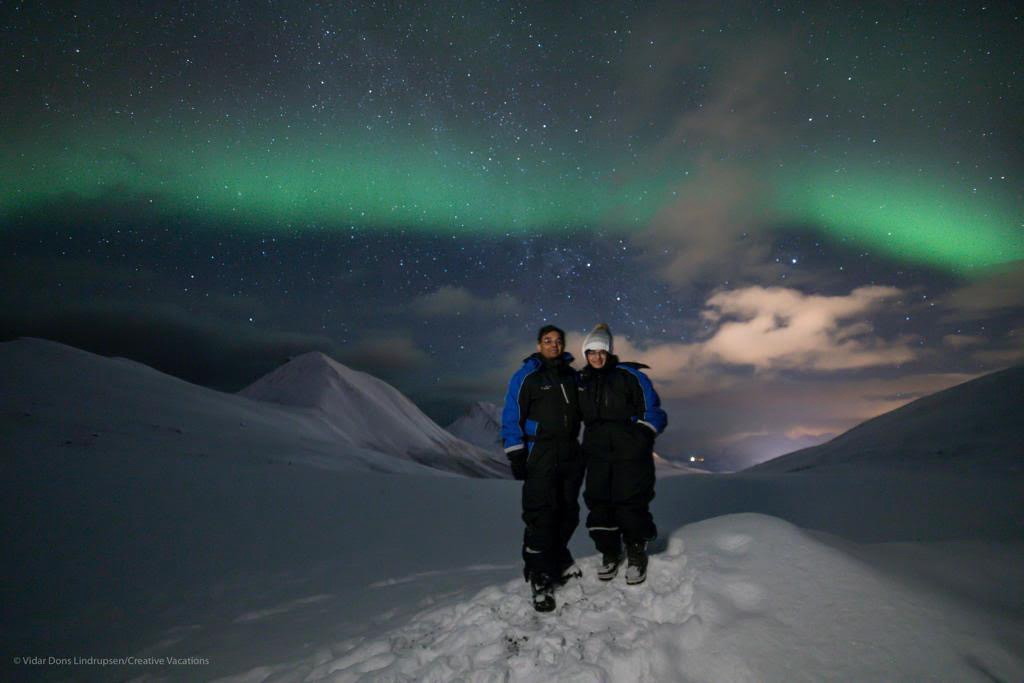
    All the mummies shook their head. The guide was defeated. He then came up with his next trick. Erecting a tripod on the snow, he invited me to fix my camera and adjust it to a very slow shutter speed, a high ISO setting and a few other settings I never even knew existed. Then he asked my wife and me to pose with the northern whites, sorry lights, behind us and told us to stay still. We were already semi frozen, so it was not difficult to follow his instructions. He remote released the shutter and it took its time while we stood unflinching and unbreathing. He finally approached us with a broad smile combing icicles off his beard and returned my camera with a flourish.

    “Have a look,” he said triumphantly.

    And there it was, the Northern Lights in all its glory. A brilliant emerald green tinged with blues and yellows instead of the white streak. He repeated the exercise with all the tourists. We returned to our respective hotels clutching our cameras that have seen the northern lights.

    (P.S. The next day we saw the northern lights with naked eyes. It was a very brief darshan.)

  • Valencia

    My first emotion on landing in Valencia was mild disappointment. On the signboards in the airport everything was repeated in three languages. The first line was in a language similar to Spanish, the next was English and then proper Spanish. I guessed the first language could be Catalan, spoken in Barcelona and other places in Catalonia. It was a bit like an Indian railway station where the signboards have the first line in the local language, then Hindi (the presumed national language although we southies resent this imposition), and finally English.

    I ignored the Catalan, known locally as Valencian, and concentrated only on the español. Walking from the plane to the passport control, I picked up a few new words. Heaps of old ones tucked away in obscure crannies of my brain emerged with gusto. It was blissfully refreshing – like the smell of first rain on parched land, like finding some long-lost heirloom behind the cupboard. My Spanish proficiency was traveling back to me through the intervening decades with reckless speed.

    The taxi driver who was engaged to take me to the hotel was called Alexandro (he pronounced x like a hard h, like the Spanish J, Alehandro). He started talking to me in laborious English. When I replied in even more laborious Spanish, he was well pleased and didn’t need any encouragement to switch languages. He started rattling away in Spanish at break neck speed. I pleaded with him to slow down,

    “Despacio, por favor.”

    Then he calmed down and spoke deliberately and slowly. I understood most of what he said. What a warm feeling it was! Old forgotten phrases came alive and danced in the air like cherubs. It’s intriguing how a language comes back to you when you’re immersed in the environment.

    Alexandro told me he’s from Argentina. I promptly endeared myself to him further by telling him of my visit to the port of Rosario and my day trip to Buenos Aires from there. I told him how a complete stranger had invited me to a cocktail party and I then extrapolated generously to how I thought the Argentinians were a hospitable lot. It’s always unwise to generalise but when it’s complimentary generalisation, it could work in one’s favour.

    Alexandro asked me if I liked living in the U.K. I said, “Sí, me encanta” (Yes, I love it). Then he told me about his uncle who had fought in the Falkland war. Apparently his uncle was captured as a POW but the Brits fed him better than the Argentinian army ever did. I was glad someone was speaking well of my home considering the world thinks it fashionable to knock America and Britain.

    By the time we reached the hotel, he and I had filled in each other about our respective families and exchanged personal telephone numbers. I had a best friend in Valencia.

    When one visits a place as a tourist, one is well informed about it. YouTube videos, Wikipedia articles and ChatGPT are studied and consulted. However, when the visit is related to work, this is rarely the case. I was engrossed in the details of the accident, worried about the challenges of conducting a thorough investigation in one day and was generally preoccupied with the logistics of the job. I knew nothing about Valencia.

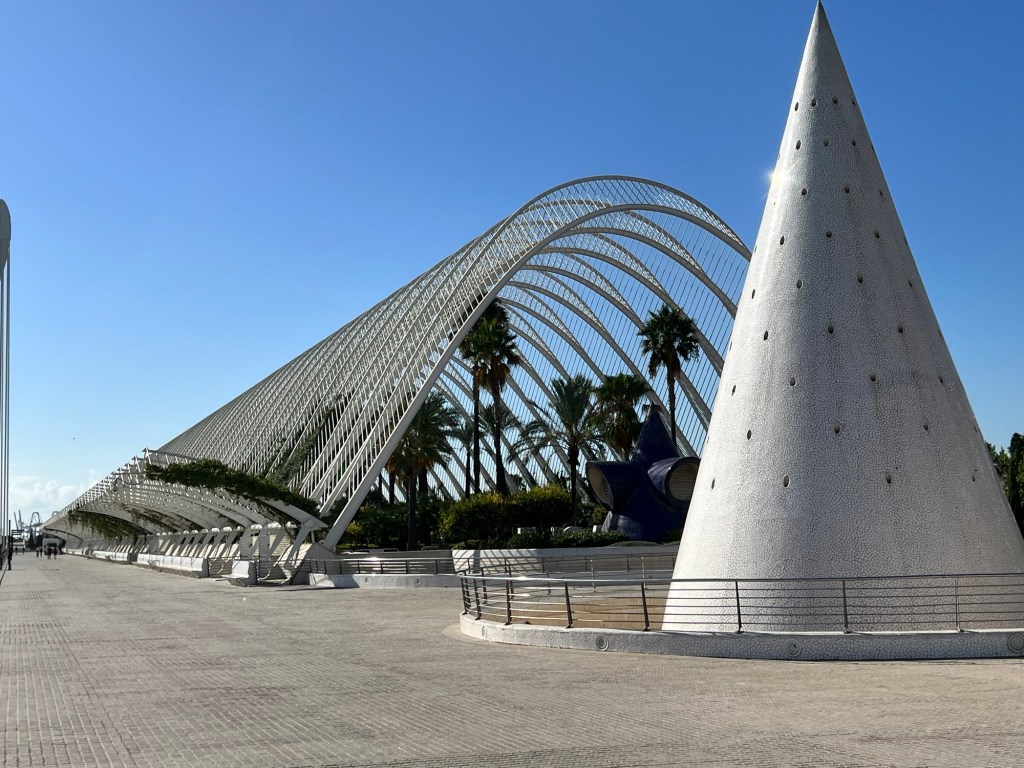
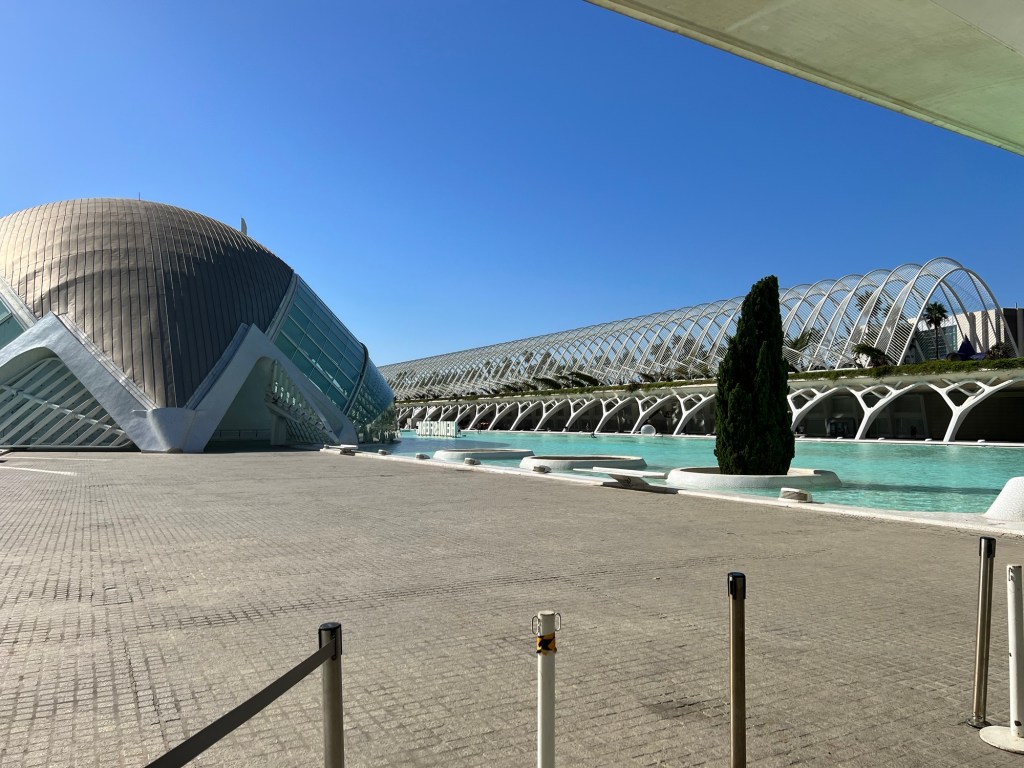
    So, when after breakfast I took a stroll outside not expecting to see anything extraordinary, the sight of the most creative structures ever built, the set of buildings known collectively as ‘La ciudad de las artes y las siencias’ (The city of arts and sciences) took my breath away. Built on the bed of a river that was drained and diverted due to past flooding, these were extraordinarily elegant and ingenious in construction. Some of them appeared weightless!

    I walked around clicking my phone like photography was going out of fashion. Usually, I don’t do selfies. I have a view on selfies, perhaps to be expanded on another occasion. Nevertheless, that morning, I wanted to be immortalised among the magical buildings. I handed my phone to a stranger and requested him to take my picture. Maybe I got the Spanish wrong or perhaps the man was psychic and became aware of my aversion to selfies. On examining the pictures he took, I observed that I was not included in any of the pictures.

    “Muchas gracias, ¿pero dónde estoy?” I said
    (Thank you very much, but where am I?).

    He seemed surprised and gave me a look that said, “make up your mind, mate!” He then took a couple of pictures with me in it.

    The ship arrived around 11 am. I was on board soon after and only completed my work late in the evening. The driver who transported me back to the hotel was from Uruguay. I was exhausted mentally and physically. There was no energy left for further gymnastics with Spanish. We spoke in English and I reminisced about the time my wife and I visited the lovely capital city of Uruguay, Montevideo. I made another best friend in Valencia.

    “Buenas noches, Martín,” I wished the Uruguayan driver good night and within an hour fell asleep in my room.

    The next morning, after securely filing away all the electronic evidence from the ship, I had exactly four free hours before the taxi ride back to the airport. But that story must wait until the next post.

  • Waking up from hibernation

    I thought I had retired. But apparently some think I haven’t. So, when asked by a friend if I would do an accident investigation, the only question i asked was ‘where?’ to which he replied,

    “Valencia, Spain.”

    That sealed the deal. Ever since I sailed on a ship with a Chilean crew some decades ago, I have had this obsession with mastering conversational Spanish. I learned the rudiments of the language and could communicate with a bit of effort. In life it is the self-concept that defines one. It’s a bit like the people who think they can sing. Negative comments don’t register with them because they think you’re talking about someone else. Similarly, I used to think I spoke good Spanish. People were generally encouraging and told me how good I was although as I improved my comprehension, I also understood occasional comments such as, “He speaks a bit of Spanish.” That hurt, of course, but overall I never let my self-image suffer any major blows.

    I also used to think I was good at French. But that story ended in tears ..

    I spent a year on a reefer ship that sailed between Marseille in France and the ports of French speaking countries in West Africa including Senegal, Ivory Coast, and Cameroon. (Reefer is jargon for refrigerated cargo and not what some of you Bob Marley fans might be thinking). I thought it was a great opportunity to become proficient in French. Purchasing a French Linguaphone set of books and cassette tapes, I spent my free hours at sea studying, and practising my skills on innocent strangers in ports. Thanks to the delicate nature of our cargo, loading and discharging were relatively slow and our ship enjoyed long port stays. I got ample opportunities to practise.

    I would walk up to random people and ask them directions for places I had no intention of visiting, and visit restaurants to order food and drinks even though I wasn’t hungry. I got my kicks from the interaction, the feeling of satisfaction that I could communicate in French, that people could understand me. I felt I was only a few steps away from reading Voltaire and Russeau in the original, in French. In short, my self-concept was running way ahead of reality. Until the day my illusions were shattered while traveling in a taxi in Abidjan with three shipmates.

    I sat in the front and my colleagues were squashed in the back seat. I spoke in French to the driver who just kept nodding his head interjecting with the occasional, Oui Oui. I kept going, regurgitating everything I had taught myself, telling him about the weather, commenting on the places I liked in his country Cote d’Ivoire, filling him on my family details, the food I like … totally unconnected and disparate topics but which were part of the Linguaphone lessons I had already mastered. In short I was just showing off to my colleagues who sat quietly with open-mouthed admiration writ large upon their faces. After patiently suffering me for over ten minutes, the driver suddenly let go of both hands from the steering wheel of the running car, turned his face to me and crossing his forearms like an X, said,

    “STOP – s’il vous plaît – STOP. Me – I no understand your English!”

    My colleagues had the evening of their life talking to me in broken French and frequently crossing their arms and screaming “STOP s’il vous plaît”. They never let me forget the episode to the day I signed off the ship. When the ship sailed out late that night, I gave a solemn sea burial to the Linguaphone course. And that was the end of my liaison with the French language.

    That was a side story. The sooner I forget it the better. I have more positive memories of my attempts to learn Spanish. As said earlier, it started with a ship where most of the crew was from Chile. I was one of three Indians on board. The conversation around the dinner table was in Spanish and I felt excluded. My ship called at most ports in Chile from Punta Arenas in Patagonia to the desert of Iquique near the Peruvian border. We also called at ports in Peru, Ecuador, Colombia, and every other South American country which was not landlocked. Spanish is spoken everywhere except in Brazil. It was imperative that I learned Spanish if I wanted get the pulse of the peoples of South America.

    So, one day I told the motorman (a colleague who assists the engineer on watch in the engine room), Sergio Gijado, to speak to me only in Spanish and also to teach me some grammar. When the ship called at Valparaiso, Sergio’s home port, he brought me some grammar books. I made very good progress. Sergio was an excellent teacher, correcting my grammar, adding a few words to my vocabulary every day and unraveling the complexities of the sixteen Spanish tenses, all in the comfort of the engine control room.

    Once, we had overhauled an engine unit in port (pulled out the piston, calibrated the cylinder liner and replaced the piston with an overhauled one). Those who have been to sea will know that everything on board has to be secured properly unless you want things flying about during rough seas. I was on watch when the ship sailed out and Sergio was assisting me. As soon as we cleared the breakwaters, the ship started rolling, gently at first and quite heavily after a short while. Sergio was taking his rounds in the engine room but soon he burst into the control room shouting in Spanish,

    “Señor, el piśton se está cayendo.”

    I figured out something was happening to the piston – but I did not know what because ‘cayendo’ was not in my Spanish lexicon. Sergio was normally a calm person, rarely perturbed by anything. However, the panic on his face was palpable. So I too panicked without really knowing why. I tried asking him in English what happened. But he continued answering in Spanish. Finally I shook him by his shoulders and screamed at him,

    “Sergio, speak English! Habla inglés por favor!”

    “Señor,” he said pointing in the direction of the engine room, “the piston – he is falling down.”

    We ran to the cylinder head platform and what I saw then still wakes me up in cold sweat at night. We had forgotten to clamp the old piston in its place. The massive cast iron piston with a crown nearly a metre in diameter, attached to a piston rod two to three metres long and altogether weighing a couple of tonnes was about to slip from its pedestal on the bulkhead and fall on to the running engine! I immediately summoned more help and eventually we managed to clamp it in place.

    But that experience only strengthened my resolve to improve my vocabulary. By the time I signed off that vessel, I was reasonably fluent in Spanish and Sergio continued to speak only Spanish to me until my last day on board.

    So, that was the alaap or the prologue. Now you know why I came out of retirement, willingly. In the next post I hope to narrate my experiences in Valencia.

  • Mahashankh

    (The great conch shell)

    A story told by ‘Bhagwan’ Rajneesh sticks in the mind. Those of my vintage will remember the sex Guru.

    A man did years of tapasya (penance through deep meditation 🧘‍♀️) until God appeared briefly one night. HE gifted him a shankh (conch shell) and said that all he had to do was blow into it and ask for anything. The man did as instructed. A voice from the shankh announced,

    “I am at your service, Master. Ask for anything.”

    The man asked for a kilogram of gold and instatntly a block of gold materialised in front of him. Just like that! Before the night was out, he had ordered everything he ever wanted and more. His simple thatched hut was replaced by an opulent palace. Luxury cars with liveried chauffeurs lined up outside, an army of servants ran around attending to him, a complete harem of desirable women frolicked in his perfumed gardens. It was as if a celestial branch of Harrods had opened in his backyard and everything including delivery was free. Soon, he ran out of ideas on things to order.

    One day, a roaming mendicant came to his palace and said to him,

    “ I hear you have a shankh that gives you everything you want?”

    “Yes, yes!” replied our man.

    “I have a Mahashankh. It’ll give you double of everything you ask.”

    Our man, greedy and stupid in equal measures, asked if he could buy it. But the mendicant replied,

    “I have no use for money. But if you want, we could exchange our shankhs.“

    It was a no-brainer. Stupid mendicant, he thought and quickly gave up his shankh and received a much larger one from the mendicant.

    The man blew into the Mahashankh and a deep voice came from within it,

    “Command me and I’ll give you double of what you want.”

    He said, “Give me a diamond.”

    Mahashankh said, “I’ll give you two.”

    He waited patiently. But nothing happened. No diamond was delivered. Maybe he was misunderstood, he assumed and blew again.

    “Yes Master, what can I do for you?”

    “Where are the two diamonds you promised?”

    “I’ll give you four,” said Mahashankh.

    Nothing delivered. Not even a pebble.

    A bit impatient, our man blew a third time and when asked how he could be served, said rather impatiently,

    “I’m still waiting for those four diamonds.”

    “I will give you eight,” replied Mahashankh.

    But gave nothing.

    This story had a profound effect on me when I heard it as a young man. I was mortally frightened of making a promise I couldn’t keep.

    So, If in the unlikely event that I haven’t done something I said I would, please remind me. I don’t want to be known as a Mahashankh.

  • Mahabali’s Onam present

    King Mahabali ruled Kerala once upon a time. He was a kind, benevolent ruler adored by the people. One day, the gods, jealous of his popularity, complained to the sustainer of the universe, Mahavishnu. Mahabali was usurping their elevated status among the people of Kerala, they said. He needed to be taught a lesson, pulled down a peg or two. Vishnu acceded to their demand. He transformed himself into a vamana (dwarf) and approached Mahabali,

    “Great king, please grant me some land to meditate,” he pleaded, “all I need is a plot covering three steps.”

    Mahabali immediately granted him his wish. No sooner had he said yes, than the vamana transformed into a giant – feet on the ground, head among the stars. With one step he covered the earth, with the next he took the heavens.

    “Where shall I take the third step?” he roared.

    Mahabali bowed down and indicated his head. As he was being pushed into the netherworld, Vishnu asked him if he had a last wish. Mahabali said he would like to visit his people once a year. Thus he emerges every year to spend ten days with his subjects. The occasion called Onam is the biggest festival of Kerala.

    People of Kerala welcome their beloved king with floral decorations adorning their floors. They offer him a grand and sumptuous lunch. Women put on their finest jewellery and everyone wears new clothes. Caparisoned elephants decked in flowers are paraded on the streets to the beat of drums and trumpets. Snake boats are raced in the backwaters. It is as if the people of Kerala genuinely believe that their favourite king has returned to them. The festivities last ten days with people of all religions participating.

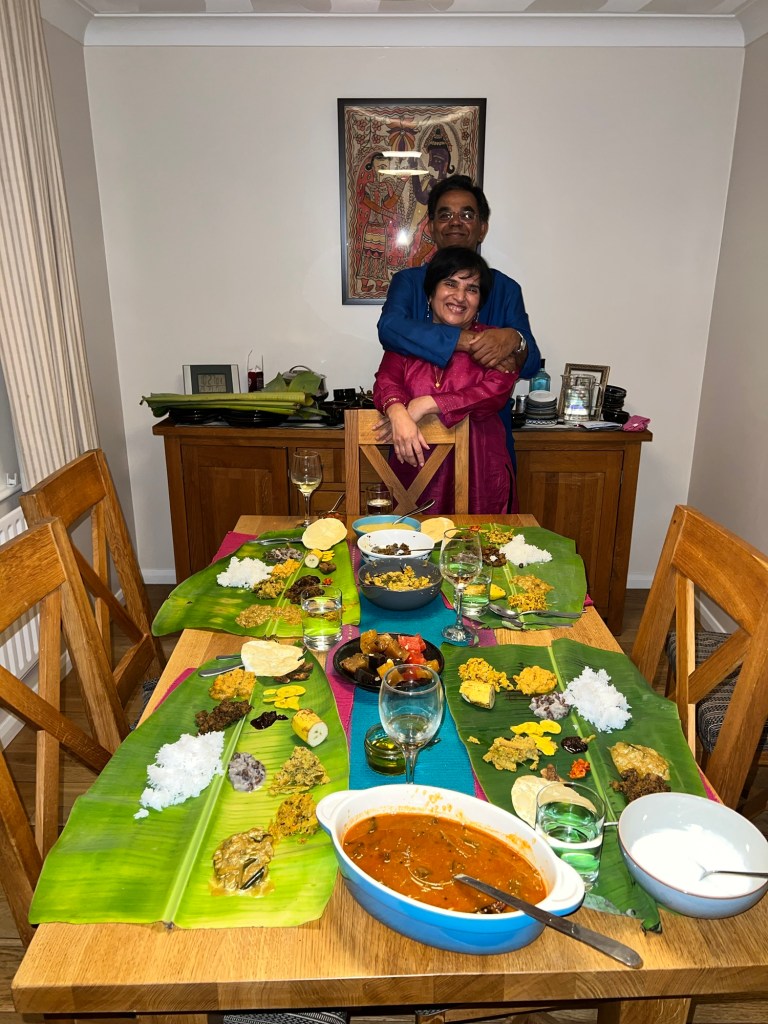
    I was born in Kerala and spent my early childhood there. Some close relatives were staying with us in Southampton during this Onam season. It was perhaps bravura induced by a glass or two of celebratory Rosé. I promised our guests that I would prepare the Onasadhya or Onam feast. They were excited by the prospect of a 27 item feast – yes you read that right – 27, all freshly cooked vegetarian dishes, served on banana leaves.

    The enormity of my promise dawned on me the next day after the Rosè had worn off. I had never cooked more than four items in a day. Yes, some of the 27 included banana chips (bought in a packet) and papadom which only has to be fried in oil. However, everything else required to be cooked, vegetables diced, mustard seeds spluttered, coconut ground and its milk extracted, lentils soaked, and a hundred other operations carried out with precision and sequenced correctly to produce the goods. I would have to multitask, juggling the activities expertly if I wished to finish in time. To top it all, I didn’t have a clue if all the traditional Onam vegetables could be purchased in Southampton. Where was I to find raw plantains and ash gourd and Kerala cucumber? What about banana leaves?

    After a lot of nail biting and a few frantic calls to Kerala friends in Southampton, I got the address of a shop which sold the Onam paraphernalia. But I had to be quick because there are many other subjects of Mahabali in Southampton and all of them would be embarking on similar cooking projects.

    My wife and I, with our two guests (our cousins) made a beeline for the Kerala store. The shop was like an Alladin’s cave of exotic vegetables and groceries. Picking up a basket, and holding a list that ran into several notebook pages, I started collecting the items one by one. As the basket filled, a part of me was rejoicing in sweet nostalgia and another major part was silently panicking.

    And then it was that the cousin shouted across to me from the far corner of the shop as if she had found a treasure.

    “Look look,” she said, pointing at some boxes in the freezer section. And there it was. Its label read, “Traditional Kerala vegetarian sadhya for five.” The box contained 19 items, all individually packed and frozen. I only had to cook the rice (item 20), fry the papadom and defrost everything else. It was as if Mahabali, sensing the distress I was in, came up with a solution. I abandoned my basket, nostalgia and all, and grabbed a box.

    We had to use some imagination to fill the remaining slots to get to the magic number of 27. So we added red wine, rosè, chardonnay, gin & tonic, vodka & orange juice .. and somewhere along the way lost the ability to count. We raised our glasses and proposed a toast to Mahabali, our very own king cheated by some jealous gods.

  • Love – 2050

    Anita, in the far corner, has film star looks, Einstein brains. A walking Wikipedia, she’s gregarious, always smiling, considerate. I melt when she looks my way; her hazel eyes caress me. She doesn’t know it, but I love her. Today, I will bare my heart.
    It’s 6 pm. The office is nearly empty. My angel is slumped in her chair, arms hanging loose, head flopped down. I start to panic.
    “Anita,” I call softly, approaching her.
    She is motionless, silky hair flutters in the aircon’s breeze. I touch her shoulder. An LED display lights up on her forehead. Anita01X17 Error404.

  • Ganesh Chaturthi and the coconut problem

    It was Ganesh Chaturthi – the birthday of the elephant-headed god Ganesha. There is an interesting story behind his creation. Even more interesting was how Ganesha solved my coconut problem today.

    Parvati, the consort of Lord Shiva was alone at home while Shiva spent aeons in deep meditation in the Himalayas. Feeling lonely, she created a boy out of clay and ghee, gave him life and started treating him as her son. One day, she went to bathe in the river instructing the boy to keep guard and not let anyone pass. As she was bathing Shiva came to visit and made his way to the river. However, the boy did not let him pass despite his demands to be let through. Angered by his obduracy, Shiva cut off the boy’s head. He then went to find Parvati. She was deeply upset when informed of the murder of her son and started venting her anger at her husband. Contrite, he promised her that he would replace the boy’s head with the head of the first living creature he encounters. An elephant was passing by. So, Shiva promptly took its head and installed it on the boy. He was named Ganesha meaning king of elephants. And everyone lived happily ever after, except of course half the elephant.

    Ganesha or Ganapathy is also called Vighneshwara – the god who removes obstacles. Hindus across India worship Ganesha for this quality. People perform special puja, ritualistic worship, when they start a new venture. Almost every Hindu home, shop, car, tuk tuk, motor cycle, briefcase, wallet .. has a little idol or image of Ganesha. Such is the faith reposed in him. Although born a Hindu, I don’t practice the religion – either overtly or covertly. But today I had a problem and I like to believe Ganesha solved it for me.

    My wife asked me to get some vegetables including a coconut so she could make a feast for Ganesh Chaturthy. I went to a nearby shop but they had run out of coconuts. So, I returned home with a bag full of vegetables but no coconut. If you know South Indian cooking you will also know that coconut is an essential ingredient – it is the potato in jacket potato, the milk in latte, the cream in strawberry and cream. It plays a major role in flavouring, garnishing and seasoning vegetables. It is also used to make traditional sweets during Ganesh Chaturthy. So, when I returned sans coconut, my wife was not pleased. Fortunately, I kept my head. Eventually, we were reconciled to make do without coconut. This is when my wife scalded her finger in the kitchen. I was dispatched again to get some Burnol.

    After purchasing the ointment, I decided to take a different route back home. Then I noticed a little Ganesh temple constructed on the pedestrian way. It was a fully functioning temple complete with two priests, a fine idol of Ganesha, garlands of flowers, lamps and bells. Let me collect some prasad for my elderly mother in law, I thought. I stood in front of the idol and folded my hands in supplication. The priest waved a copper plate brimming with marigold and hibiscus flowers, burning oil lamps in little clay pots, vermillion and holy ashes above and around my head and chanted a prayer in Sanskrit asking Vigneshwara to remove the obstacles in my path. The smell of burning camphor and warm coconut oil wafted towards me from the idol and there I was – for all practical purposes a devout Hindu like any other, paying obeisance to the Remover of Obstacles. I accepted the prasad – the remnants of the offering presented to the gods. Hidden among the flowers and the sweetmeats and the vermillion was half a coconut.

  • The pacer

    The one good thing about COVID was it forced us to exercise once a day. Most of us looked forward to the one hour outing we were allowed everyday and my wife and I were no exception. However, there was a problem. My wife liked to walk slowly admiring the wild plants and ducks. I liked to walk as if I were about to miss a flight. The result? I would be way ahead waiting for her while she ambled along like peak hour traffic on the M25.

    “Walk faster,” I would entreat her.

    “You walk fast if you want,” she would retort.

    It is no use arguing with her. She tends to dig in, the more persuasive I become. One day, we had some minor disagreement which turned into a full blown verbal. The curious thing was, as long as we were arguing she kept pace with me, matching me step for step, word for word. That’s when I had the ‘Aha’ moment – my own little epiphany.

    From the next day onwards, five minutes into our walk, I would start a small argument – nothing connected to household matters or with the potential to escalate, but something that held tremendous promise for an hour’s worth of harmless disagreement. So, for instance, keeping a poker face, I would say something like,

    “How can anyone live on the South Pole? Won’t they be standing upside down?”

    She would look at me as if I had completely lost it and respond,

    “I can’t believe this. Just what are you saying? Have you heard of gravity?”

    “Yes, but gravity only makes sure you don’t fall off into space. But you’ll still be upside down.”

    “So you think the Antarticans are all upside down?” she would try sarcasm.

    “Yes exactly! Imagine an ant going round a football. However big the football, by the time it reaches the bottom of the ball it’ll be upside down. No? It’s simple logic. Think about it ..”

    “OMG! What’s the matter with you?” she would move from incredulous to mildly amused to mildly irritated.

    “It may sound stupid, but actually it’s not,” and so on I would string it along, gently increasing my pace all the while.

    She would match my pace while trying to drum some sense into my head. And so it would continue until we returned home. Back at our front door, I would concede defeat and declare,

    “Yes. You’re right.”

    And all would be well again.

  • Heirlooms

    An heirloom has no monetary value for its owner until it’s stolen or lost. Do you find this assertion outrageous? Then read on.

    Let us assume you own a diamond necklace worth a crore of rupees (~£100,000). That’s how much it’ll cost to replace it at today’s prices. You have inherited the item from your mother who got it from her mother who got it .. you get the idea. It’s been in the family for several generations. Not only is it worth a lot of money but it also holds a tremendous amount of sentimental value. It is an heirloom. So, you would never sell it. Not to buy that sexy new car you always crave for, not to finance the house extension you so desire, not to send your children to Harvard. No.

    You will hold on to it as if your very life depends on it. You would not sell it even if you are starving. Well, maybe you would sell it if you were starving but I have never heard of starving diamond owners. Hence we will dismiss this hypothetical scenario.

    What you have in your possession, what you guard with your life, what you worry about and lose sleep over, is really worthless – monetarily speaking. Sentimental value – certainly – a lot. But you can’t eat sentiment, neither can you buy that jazzy car with it. You might just as well store a piece of granite in your high security safe. If on the other hand you lose it, its true potential starts shining through like the floodlights of an IPL stadium.

    Let us explore this further. Imagine, one day your diamond necklace is stolen. You will file an insurance claim to recover its value. A crore of rupees landing in your bank will take the sting out of your loss. Yes, you will miss the heirloom, your children will be deprived of their inheritance. But you will be richer, with the new money in the bank opening up multiple possibilities. Your loss becomes your gain.

    And the thief? S/he is laughing all the way to the bank. No sloppy sentiments to worry about, just unadulterated profit. With the proceeds of the diamond sale, they could send their children to medical school, afford a new car, enjoy a holiday abroad. The potential is vast. The loss of an heirloom, therefore, makes life more comfortable for two individuals: you and the thief.

    I wear a Rolex watch that belonged to my father. It’s nearly 40 years old. I have worn it everywhere despite the risk of getting mugged whether it is in the Bronx in New York or in Maputo in Mozambique. I have swum in the sea and lazed around in a sauna with the watch on my wrist. It runs smoothly, uncomplaining, deriving its energy from the movement of my arm. I never take it off except while sleeping.

    Recently I decided to take an overnight train from Bangalore to Thalassery, my hometown. I lay awake in the lower berth ruing my decision to travel by train, unable to sleep or experience the magic of the train journeys of my past. Too many things had changed. I kept my watch under the pillow. When I woke up in the morning, I couldn’t find it. I looked everywhere – under the berth, inside the sheets, and eventually in the most unlikely places like the upper berth where it could only have reached by defying gravity. I was desperate.

    Then, for fleeting moments, I suspected my co-passengers. Could it have been the couple who disembarked at 3 am at Coimbatore? Nah! They didn’t look like thieves. Could it be the guy snoring in the next berth? No. He’s sleeping too soundly for a thief. Then where oh where is my precious watch gone? I was miserable.

    In my mind I had already started the process – filing an FIR at the police station, making an insurance claim, arguing with the insurance company, narrating my pathetic story to my sister and brother-in-law who I was visiting in Thalassery. I could almost hear by brother-in-law admonish me,

    “How could you be so careless?”
    “Only you would do such a thing!”
    “Why carry valuables in the train?”
    “You should have taken a flight.”

    The loss of something that I had cherished for over three decades was painful. I sat staring through the dark tinted windows. Over the years I had developed a superstition concerning the watch. I believe the tutelary spirit of my father is protecting me and I am invincible while I wore it. Without it I felt naked and vulnerable. At least it was insured, I consoled myself rather weakly. I’ll use the cash to finance my travel to South America next year.

    I decided to check one last time as the train was approaching my station. Shining my phone’s torch under the berth once again, I saw a glint of metal in the corner where the side bulkhead, the division bulkhead and the floor met. Crawling under the berth, I examined the object. It was the bracelet attached to my watch which had lodged itself between the linoleum on the floor and that on the bulkhead. It was as if someone had deliberately placed it there!

    I was overcome by a mixture of immense relief and mild disappointment (at having to shelve my South American sojourn). I realised then that my watch was more than just an object of sentimental value. It made me feel like superman. And no, it’s not for sale.