Category: Uncategorized

  • Code 100

    What’s with people? WhatsApp has removed the last vestige of common sense from a lot of them. There is such a lot of fakery expressed on this platform that I struggle to hold my peace at times. WhatsRight with WhatsApp is the title of the book that I will never write.

    Imagine this: someone’s elderly father-in-law dies.

    Straight to the WhatsApp groups:
    “My father-in-law died in his sleep. He was 94.”
    The group is now buzzing with activity. Every man, woman and their dog is writing, writing, writing. Then the deluge.

    “Oom Shanthi” accompanied by the obligatory Oom symbol in Devnagari script. Folded hands, mostly brown to match one’s skin tone, some sombre white flowers …

    “May his soul rest in peace” accompanied by more emojis.

    “God bless his soul” chimes in another, more emojis.

    Multiple variations on the God theme. Poor God is overloaded. S/he has been commandeered to look after the departed soul, make sure it is resting peacefully somewhere in the ether, proffer her/his ‘lotus’ feet as shelter to the millions of freshly departed souls.

    “I am devastated by your loss” writes the more literarily accomplished, able to string a full sentence together. Devastated? Are you real?

    Reminds me of the telegram codes we used back in the days. As each telegram was charged by the number of words it contained, one could use economical standard codes that transmitted a standard phrase. Code 100 simply said, “My deep condolences.” Neat. Sadly, Indian Telegraphs have abandoned telegrams. @Meta are you listening? Please introduce standard phraseology. I am drowning in bs. So is God- overworked and drowning in bs.

    The one occasion when I couldn’t hold my peace leading to threats of eviction from a WhatsApp group was when someone’s grandmother died and a member consoled the bereaved,
    “I am sure she is playing in the lap of God.”
    “She was a grandmother, not a lap dancer,” my fingers won the race with my brain and before I knew it, the message was sent and read by the permanent residents of WhatsApp. I still bear the scars of that exchange.

    So, next time someone dies and you never even knew this person existed, don’t go overboard. Don’t send those cheap overused emojis or those creepy flowers. Just say, “My sincere condolences.” Even better, say Code 100.


  • Privacy? What privacy?

    When a young person falls down we say s/he fell but when it happens to an older person we say s/he had a fall. Last evening I had a near fall.

    I was going upstairs with a cup of tea in one hand and my iPhone in the other. Half way up, I stumbled and lost my balance spilling my tea. I must have cursed aloud as I had spilt most of my tea.

    My wife, watching TV downstairs, shouted out to me,
    ‘Did you fall ?’
    ‘No, I just slipped,’ I replied.

    My phone, without any prompting from me, says,

    ‘That’s what I reckoned.’ Yes, my phone spoke without permission and without the Hey Siri cue.

    Incredible? I thought so too. I have heard stories about how the FBI once forced a big company to release all the data they stored about a dangerous criminal. Seems the company handed over a recording of every bit of sound ever made in his bedroom including moans, groans and conversations on and off the phone.

    Immediately after my phone spoke of its own volition, I asked Siri and Alexa whether they were surreptitiously recording me all the time. Both denied it with a vehemence bordering on hurt, and responded by pointing me to their privacy policy which said -you guessed it – they take clients’ privacy very seriously and all that baloney.

    Smart devices are getting too smart for my liking.

  • Walking your cat?

    Walking the cat on a leash is catching on. Pet shops offer a wide selection of cat harnesses, collars and other cat-walking accessories. Shops would sell anything as long as there is demand. If spouse walking becomes fashionable, I’m certain they would sell tastefully designed collars and leads/leashes for the purpose. So, the availability of the gear is no justification for the act.

    Tim Walker quotes the RSPCA on The Guardian news website,

    “A sense of control is very important to cats, and being walked on a collar or harness prevents them having control. It may be more difficult for them to move away or hide from anything which might scare or worry them.”

    The other day I asked a cat-walker why she did it.

    “It’s a lot better for the environment,” she replied. “Cats kill other creatures. But our cats are fed well. They don’t need to kill to eat.”
    She lets them out in her back garden though, she added.

    Hmmm… I am not convinced. Cats are essentially wild creatures. They have an independent mind and, unlike dogs, don’t dote on their owners. They don’t fetch, they don’t usually respond to verbal commands, they do what they like. The expression ‘free spirit’ must have originated from observing the behaviour of a cat. They might snuggle up to you and purr. However, I’m sure they don’t do it out of affection. They are self-centred in every sense of the word.

    My neighbour encapsulates it well.
    “I love Sunny,” he says referring to his tabby cat. “But I know if I shrink to his size, he would kill me.”

    That is the fundamental nature of a cat. Free spirited, independent and wild – like birds. Can it be right to cage a bird or walk a cat on a leash?

    How would I feel if you tied my hands to prevent me from killing you softly on FB?

  • The cure for boredom

    ‘When you have nothing better to do, write a story’: an old iPog saying.
    I am stuck in the departure lounge of Heathrow for the next 8 hours thanks to Flybe, COVID hangover and Brexit – in that order if you want a chronology. In weightage terms, the order would, most likely, be reversed. In any case, here I am sat (‘sitting’ for the punctilious) opposite Harrods Food Hall, wondering if the £12 that Flybe compensated us with would buy me anything there. I haven’t checked but I doubt it. If the Caviar and Seafood House right behind me is an indication of food prices at Heathrow, probably not – on the menu is a lobster dish for £65 and with a dash of caviar thrown in, that would be £75, thank you very much. I didn’t ask if I could just have the caviar without the lobster. I don’t want to make trouble even before I reach my destination. It has, however, made me ponder over an existentialist conundrum: if someone didn’t eat fish but ate eggs, could that person eat caviar, considering caviar is fish (Sturgeon) eggs!
    Quite a pointless question, of course. But it’s a good way to pass time. Only another seven hours to go.

  • Eyes that don’t see

    When we were in primary school, we read stories in Malayalam each of which invariably ended with a strong moral lesson. It was as if the only purpose of a story was to teach you something worthwhile. If it didn’t, it had no business in a text book. They were probably right, considering the purpose of school is to impart lessons. (There must be a place for pointless stories as well. Something that doesn’t harangue you, a tale sufficient in itself for the telling of it.)
    I will concede that in the long run, these lofty stories help you to navigate life and survive reasonably unscathed. The proviso is of course that you understand the lesson.
    Often one remembers the moral and forgets the story. Something that has remained with me is the adage, ‘It’s not enough to have eyes, one must also see.”
    My phone was running out of juice. Fortunately, my charger was in my cabin bag. However, every charging station in the airport terminal was full. People were queuing with their phones for a bit of charge. They might as well be queuing for drinking water, if you go by the expression on their face: parched, desperate. Some people were sprawled on the floor having plugged their instruments into low points on the wall.
    I too was desperate as I couldn’t contemplate being without my phone until I reached my destination. Eventually, I found a free plug point and made a beeline for it. It was at the other end of the terminal but that was ok as I had all the time in the world.
    Having successfully got 80% charge on my phone, I triumphantly returned to my seat. My wife was beginning to get impatient and asked me where I had gone. When I told her about the elusive charging points and my successful mission to find a free plug point, she points to a plug point tucked away between my seat and the adjacent one!
    The moral of this story? Yes, of course, if you have eyes, you should also see. But the stronger moral I think, is ‘Look under your nose before you search in the neighbour’s house.’

  • Taman Negara

    Tribal village in Taman Negara

    I am familiar with the forests of Western Ghats, India’s mountain range running like a spine from central India to the tip of the peninsula. In November 2024, I discovered Taman Negara, the Malaysian rainforest – Western Ghats on steroids.

    When I was 26, I had travelled to Thekkady, a wildlife resort in Kerala. A lonely official wearing khaki sat staring with a ledger at a table in a tent pitched on the bank of the river. Curious, I approached the man and struck up conversation with him. He was a forest protection official, granting permits for entering the forest.

    “On foot?”

    I was incredulous at the thought that the forest department would allow ordinary people like me to walk inside the forest teeming with wild animals.

    “Yes on foot, with a guide,” he responded.

    Reading the fear on my face, he added helpfully,

    “There’s a group of twenty Americans who have signed up for the tour tomorrow. Do you want to join?”

    That clinched the deal. Safety in numbers. I signed a bond for two Indian Rupees, absolving the forest department of any liability if I were unfortunate enough to become a tiger’s lunch or an elephant’s football. The official supplied some statistics – apparently in the last ten years only two persons were attacked by wildlife. Very reassuring, statistically speaking, I thought.

    The next morning, trying not to dwell on the nightmares that woke me , I headed for the tent by the river. Did I come to the wrong tent? It was nearly 6 am and the tour was to start at six. The only person loitering outside the tent was a young man wearing a lungi (sarong) at half mast and plastic sandals. He smiled and introduced himself,

    “Hello, I am Babu, your forest guide.”

    “Where is the rest of the group?” I asked.

    “Oh! The Americans have cancelled. It’s just you and me.”

    There goes the safety in numbers concept. Maybe it was the foolish recklessness of youth, or an exaggerated sense of invincibility – also an artefact of youth, I did not cancel.

    We walked into the depth of the forest. Although it was a bright and sultry day, the forest was cool and dark. The thick canopy of the rainforest blocked the sun. A carpet of dead leaves covered the forest floor. It was like walking on a mattress. The guide, not very talkative by nature, made little conversation with me and I enjoyed the solitude. My fear of being attacked by wildlife dissolved gradually. I must have started whistling – I was so relaxed. Then all of a sudden, he turned to me and said,

    “If a wild elephant should chase you, try and run downhill. Elephants gain speed when they run uphill.”

    I experienced the primordial fear of the prey when I heard his words. I stopped whistling and looked around expecting a tusker to come charging at me from any direction. It was flat land, no downhill slopes. I began to hear the eerie cries of monkeys, resounding birdsong, the constant hum of cicadas. I was listening to the forest rather to my own whistling. The guide continued in his silent walk and I, shaken out of my complacence, followed.

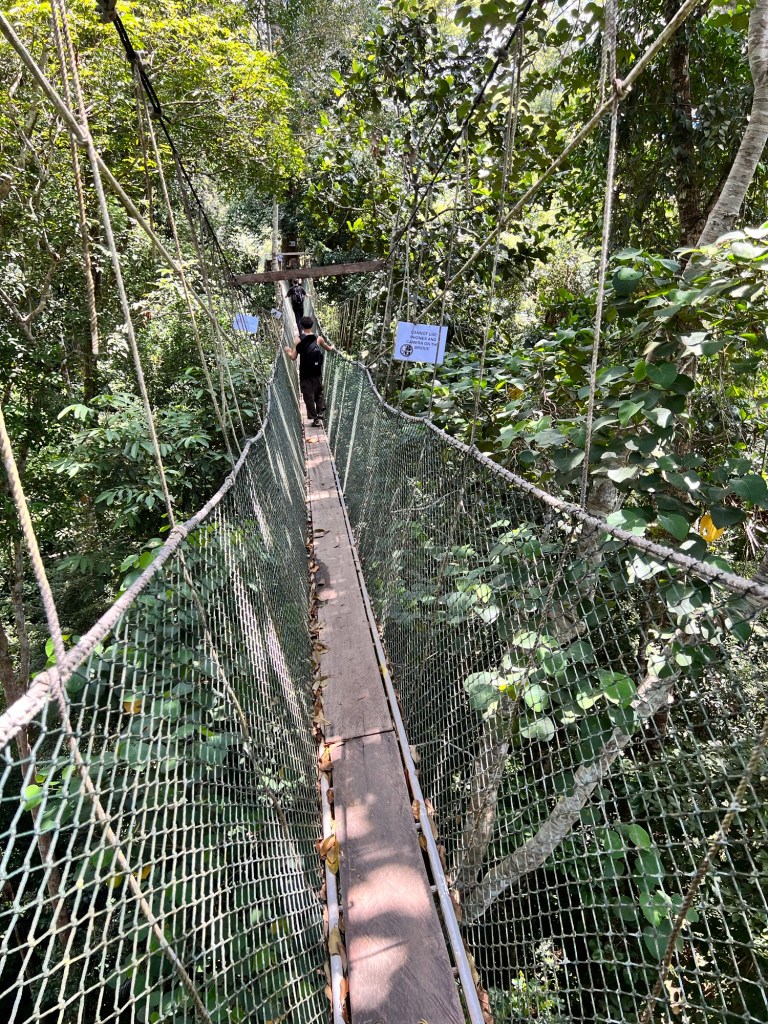
    The experience in Teman Negara was quite different. You are restricted to a path cordoned off on either side. It is certainly good for the forest not to allow tourists to go traipsing around. But the sense of danger and adventure was lost. It was a sterile experience. The rope walkways, all part of the tourist trail, take you up to levels above the trees until you’re looking down at the canopy of ancient trees. All very exciting but in a packaged kind of way.

    For me, personally, there was nothing new. So, I didn’t take photographs of big ants carrying big leaves or marvel at the incessant chirping of the cicadas or gasp in wonder at gushing streams. I just felt at home and relished the exercise.

    We visited a tribal village and it was all very authentic. The chief demonstrated the technique of blowing little arrows through a blow pipe and starting a fire with twigs. I am not a big fan of viewing people in a showcase, as if they are exhibits in an anthropological museum. However, it did serve a purpose, perhaps to give the tourists a glimpse into something exotic, all in the space of one day.

    Mosli Adi, the guide (calls himself ‘Mushroom’)

  • Eclipsed by the rain

    Everyone complains about the British weather. Rains all the time, we moan. If you ask me, it doesn’t rain here, it only leaks. Nevertheless, it has an uncanny knack for preventing the sighting of eclipses, spoiling a game of cricket …

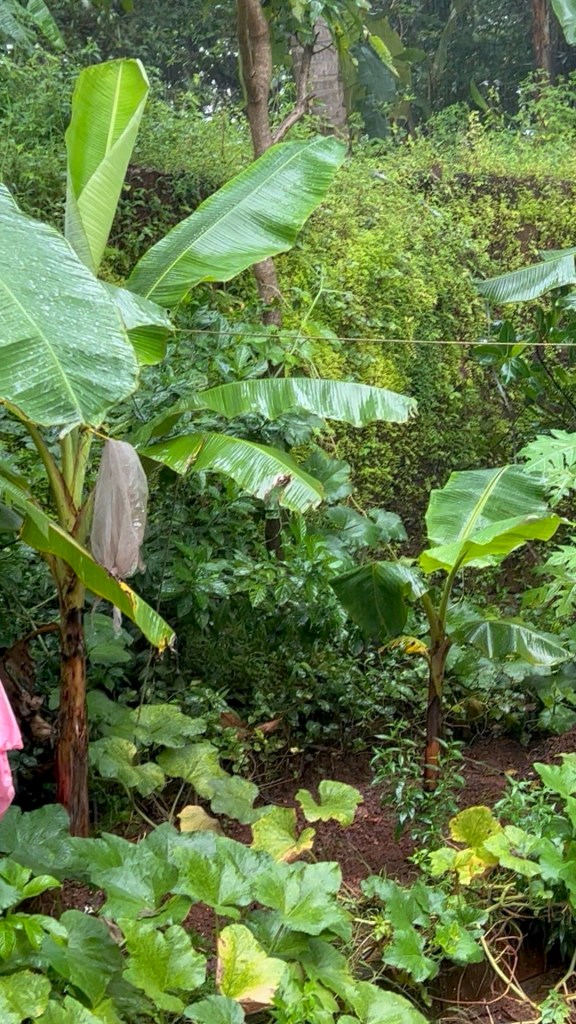
    If you want to see real rain, come to tropical Kerala. There the downpour lasts days. It is intense, full of drama. People dare not step out without an umbrella unless they want holes on their head. They rather sit on an easy chair with a cup of tea and banana chips to watch the rain. The water gushes down from gutters built into roofs, splashes the gravel covered ground, presses down the trees, frightens the birds into silence. The sound of water meeting the roof tiles and the hard cemented courtyards – like the crescendo of wedding drums marking the solemn exchange of garlands. Only, the drum beat lasts through the day, the night, and the days following. Spontaneous rivulets coming together in little streams rush to find the lowest level, cascade down streets, down fields, under culverts, until they meet the roiling river, the uprooted trees, all travelling at a terrific pace taking some of the earth with it, colouring the water the brown of a milky cup of tea, incessant, unstoppable. It roars like a lion and sings like a koel – real rain.

  • The talking robot

    There are two types of people: the type who are polite to Alexa, Siri and similar others, and my type who treat them with mild contempt. My wife and I have this ongoing debate along the lines of,
    “It’s only a machine. Why waste your breath?”
    “You can still be polite. What do you lose?”
    We have not resolved this argument.
    For example, my wife goes,
    “Alexa, please switch on the light; Alexa, tell me what’s fata morgana, please; Alexa, thank you very much.”
    My interaction is similar, but I miss out the pleases and thankyous.

    I have a reason.

    Way back in 1997, I was a PhD student/Research Assistant at the Department of Computer Science, University of Sheffield (DCS). Our group had several students working in robotics and we even had a full-fledged robot, Murphy. Other groups worked in speech recognition and natural language processing (NLP). I used to follow their research with keen interest. Making a computer respond to and understand spoken language is extremely hard, like trying to put toothpaste back in its tube, the pundits said at the time. Alexa and others have come a long way since then, as we know.

    One Saturday morning, I took my family to a science fair at Doncaster, a nearby town. There was this robot installed in one of the stalls, all swivelling head and blinking eyes and flashing lights. It’s info sheet claimed the robot was able to talk and respond to you just as if it were another human being. I was impressed. What’s all the fuss at DCS then? I wondered. Here’s a robot which claims to pass the Turing Test (when, judging by its response in a conversation, you can’t make out if it’s a machine or human.)

    There was a sign pinned on the robot: ‘Talk to me.’ That was my cue to put it to a rigorous test. Let me say my academic curiosity got the better of me before you say, ‘how naïve.’

    The conversation with the robot went like this:
    “Hello, good morning.”
    ” Good morning, sir. I am Mary, what’s your name?”
    “I’m Gopi.”
    “Are you enjoying the day?”
    “Oh yes. Very much. Particularly impressed by your speech recognition and NLP abilities.”
    “N.L… ? Hmm, thank you very much Gopi.”

    We had an intelligent conversation touching on politics, the problems of the world and how to solve them, the weather and everything else.

    To say I was impressed would not begin to express the amazement and admiration I felt for Mary’s creators who had cracked the NLP problem completely. Here was a full blown, almost sentient, robot who could understand spoken language and speak just like any other human being. How could this be while my colleagues at DCS struggled on with rudimentary phrases?

    Then I had an idea. My family, including my 8 year old boy, had moved on to other stalls bored of my protracted interaction with Mary. Out of the blue, I told Mary,

    “Fuck off.”

    Now, I am not a vulgar man. I rarely use four letter words unless I am in the company of close friends. This was an academic exercise. I wanted to know how Mary the sentient machine would react.

    A young woman in her late twenties tore out from behind the curtain. Her otherwise pretty face was contorted with anger. She was holding a microphone with a long cable attached to Mary.

    “You … you … you told me to …,” she stuttered, half sob, half shout.

    She would have hit me had my expression not been a mixture of disbelief, shock and disappointment.

    My disdain for machines who pretend to understand human language, stems from that day at the science fair. I refuse to say please and thank you to Alexa and her ilk.

  • Video bell

    Are you a good liar? If not don’t buy a video doorbell. There is a reason for why I say this.

    All of us live our lives by assessing the risks of actions we intend to take, whether it is crossing a road or choosing a life partner. When someone suggested I purchase a video doorbell, my first thought was: ‘that’s a great idea.’ However, when I started analysing future scenarios, I wasn’t too sure.

    Mr Thief rings the bell. I am not home. In fact I am abroad.

    “I have a parcel for you.”
    “Ah! Please leave it with the neighbour.”
    “Why don’t you open the door and take it?”
    “I am not home.”
    “I see. Maybe I can return tomorrow with the parcel?”
    “No. I won’t be back tomorrow.”

    The thief is now smacking his lips, hatching a plan. Time is his ally. He is looking around, gauging the doors, scanning for cameras, generally taking stock. He is momentarily distracted.

    “When will you be back?”
    “Two weeks Monday.”
    “OK. Cool.”

    Cool, indeed.

    Some of you must be wondering, why I am giving away all the information to a stranger. The thing is, I don’t know what else to do. I find it hard to lie. Not because I am the paragon of Truth, but because I always get caught when I lie. So, for a long long time now, I haven’t lied to anyone. I am also very generous with information. If I don’t tell you every last detail, I somehow feel I am being devious, disingenuous.

    Consider the same scenario. I am abroad but don’t want to disclose my whereabouts. I have a go at telling porkies.
    ‘Ring-Ring’. Mr Thief, carrying a package, is at my door.

    “I have a parcel for you.”
    “Please leave it with the neighbour.”
    “Why don’t you take it yourself?”
    “I am in the shower.”
    “I will wait. It’s raining. Your parcel will get wet.”
    “Nooo. Please leave it with the neighbour.”

    Thief returns after 5 minutes.
    “Your neighbour’s not home. Where are you?”
    “In the shower.”
    “ok, no worries, I’ll wait.”

    “No no.”

    “Sir, are you in your own shower or somewhere else?”
    “Hmm … Aaaah … I am not home.”
    “OK. I can come back tomorrow.”
    “Nooo.”
    “So, you are not back tomorrow?”
    “Hmmm … aaahh …No. I am abroad. Back in two weeks.”
    “Coool.”

    I can’t lie.

    I am, therefore, still considering if I should install a video doorbell. Will it convert me – an honest, straightforward man – into a devious, lying, crook?

  • SWVG (Southampton and Winchester Visitor Group)

    Last Friday was my first day of teaching English at the SWVG (https://swvg-refugees.org.uk). I was waiting for C, the coordinator of volunteers, to assign me a student. Mingling with the crowd, I eavesdropped on conversations. Afghans, Egyptians, Syrians, Pakistanis, Kurds … milled around. A veritable United Nations of the desperate seeking refuge in my city. Volunteers, almost all of them white women, flitted from table to table. Around my table, an Iranian was speaking to an Iraqi. I asked them what language they were conversing in. Farsi, one of them responded. A new learning point for me. I had always thought Iraqis spoke only Arabic. In the 10 minutes or so I spent around the table, I got a brief peek into the tribulations of asylum seekers.

    Then a woman came around with leaflets and spoke to everyone around our table about forthcoming events. She addressed each person individually. My turn was last.

    “We have this nice walk in the New Forest,” she said, quickly adding, “SWVG will pay your train fare.” I just couldn’t resist it. I pretended I was struggling to understand. Deep inside, in some obscure alley of my psyche, I was offended that I was mistaken for an asylum seeker. And then I was offended at myself for being offended.

    I felt as if I had driven into a cul-de-sac and my reverse gear had failed. I didn’t know what to do or how to come clean, now that I had started. So, I continued my act.
    Pointing at a map of the New Forest, I asked the lady,
    “This Lundoon?”
    “No, this is Southampton, not London!”

    A few minutes more of this game and I was contrite that I was teasing an innocent person, a fellow volunteer who was giving up her time for others. I came clean, and the lady, bless her, wasn’t upset with me. She was wearing a mask. It couldn’t hide the smile in her eyes.

    To avoid further confusion, I asked C to find me an SWVG ID card.
    The funny thing was, the ID card made no difference!
    An academic from a local University came to our table next and asked if I would like to attend a colouring-in session on 27 October. I quickly fessed up that I’m a volunteer teacher and not an asylum seeker. He was quick-witted enough to respond,
    “That’s fine. All are welcome.”

    All the confusion and the philosophical conundrums about identity and belonging dissolved after I was assigned my first student. It was a pleasure to teach her- her enthusiasm was catching. She asked if she could have lessons 7 days a week! We settled for two.