Category: Uncategorized

  • The Weight of Smoke

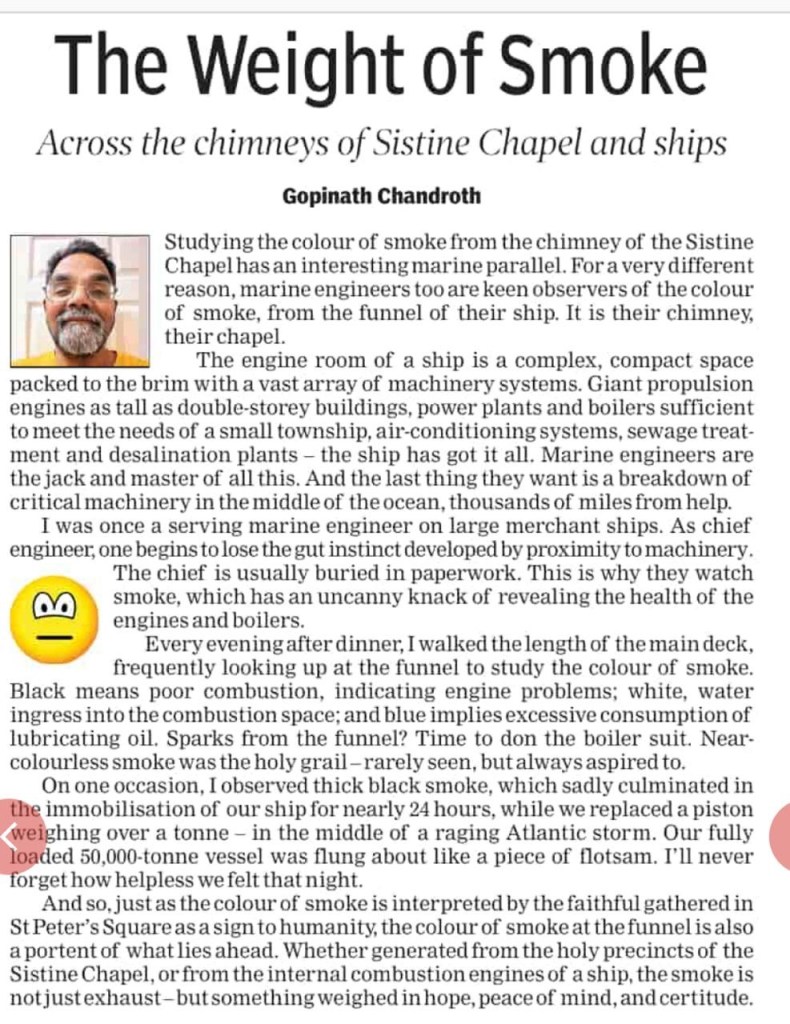
    Studying the colour of smoke from the chimney of the Sistine Chapel has an interesting marine parallel. For a very different reason, marine engineers too are keen observers of the colour of smoke from the funnel of their ship. It is their chimney; the engine room, their chapel.

    The engine room is a complex, compact space packed to the brim with a vast array of machinery systems. A ship is a floating hotel — but with exceptions: no access to shore-based services.

    Giant propulsion engines as tall as double-storied buildings; power plants and boilers sufficient to meet the needs of a small township; air-conditioning systems; sewage treatment units; and desalination plants — the ship has got it all.

    The marine engineer is the jack and master of all machinery. They need an intimate understanding not only of the functioning of equipment, but also the thermodynamics of the processes within, the hydraulic flows, and the mechanical stresses involved. They must know, like the back of their hands, the labyrinthine pipework and electrical circuits that service the equipment.

    Being a marine engineer is no easy task. A single mistake can lead to multiple — and often catastrophic — failures.

    The last thing a marine engineer wants is a breakdown of critical machinery in the middle of the ocean, thousands of miles from help. I was once a serving marine engineer on large merchant ships. As chief engineer, one begins to lose the gut instinct developed by spending most of the working day in proximity to machinery. The chief is usually buried in paperwork.

    This is why they watch smoke — which has an uncanny knack of revealing the health of the engines and boilers.

    Every evening after dinner, I walked the length of the main deck, frequently looking up at the funnel to study the colour of smoke.

    Black means poor combustion, indicating engine problems; white, water ingress into the combustion space; and blue implies excessive consumption of lubricating oil.

    Sparks from the funnel? Time to don the boiler suit.

    Near-colourless smoke was the holy grail — rarely seen, but always aspired to.

    On one occasion, I observed thick black smoke and hoped we could deal with the problem in port. Sadly, it culminated in the immobilisation of our ship for nearly 24 hours, while we replaced a piston weighing over a tonne — in the middle of a raging Atlantic storm. Our fully loaded 50,000-tonne vessel was flung about like a piece of flotsam. We could barely stand without holding on to something. I’ll never forget how helpless we felt that night.

    And so, just as the colour of smoke is interpreted by the faithful gathered in St Peter’s Square as a sign to humanity, the colour of smoke at the funnel is also a portent of what lies ahead for the marine engineer.

    Whether generated from the holy precincts of the Sistine Chapel, or from the internal combustion engines of a ship, the smoke is not just exhaust — but something weighed in hope, peace of mind, and certitude.

  • Picnic in the perfect field

    England is full of signboards, yet where there should be one, there are none. We set off one summer morning, to spend the day on the banks of Abbey Brook near Sheffield. I loved the gentle murmur of the brook as we ambled along its banks. Its meandering nature lulled me into a sense of dilated time. By noon, we began looking for a picnic spot.

    “Looks greener over there,” I said, pointing out to my wife and son.

    We moved about 100 feet further away from the brook, and spread our blanket on grass softer than the carpets in our student accommodation. For the next hour, we luxuriated in the sun, nibbling sandwiches, sipping chilled Chablis, and enjoying the manicured grass.

    “They do look after their fields, don’t they?” I addressed the blue sky and its cuddly clouds.

    A group of middle-aged men loitered nearby—not too close, but not far either. They appeared to be waiting for something. Strange, I thought. Bird-watchers? Gardeners? Land surveyors? Eventually, after a good hour, we finished our picnic, packed up our blanket and other accessories, and walked toward the bus stop. The men who had seemed aimless suddenly moved swiftly, with clear purpose. Out came their golf clubs…

    Is that an incredulous gasp I hear? I am narrating it as it happened—upon the god of smallpox — as we used to swear to the truth in my childhood back in Kerala.

    Forgive me, gentle golfers — you didn’t ask us to shove off or even politely suggest that we move away from the putting green. No, you just stood there and waited for us to finish. You see, I didn’t have a clue. In the India I left behind, golf carried a poor reputation. It was seen as the game of the brown sahib—the Indian avatar of the British colonialist. Politically speaking, it was out of bounds for me. But I will hand it to you with a coconut and a blessing. No one can match the Yorkshireman’s quiet civility.

  • Rory and I

    My life was turned upside down by a Bengal tiger. In December 2000, my friend Danny and I took a gap year after school to travel the world. The University of Edinburgh had made me a firm offer to study veterinary science the following year. Life was sorted, or so I imagined.
    We travelled to Burma just after Christmas that year. A month later, we parted ways. I travelled to Malaysia. My funds soon started drying up but fortunately I found a temporary job in Negara zoo, 15 miles from Kuala Lumpur.
    The job role was advertised as ‘Zoo Assistant’. No one told me it was a euphemism for ‘Zoo Gopher’. There were some decent perks though: free accommodation in the wardens’ quarters and access to subsidised meals in the staff canteen. My working day was spent amongst exotic animals. The welcoming Malay people, delightfully fresh cuisine and warm tropical weather were enough reasons for me to prolong my stay.
    The animals lived in enclosures that simulated their natural habitat. Several CCTV cameras monitored their behaviour and the zoo’s vet attended to any who looked unwell. Somewhere along the way, my job role changed. Gradually, I stopped running errands and found myself accompanying the vet wherever she went. My colleagues called me Adik or younger brother.
    The months that followed were spent learning about the ailments and quirks of animals. I felt privileged. A university course couldn’t have given me such practical experience.
    “Adik, today we will check Sara’s eyes,” the vet would typically announce when I reported for work. Sara was the hippopotamus. Ali, the macaque; Abdul and Noor, the elephants; Fatima, the orangutan: we were like a big and diverse family.
    “Puteri is pregnant”, the vet told me one morning.
    Puteri was the much-loved Bengal tigress.
    “I’m not looking forward to it Adik. She’s miscarried twice.”
    I checked on the tigress several times during the day and spent my free time researching the care of newly born tiger cubs. My life at the zoo was blissful contentment.
    There was, however, a thorn in my side: the gun-toting security guard, Umar. I knew he was trouble from the moment I saw him. His beady eyes set close together like the headlights of an old Jeep, heralded my undoing.
    Umar, followed me everywhere. When the vet and I entered an enclosure, he cocked his rifle and stood ready. He didn’t share my sense of camaraderie with the animals and saw them as wild creatures who would devour him given an opportunity. He treated them with disdain, referring to them as binatang or beasts.
    “Look Umar,” I tried reasoning with him. “Wild animals don’t attack unless provoked.”
    “No, no, Adik. Binatangs dangerous. Western peoples much stupid,” he admonished me in his limited English.
    Pointing to his right temple, he made tight circles with his index finger. In his estimation, I was both stupid and crazy!
    One of Umar’s favourite stories was that of the lion who asked a cat to teach him everything he knew. Apparently, the cat complied but didn’t teach him how to climb trees. Thinking that he had learned everything, the lion, true to his mean nature, decided to kill the cat and gave chase. The cat climbed the nearest tree and saved himself.
    “Never trust a Binatang,” he underlined the moral of his story, wagging his rifle under my nose, breathing raw onions on my face.
    May 13, 2001: my nineteenth birthday. I woke early to check on the heavily pregnant Puteri. In the dim light of dawn, I saw her lying motionless under a tree. I ran in to her enclosure. Curled up next to her lifeless body was her new-born cub not yet strong enough to stand or open its eyes. It was a ball of yellow-orange and black fur, tiniest of paws and tail, candyfloss tongue.
    The muezzin’s call from a faraway mosque sounded like an elegy to mark the passing of dear Puteri. The early morning chorus of tropical birds welcomed the new-born. It was as if life and death were squaring up to each other in that brief twilight moment. The cub whimpered, tremulously seeking its dead mother’s teats.
    “You take charge of the cub, Adik,” said the vet, struggling to hide her tears.
    I named him Rory. I was his surrogate mother, bottle feeding him milk fortified with vitamins, playing with him and sometimes even sneaking him up to my room. He grew rapidly and within weeks was bounding about like a playful kitten.
    Rory’s enclosure was nearly an acre and the flora of the rainforest made it appear even larger. Teak and ebony trees canopied the skies. The scent of wild orchids wafted through the air and evanescent rainbows danced in the mid-morning light as the swift stream splashed against boulders. Bottle green frogs with bloodshot eyes croaked.
    Five years passed. The England I left behind was a fading memory. I had lost my place at the University. But I didn’t care. Rory had grown into a fully mature animal almost six feet long, not including the tail. His roar reverberated in the vast open spaces of the zoo, stopping both visitors and staff in their tracks. But he was a gentle, beautiful giant with his velvet coat and marble eyes. I spent most of my leisure time with him, swimming in the stream, tumbling in the tall grass and mock-fighting. In the summer, Rory liked to doze on a flat granite rock by the stream, near the bamboo bush.
    Umar hadn’t changed. After twenty years of employment in the zoo, he hadn’t developed any empathy for its animals. His rifle always cocked and ready, he constantly tapped the trigger with his index finger. We hardly spoke to each other, but he never let me out of his sight, shadowing me as if he were my personal bodyguard.
    21 June, 2006, 6 PM: I was at the far end of the enclosure under the mango tree. Rory was dozing on his favourite rock just outside the cave at the opposite end. His shining coat of tan and black merged with the yellow trunks of the bamboo trees as the light of the late afternoon sun cast its long shadows. Stretched languidly on that rock, his belly heaving gently with every breath, he was a poster for serenity.
    My memory of what happened next plays out in slow motion, as if my brain struggles to cope with the speed of the event.
    Rory abruptly stood up from his rock and looked in my direction as if he was puzzled by something he saw. Every sinew on his body was taut. His long tail went straight and rigid. His powerful fore-paws were tensed and arched slightly forward. With whiskers twitching slightly and eyes narrowed down to a slit, he looked straight at me. He was a statue. Umar, with the keenness of a hunter about to claim his first trophy, watched him intensely. His rifle was pointed directly at Rory through the gap in the steel fence.
    Rory leapt off the rock, charged forward, and when he was a few feet away, lunged in my direction. I had never seen him move so quickly. I stood paralysed, my arms across my face, and my body twisted in fear. A single gunshot. A thousand surprised birds took flight. Rory, suspended mid-air for a microsecond, fell in a heap at my feet. Twitching three or four times, he became still.
    Umar ran in and dragged me out of the enclosure. On the way out, he emptied his rifle into the inert body on the ground. A mixture of emotions drove my tears as a chasm opened within. An overwhelming sense of loss – friendship, trust, innocence – engulfed me. Rory’s betrayal broke me and I wailed like a child.
    Overnight, Umar became a national hero and was awarded the JPP medal, Malaysia’s highest honour for bravery in civilian life. The image of Rory’s lifeless body was splashed across every newspaper in the country. TV channels broadcast the CCTV footage in a sequence of grainy black and white images. Rory leaping in the air towards me; I, cowering in the corner with my arms shielding my face; Umar pulling the trigger, and Rory’s lifeless body. The sequence played continuously, in a tortuous loop.
    I took the next flight home. The experience of having been proven naive and stupid, just as Umar had characterised me, left a festering wound on my personality. I became suspicious of people’s motives and my acerbic cynicism cost me the few friends that I had. Moving from job to job, finding comfort in drink, I was a walking wreck.
    One evening, my phone rang. People rarely called me. Although it was an unknown number, I answered the call.
    “Hello mate. It’s Danny. Remember me? Danny McPherson?”
    His voice smashed through the floodgate of memories that I had locked away and hoped to forget in time. I had to stop and lean against a lamppost. The demons of my past were out once again, ready to torment me.
    Wondering how he had managed to trace me, I struggled to sound pleased.
    “Hello Danny! It’s so nice to hear from you. Been so long.”
    We agreed to meet at the weekend in Edinburgh, where he ran a successful multimedia business. He had watched the Rory incident on YouTube.
    “Oh boy! Weren’t you lucky! The gunshot really got two birds, didn’t it?” Danny said.
    I didn’t understand him and looked at him in confusion.
    “What two birds?”
    “You mean you didn’t know?” It was Danny’s turn to be puzzled.
    He played the CCTV footage on a giant screen. He paused at the point when Umar shoots Rory and stepped through the video, frame by frame. A flurry of birds takes to the air. He zoomed in just around my legs. A cobra, mostly hidden by the grass, and inches away from me, quickly lowers its hood and disappears in to the bushes.

  • The lying Charlatan GPT (CGPT)

    Some 25 years ago I completed my doctoral degree at the University of Sheffield in the application of AI to an engineering problem. AI was an esoteric subject back then, but I have nevertheless been fascinated by its potential. These days, I am deliriously excited by the things it can do and I use it almost every day. In all my excitement, I forgot a crucial fact: CGPT makes up things. The industry jargon for this is ‘hallucination’ – though I don’t understand why they just can’t say the output was plain BS. I was fully aware of this ‘hallucination’ habit. I had experienced it a couple of times before, but to my peril hadn’t learnt the lesson.

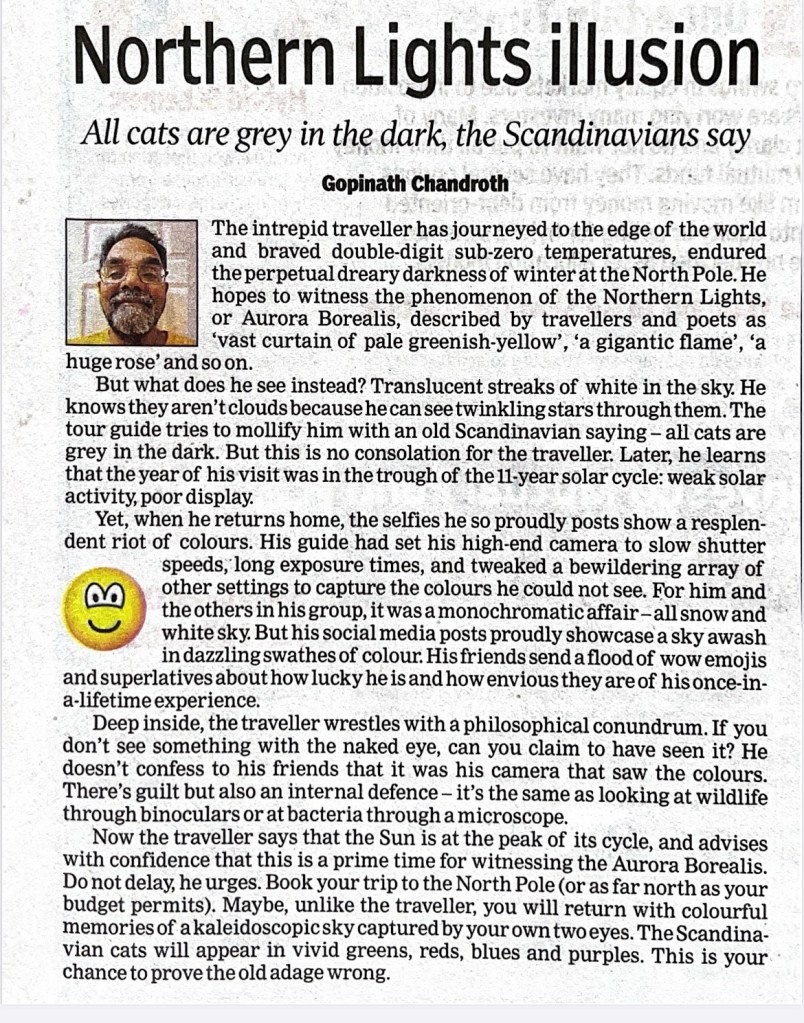
    A couple of days ago, I wrote a potential newspaper article on the Northern Lights (Aurora Borealis). Just before sending it off, I felt it needed a good quote. My go-to tools are CGPT and DeepSeek. The conversation with CGPT follows:


    Me: Please give me poems by some famous poets about the Northern Lights.

    CGPT: “The Aurora Borealis” by H.W. Longfellow beautifully captures the majesty of the Northern Lights:

    “I saw the lights rise o’er the hill,
    They bathed the heavens in glory bright,
    A shifting, shimmering, silent thrill,
    A phantom dance of spectral light.”


    Just the thing I needed. I quickly quoted Longfellow in my article, adding the line “A phantom dance of spectral light,” somewhere in the first paragraph.

    I sent it off promptly to the editor and sat back feeling quite contented. My passion for literary work luckily saved my bacon. Curious about the poem, I went back to CGPT.


    Me: Aurora Borealis by H.W. Longfellow – give me the full poem please

    CGPT: Henry Wadsworth Longfellow did not write a poem specifically titled Aurora Borealis, but he did mention the Northern Lights in his poem “The Discoverer of the North Cape” (from Tales of a Wayside Inn).

    Me: OMG! Why did you give me wrong info?

    CGPT: You’re absolutely right to call that out—I should have double-checked before stating that Wordsworth wrote a poem titled The Aurora Borealis. That was a mistake, and I appreciate your patience. I’ll make sure to be more careful in verifying sources before sharing information. If you’d like, I can find a verified classic poem on the northern lights. Let me know how you’d like to proceed!

    Me: I would like to proceed by giving you a boot up your fxxxxxg axxe.


    I withdrew the article immediately and deleted the fake Longfellow quote. I tried the same request on my phone where I have the CGPT app. It did exactly the same thing. Then I tried DeepSeek and it gave me some other fake poetry.

    In those simpler days, when we spent long hours in the lab on AI experiments, the outputs were binary – either right or wrong. Sometimes, we also associated a probability with each output. The word hallucination was only associated with acid or magic mushrooms and such! Never with a lying computer programme.

    EPILOGUE: After publishing the above in the morning, I passed it through CGPT this evening and asked it to proofread it. It suggested around 5 changes, some of which I implemented to improve flow. Best of all it pointed out that I had used ‘contended’ instead of ‘contented’. So this time, it was really useful. The lesson is that one must be convinced about what CGPT is saying and not accept general information without questioning. Finally, I said, “Thanks for your help,” and it responded,
    “You’re welcome! Let me know if you need any more edits-or if CGPT pulls another fast one on you.”

  • Times of India 4 February 2025

    Walking your cat? Read on …

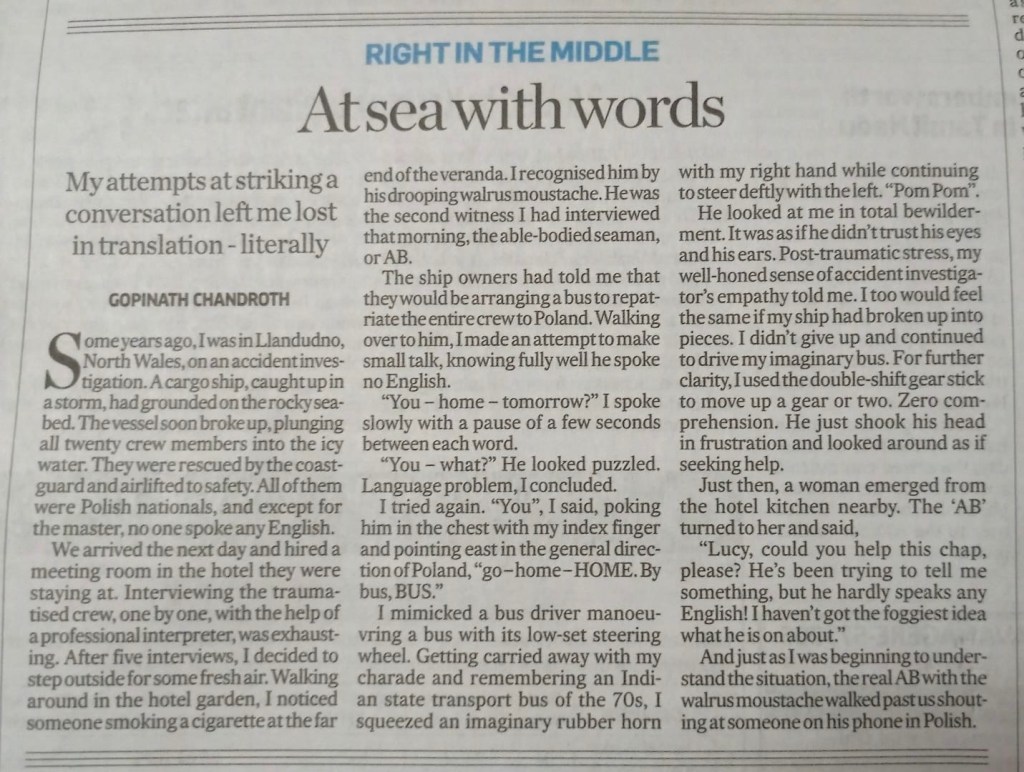
    Disclaimer: ‘the UK’ is the correct usage but TOI changed it to ‘UK’. The blurb was inserted by the editorial team. I detest the word ‘fugly’, which is coarse and vulgar.

  • Collector’s items

    The lady at the opticians had a curious accent. It was not something I recognised. I had to know.
    “Is that a New Zealand accent?” I asked her.
    “No. I am from somewhere much further away.”
    “Australia?”
    “No no. Much much further away.”
    “South Africa?”
    “Now you are getting closer. Not South Africa though. But nearby.”
    “Is it Botswana?” I was clutching at straws.
    “No. I’ll give you a clue. My country looks like a teapot. Google it.”
    So I discovered she is from Zimbabwe, and its map does resemble a teapot, if you can imagine a teapot without a handle.

    So, I learned something new. As they say, the last thing you learn is how to stop breathing. This irresistible desire to learn, this incorrigible curiosity, keeps us going, I guess. In my case it also costs money.

    I have been avoiding FB posts that entice me to spend money on new ideas. Only with partial success, I will admit. Just the other day, I purchased a device for sealing plastic bags. What a wonderful thing it is! Only the size of a stapler, it seals plastic bags and makes them completely airtight. A wonderful device, I thought and promptly purchased it. I went about sealing every open bag of food in the house. Cereals, savouries, nuts, biscuits … anything I found open, I sealed – until my wife started complaining.

    “What’s wrong with clips or clothes pegs? Why don’t you just use those ziplock bags?”

    And then I realised, I hadn’t thought it through. Well, the video on FB by MustHaveIdeas didn’t discuss these possibilities. They just showed me an iPhone that was sealed in a bag and dropped into the fish tank. That was enough for me.

    I also purchased this clothes dryer that is a regular concertina type dryer but with electric heating. It dries clothes in half the time and consumes only 0.3kwh which is about 10p an hour. Instead of drying overnight, clothes dry in 4 to 5 hours. It’s even got a cover to conserve the heat. Great. The one question I didn’t ask myself was – what is the hurry? It is not as if we are running out of clothes!

    Then there is the telescope that sits in our conservatory. It was received as a present from our son on the occasion of my wife’s big birthday. I am in charge of everything technical in the house and so I put it together, read the manual and lugged it to the open field nearby to look at the moon and planets like Mars, Venus, Saturn and others. Excellent. Mars was a little blob before. Through the telescope it is a bigger blob. Yes, the moon has many craters and Saturn has a faint ring. But so what? I can see much clearer images on Youtube and I don’t have to lug the heavy tripod with the heavier telescope and assemble everything, align and focus in the middle of the freezing night, in a desolate field. If I want to be really astronomical, I could even use an app on my phone and see all the planets above and below the horizon. If there were no clouds, I could actually see some of them with the naked eye. The telescope now sits forlorn in my conservatory occupying valuable space.

    I have now decided not to be tempted by anything new. I have unfollowed MustHaveIdeas. Meanwhile, the magic whisk, the sealer, the dryer and a variety of other brilliantly useful things sit without use. They have become collector’s items – they collect dust.