

Author: Gopi Chandroth
-
Duality
This story attempts to illustrate how our dormant identities shape our worldview, and how transient these identities truly are. The corollary is that although our worldviews may differ, essentially it is the same world we argue about. It is only human fallibility that makes us view the world from a single perspective and deny all others. Man’s worst enemy is his dogma.
Many years ago I was visiting my sister who lived in Malakkallu (Kerala), at the southern end of the 1000-mile-long mountain range that bisects the Indian Peninsula. I had acquired a new camera and intended to capture the sights of Kerala for my friends back in London.
When I looked around, however, I saw only mundane, everyday sights: cashew fruits in bright yellows and reds, translucent orange mangoes falling in the wind, oversized and abundant jackfruits with their succulent flesh hidden by the spiked outer skin, hibiscus flowers spilling over the fences, and the occasional goat lazily nibbling at them, coconut and betel nut trees competing to canopy the clear blue skies, precarious bamboo bridges swaying in the wind, the shy touch-me-not leaves closing in on themselves on contact, and a myriad other sights. Nothing novel to photograph.
It was my sister’s 60th birthday. A priest conducted ancient Vedic rites in her honour, chanting Sanskrit verses and gesticulating with timeless gestures. The ritual fire, fed with the occasional spoon of ghee, leaped and raged. A mother hen chaperoned her chicks, feeding them grains scattered across the hard, earthen courtyard. The mountain stream flowed nearby, and a cement tank interspersed in its path sparkled with clear fresh water, forever overflowing back into the stream. The delighted cries of little children splashing about mingled with the mantras invoked by the priest.
I sat there mesmerised by the flames of the sacred fire, the air intense with the smell of burning ghee and camphor. There I was: born here, grew up here, part of the scene in every sense. I slipped into a semi-trance, induced by the evocative smells and sounds. I had moved beyond the present as I floated on the magic carpet of happy childhood memories. The spirits of my departed parents smiled upon me.
Suddenly and without warning, I thought of London. I was trudging across London Bridge on my daily march to work. I thought of my home in England: the breathtaking beauty of magnolias in April, the daffodils and cherry blossoms of spring, the robins, the swallows, and the blackbird. I was suddenly homesick! I missed my family and friends back in London. I longed for my Guardian newspaper there and then.
I was sitting in one part of the world and missing another. I was curiously happy and thankful for this dichotomy. The existential concepts of the West—free will, choice, and personal responsibility—sat comfortably with my Eastern Karma and its very diminution of the self. Sarvam Maya—“All you behold is an illusion”—seemed more palatable in that fleeting moment. I observed the dualities of my mind with an objectivity that comes to one at rare moments. I felt thankful for everything: for my past and my present, for my mental reconciliation of divergent philosophies, and above all for my feeling of comfort with them.
Almost without thinking, I started seeing the sights I had grown up with as if for the first time. I photographed everything—the jackfruits, the cashew, the untranslatable vegetables, and the misty mountains. Even the stark, unforgiving laterite soil where I had grazed my knees as a child.
I was a complete man of dual identities—both transient, both illusory.
-
Rochefort
Over the years, I’ve realised that stately homes and mansions hold little appeal for me. Where someone slept, cooked, or entertained simply doesn’t interest me. Plush Persian carpets, silver cutlery, and crystal glassware do nothing – except perhaps stir a faint twinge of envy.
So, when told that we were visiting the “Maison de Pierre Loti” in Rochefort, about 70 km south of Luçon, my first reaction was not delight but a fake “Nice.” Pierre Loti, the darling of Rochefort, was the nom de plume of Julien Viaud (1850–1923), a French naval officer, novelist, and travel writer known for his exotic, romanticised depictions of foreign lands.
When my host returned from his laptop looking crestfallen and announced that all entry tickets were booked until the end of August, I had to work hard to match his disappointment. “What a pity,” I said, summoning an appropriate drop of the lower jaw, while internally smiling in relief. I really should’ve gone into acting.
Envy in one paragraph, fraudulent behaviour in the next two – I’m not exactly painting myself in a flattering light, am I?
We travelled to Rochefort and found lunch in a modest bistro. While the others tucked into hearty meat dishes, I was faced with a goat cheese salad. I do have a weakness for cheese, but goat cheese remains an outlier. It’s one of those strange substances which though mostly odourless, tastes like the smell of a goat. It conjures the unmistakable presence of a goat—perhaps under the table, or lurking just behind the chair. With no other vegetarian options, I ate my salad while trying hard not to think of goat – a difficult feat, given one seemed to be right there with me in the room.
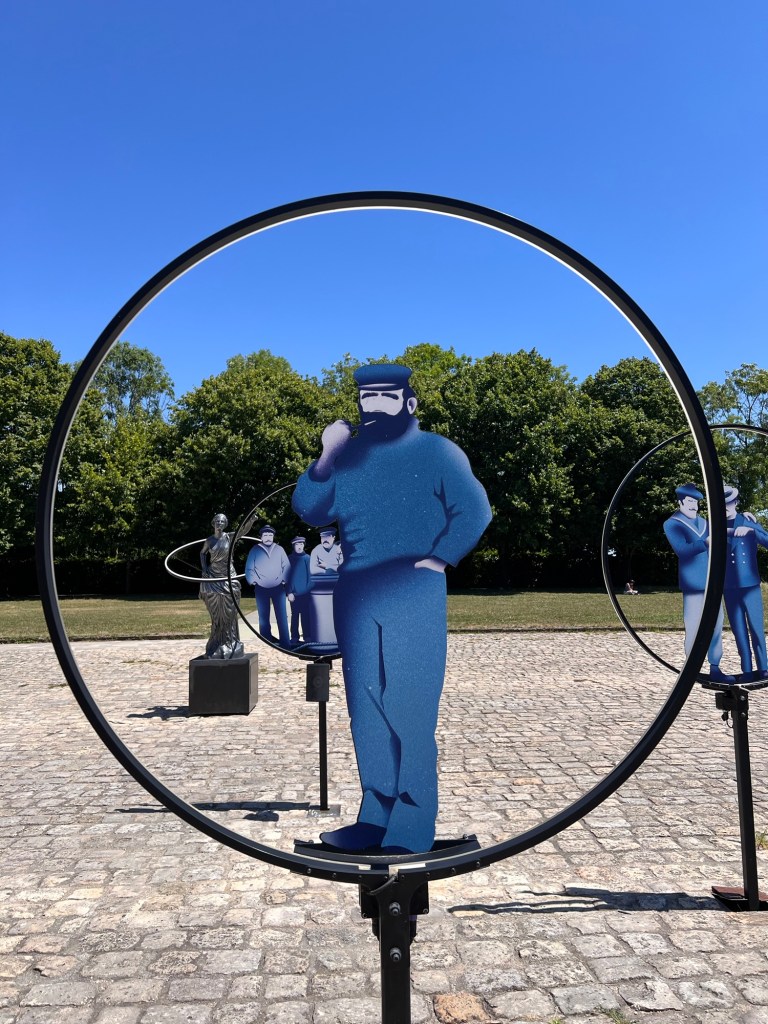
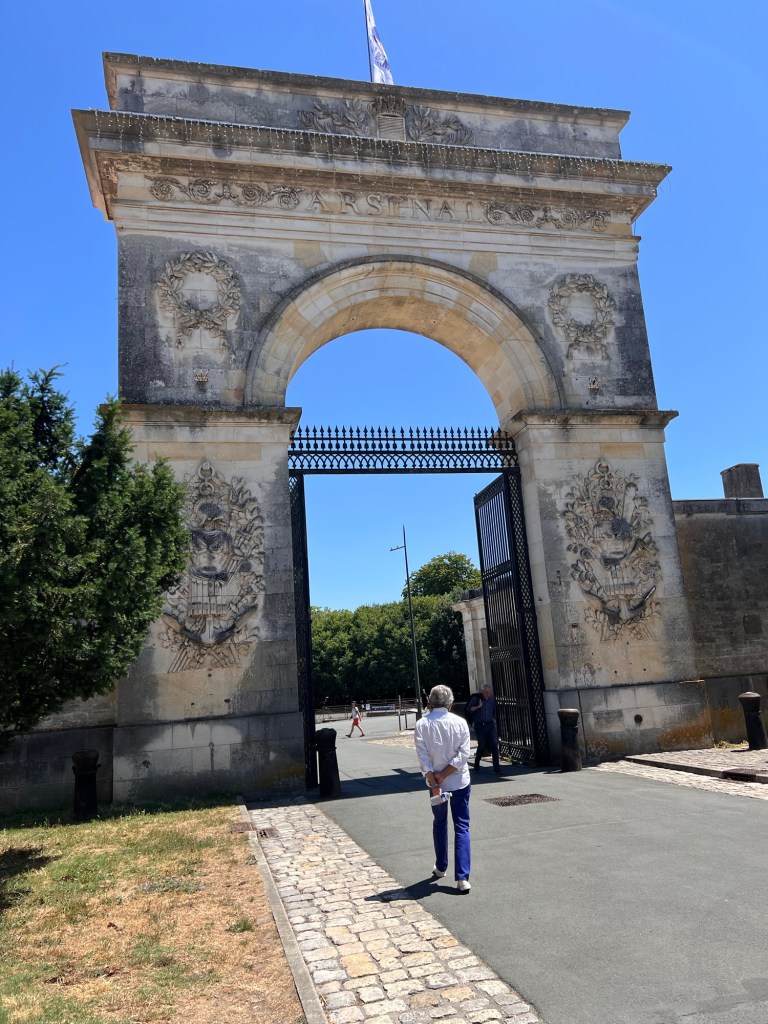
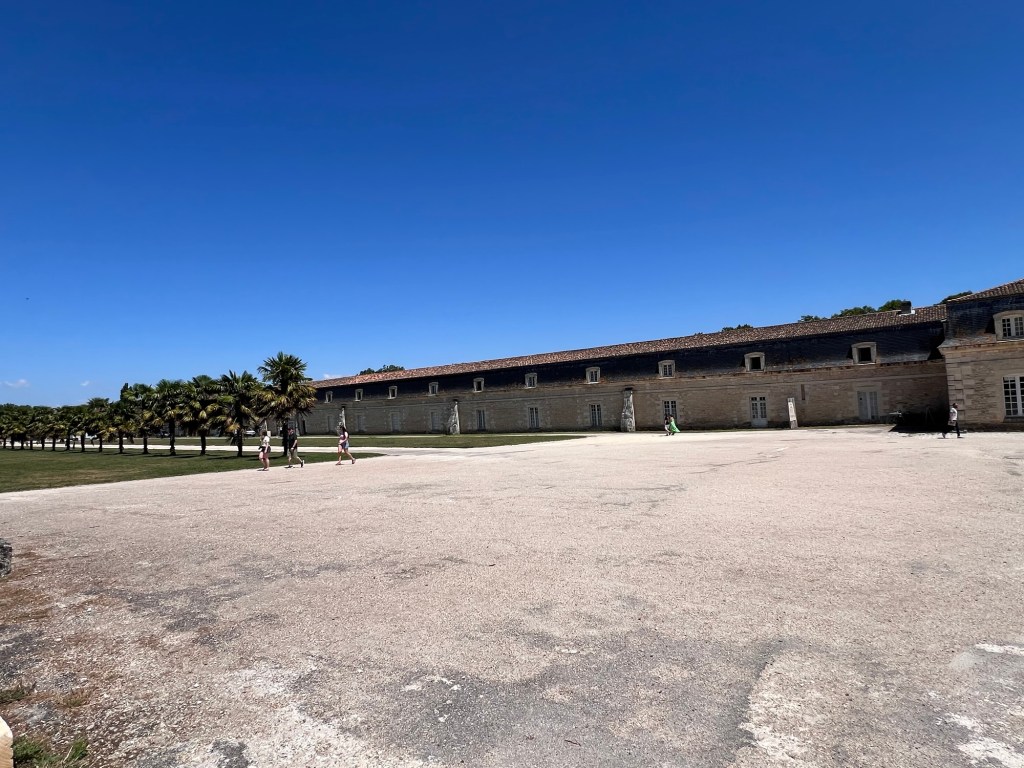
Next stop: a museum. Where else? Two art historians and an archaeologist were in charge of the programme. Fortunately, the Arsenal de Rochefort proved interesting. The pre-Revolution naval base, built on the orders of Louis XIV in 1666, and set beside an estuary, includes a 374-metre-long rope-making factory – the longest building I’ve ever seen. Metal cutout figures of Captain Haddock, Tintin, and other nautical figures welcomed us in the courtyard.
We then visited the Musée Hèbre, which turned out to be a revelation. It houses a fascinating collection of Aboriginal art from Australia and artefacts of ethnographic interest from across the Pacific islands. In that section of the museum I felt like I was peering into another world. One object, a ‘pahu’ drum from French Polynesia, oddly reminded me of the long cylinder liner of a two-stroke marine engine complete with exhaust ports.
As it happens, the Musée Hèbre also coordinates visits to the house of Pierre Loti. We casually mentioned we hadn’t managed to get tickets – and were informed that due to cancellations six places had opened up for the 16:30 tour.
I feigned, once again, an exclamation of delight. But as it turned out, my concerns had been misplaced… (continued).


-
Pierre Loti of Rochefort
– continuation of Rochefort and conclusion –
My earlier post on Rochefort ended just before our visit to the house of Pierre Loti, the most famous citizen of the city. The house was under renovation for 10 years and had only opened in June 2025. Who was Pierre Loti, and why do I feel compelled to write about him?


I will answer the second question first. Loti travelled the world on ships as a naval officer, wrote extensively on the places and people he visited, and brought back exquisite artefacts from each of these places. As we were guided through his house, which was crammed full of these objects, I couldn’t help finding some parallels with him in my own career. I too was lucky to visit exotic places around the world during my seafaring career; I wrote about the places I visited, but only in letters to my wife (then girlfriend) and my parents. Loti was elected to the Académie Française in 1891, in recognition of his literary talent. OK, that’s where the parallels end. I wasn’t even elected to our college mess committee! Nevertheless, I felt a certain kinship with the man.
I haven’t read any of his works, having only become aware of him during my recent visit to his city. But I understood the close affinity he developed for the people of the countries he visited. Those were different days. Loti lived between 1850 and 1923. I was born more than a hundred years after him. His naval vessels stayed in ports for months at a time. Mine – vessels of the merchant navy – stayed 10 days if we were lucky, and often only a day or two.
Loti was once threatened with dismissal from the French Navy for publishing a series of articles in Le Figaro about the atrocities committed by the French in North Vietnam – just the type of man I admire.
I could empathise with Loti for wanting to become one with the locals, adopting their customs and sartorial habits. I too went ‘native’ when I visited foreign countries, often travelling by the local bus, visiting places of religious interest, and conversing with the locals in mime or whatever smattering of the local language I had picked up.
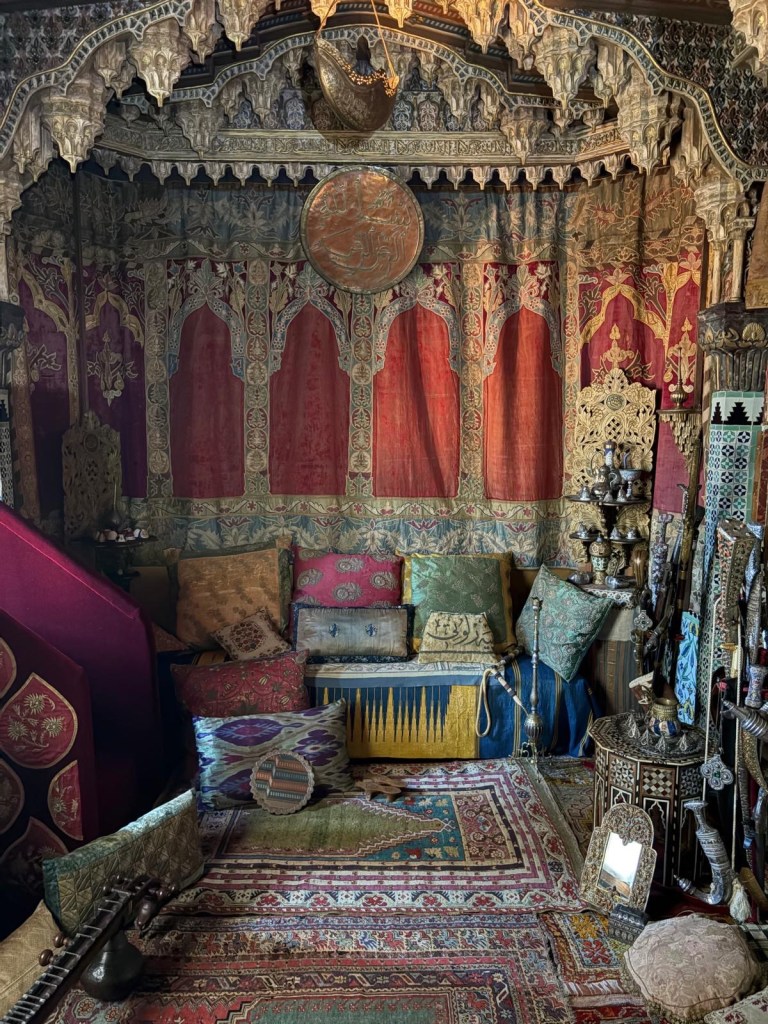
Loti, like me, didn’t practise any religion. But he was fascinated by Islam, and one of the rooms in his house had a veritable mosque in it, complete with a mihrab. I sometimes pine to hear the melodious azan, the call to prayer from the mosque. It reminds me of my childhood in India, when religion was not practised on the streets as it is today. I’m often enthralled by the weird and wonderful rituals practised by people of all religions. I have visited synagogues, churches and mosques; Tao and Shinto temples; Buddhist, Jain, and Zoroastrian places of worship. I love to visit ancient Hindu temples, more for their architecture than for the gods they house.
I won’t describe the rooms in Loti’s house but will refer you to the photographs included with this post. The experience of peeping into his life left me with the same feelings I had when we visited the Clive Museum (of Loot) in Powys, Wales. Although I had no claim to Tipu Sultan’s sword or the jewel-studded tiger-head finial of his throne, I somehow felt the objects belonged more to me than to Clive. Similarly, looking at the objects in Loti’s house, I couldn’t help but feel that I too had a claim to the places he visited – I shared his intuitive sense of camaraderie with the locals.
-
Green Venice
In Malayalam, there is an old idiom that translates to: the patient desired milk, the doctor prescribed milk.
When I woke up yesterday, I thought to myself, “I would like to visit some wetlands nearby.” I am writing a children’s story on ecosystems and wished to immerse myself in the subject. ChatGPT suggested the Marais Poitevin, the second largest wetland in France, with some 800 km of canals. Quite serendipitously, our hosts had the same idea—independently!
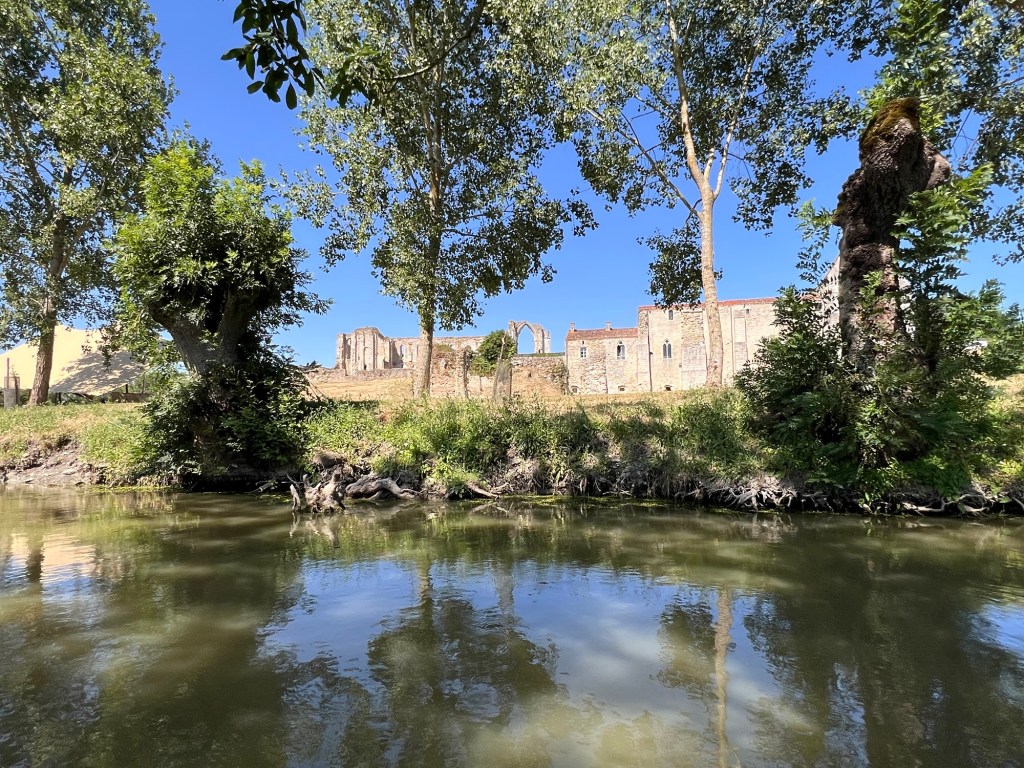
We drove to Maillezais, the site of a tenth-century Benedictine abbey, now in ruins but still grand in appearance. The monks were responsible for draining the saltwater marshes and creating the network of canals.
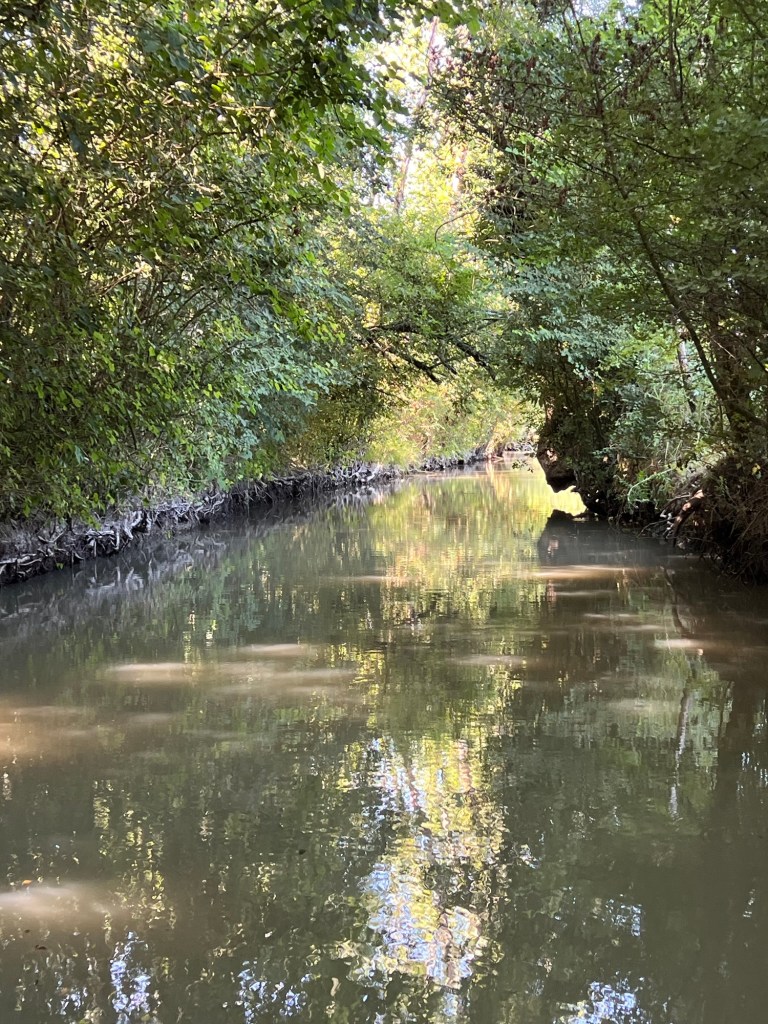
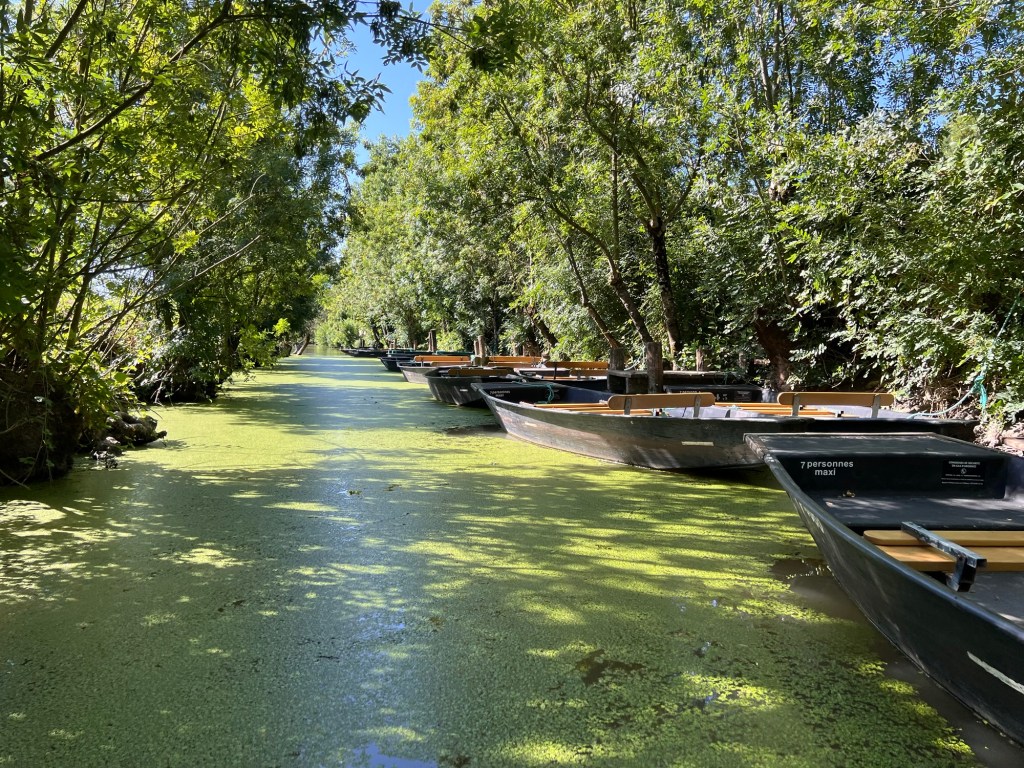
We boarded a flat-bottomed boat—a punt—skippered by Paige, a schoolgirl of 16 or 17. I can’t even begin to put in words the scenery: the canopy of willows and ash trees on the banks, the waters at places covered with duckweed that, as our boat glided through, felt like we were in a green tunnel on the way to heaven. No wonder it’s called Green Venice.
The 3 km trip took us an hour and a half to complete. A delightful experience.


-
Rest Day
It was meant to be a day of rest after the trip to the market, but the oyster episode kept me on my toes for the rest of the day. I consumed an entire box of mints.
At the entrance to the market was a man asking for money. I said, “No français,” to sidestep the awkwardness of refusing him. He switched to impeccable English and asked, “Have you got three or four euros?” I quietly slipped the 50-cent coin I’d intended to give him back into my pocket.
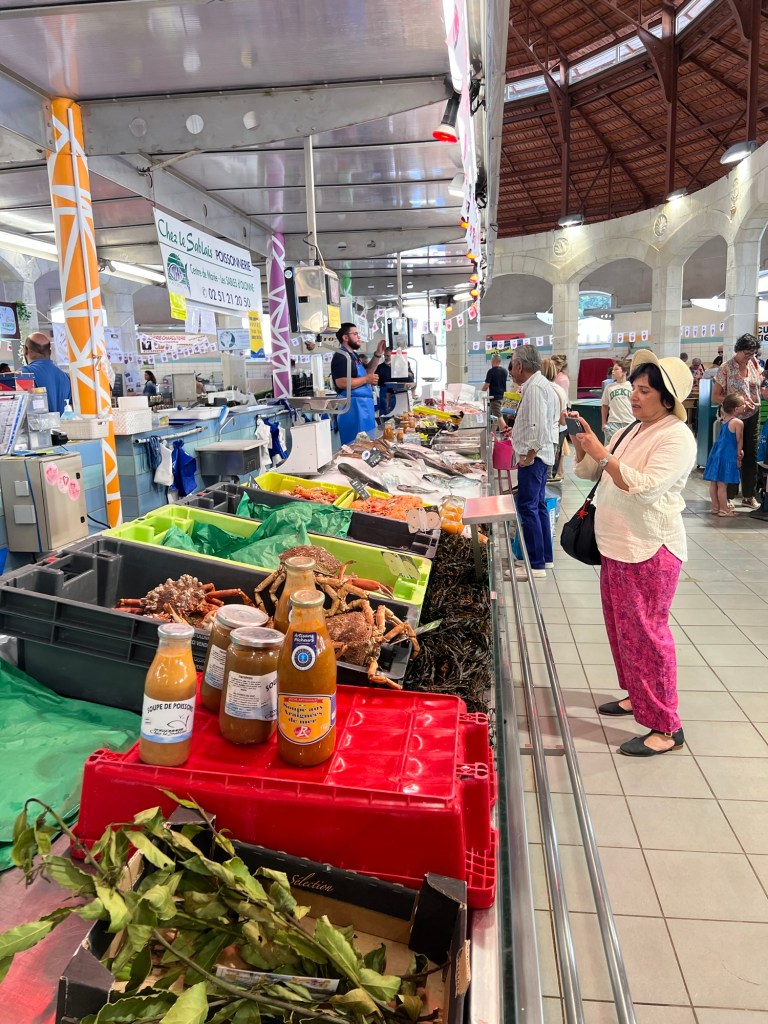
The market itself was overflowing with local produce. My brother-in-law bought generous quantities of vegetables I consider exotic: celery, celeriac, fennel, beetroot, artichokes. I say exotic because I never buy them back in England—I simply don’t know what to do with them. He, on the other hand, has an intimate knowledge of how to transform them into salads and simple dishes.
Herbs like dill, basil, parsley, and others found their rightful place in both salads and lightly cooked vegetables. Beetroot, which usually tastes of mud to me, was miraculously transformed: he boiled it, dressed it with olive oil, vinegar and lemon, and served it with boiled eggs. The result was a delectable salad.
I won’t dwell on the three quails I saw going into the oven—I made a hasty retreat to the rear garden under the pretext of writing this bulletin.
A brisk walk in the local park completed the day. There is a certain charm to these parks, which I can only attribute to the refined aesthetic sense of the French. The topiaries were especially imaginative, some even illustrating little fables displayed nearby.
Excellent wine and good food served in the garden, accompanied by bird calls and the soft sound of a water feature, brought the evening to a perfect close.


-
Oyster and me
I have a policy: not to expand the list of of marine animals I consume. I am a vegetarian at heart, but I do eat fish and a couple of crustaceans. I have no desire to taste new things. So when I asked the fishmonger at the Luçon market, in broken French and mime, whether one must cook the oyster before consuming it, he cracked open one with his pen knife and offered me the real thing. He obviously thought I was asking to taste one. That put me in a difficult situation. The last thing I wanted to do was offend the man by refusing it.
I received the half with the slimy mass – like raw egg white mixed in with some black stringy stuff and brown translucent blobs. I looked for an exit. I asked weakly if he wanted me to swallow the lot hoping he would say that it was up to me. He just said ‘oui oui’ and I knew the game was up for me.
I transferred the contents into my mouth. Disgusting doesn’t come anywhere near expressing what it felt like. Fortunately, the overwhelming taste was that of sea water. I can’t remember anything else in the taste department except that I knew I had a live creature in my mouth. But it couldn’t stay there. I had to spit it out or swallow it. As I said, my intention was not to offend. So I swallowed the lot.
I summoned a fake ‘so tasty’ expression on my face if only to please the man. But then a strange aftertaste lingered. I retched. My face twisted, and grimacing, I pushed out my tongue – all in one smooth involuntary movement. That probably saved me from throwing up on his large oyster collection. He got the message.
How much? I asked.
He pointed to the price on a piece of board: €6.90 for a kilogram.
No no! Just for the bit I ate. I mimed.
Oh! Nothing.
For the next hour, I watched for internal reactions. Did i feel something moving inside me? Or was it just my imagination? Did my stomach hurt a bit? No. Just imagination.
Never again to oysters. Octopus, eels, turtles and everyone else – you will remain strictly outside my menu. The next time I am curious about something, I’ll just go to YouTube.

-
La Rochelle
I stepped out for a café au lait yesterday morning. Even a simple act like that can lead to some complicated situations when one doesn’t speak the local language. I wanted oat milk in my coffee because that’s how I drink my coffee at home. I looked up the word for oat milk – lait d’avoine, pronounced leh dav-wen. The woman at the café didn’t understand my rendition of the word and so I asked her if she spoke any English.
“Yes, yes. Left, right, up, down. Thank you. Bye-bye,”
she replied proudly. That was the limit of her English – comparable to my French, perhaps. Anyway, I managed to establish that she only had regular milk. The coffee hit the spot. I was ready for La Rochelle, our destination for the day.La Rochelle, literally translating to ‘The Little Rock’, is around 42 km south of Luçon. The town has an interesting but turbulent history. Set up in the 10th century, it grew into a stronghold for the Huguenots (Protestants) by the 16th century, declaring independence from Catholic France. The subsequent siege by the army of King Louis XIII starved and reduced a population of 28,000 to 5,000. Although England sent a contingent to help their Protestant brethren, they were badly defeated.
Protestant political power was thereby broken and La Rochelle became an integral part of France. But enough of history!
Our visit started with lunch at Café de la Paix. I had a large bowl of Moules Marinières (mool mah-ree-nyair), a classic French dish of mussels cooked in white wine, cream, garlic, shallots, parsley, and butter. It was not the easiest dish to tackle. Any semblance of elegance was quickly jettisoned and I tackled the delicious dish with both hands. I’d checked in advance that it’s highly unlikely mussels experience pain, so I enjoyed my lunch without guilt and washed it down with a generous helping of white wine.
After lunch, we visited the old port protected by twin towers, across which in the olden days chains were stretched to prevent enemy ships from entering. La Rochelle is a bustling city and somehow the old medieval gates and towers lent it an air of authenticity and living history. Squawks of seagulls mingled with the sound of church bells.
Then I saw signs for Hôtel de ville. I had seen the same sign in Luçon and you can’t blame me for thinking it was a chain of hotels – like Premier Inn! Fortunately, I was informed by my erudite hosts that a hôtel is a large mansion and Hôtel de ville is actually the Town Hall. One lives and learns. La Rochelle’s town hall was established back in the 13th century and the Gothic towers and walls remind one of the town’s fiercely independent past.
We walked into the Saint-Louis Cathedral. A small funeral service was going on. The incantations of the officiating priest rendered the atmosphere sombre. For a brief moment, I partook in the grief of the people gathered near the coffin. The thought that death is the final destination for everyone had a sobering effect. I quickened my pace a bit, almost as if to gain more time to live, until my time is called.
Walking around La Rochelle, I thought of the centuries of trials and tribulations the old town has lived through. In some strange way, I too felt a trace of that history.


-
The Purchase of a French Village
William Christie, an American art historian and musician, moved to France in 1971 in protest against the Vietnam War. William – or Bill, as he’s known to his friends – set up Les Arts Florissants in 1979. The foundation runs a Baroque music festival each year in Thiré (Vendée prefecture), near Luçon, where we are visiting my brother-in-law and his friend, also reputed art historians.
The forty-minute drive to Thiré gave us an intimate view of the countryside. The spectacular view of sprawling fields of hundreds of thousands of sunflowers had a mesmerising effect. The flowers, in full bloom, stared up at the sun like some classical danseuses paying obeisance to the Sun God.
Little did I foresee then that I would soon be witnessing the makeover of a village acquired by the foundation. Many of the properties in the village were purchased by the foundation to board musicians participating in the week-long festival, Dans les Jardins de William Christie, which is held in late August each year.
William Christie purchased and converted a once-dreary farmland in Thiré into an exquisite garden – lakes with families of swans, oak and elm woods, and a river that meanders through the 25-acre property. The swans floated about in the lakes as if they, and not Christie, owned the property.
I imagined the concerts of 17th-century music performed on the premises: by the lake, within the woods, inside the charming cloisters with intricate, labyrinthine formal French gardens, in the village church. I saw, in my mind’s eye, the proliferation of roses in full bloom – their fragrance embellished my reverie.
In the solitude, only softened by the rustle of the leaves in the trees, gentle murmur of the river, trill of songbirds, I almost heard the captivating music of Purcell, the sparkling soprano arias of Bach and Handel. The music that played in my head somehow reinforced the solitude – didn’t disturb it. I saw the faces of aficionados listening with rapt attention – some with their eyes closed, some leaning forward as if to catch all the notes that twirled and floated in the cool evening breeze. An opalescent sky formed the backdrop.
Did I worry about the locals of the village – that their ancestral land had been bought up by an American foundation? Yes, I did.
“It’s better than converting it to a golf course,” I answered the trouble-maker, my inner socialist.
I was made aware that the foundation is only purchasing properties coming up for sale and restoring them. Otherwise these buildings might have fallen to ruins or made way for new construction.
I must return to Thiré one year during the festival, if only to validate my imagination against reality. It can only be more vivid, for what I picture is limited by shades of what I experience. I can but glimpse a small part of what truly might be.