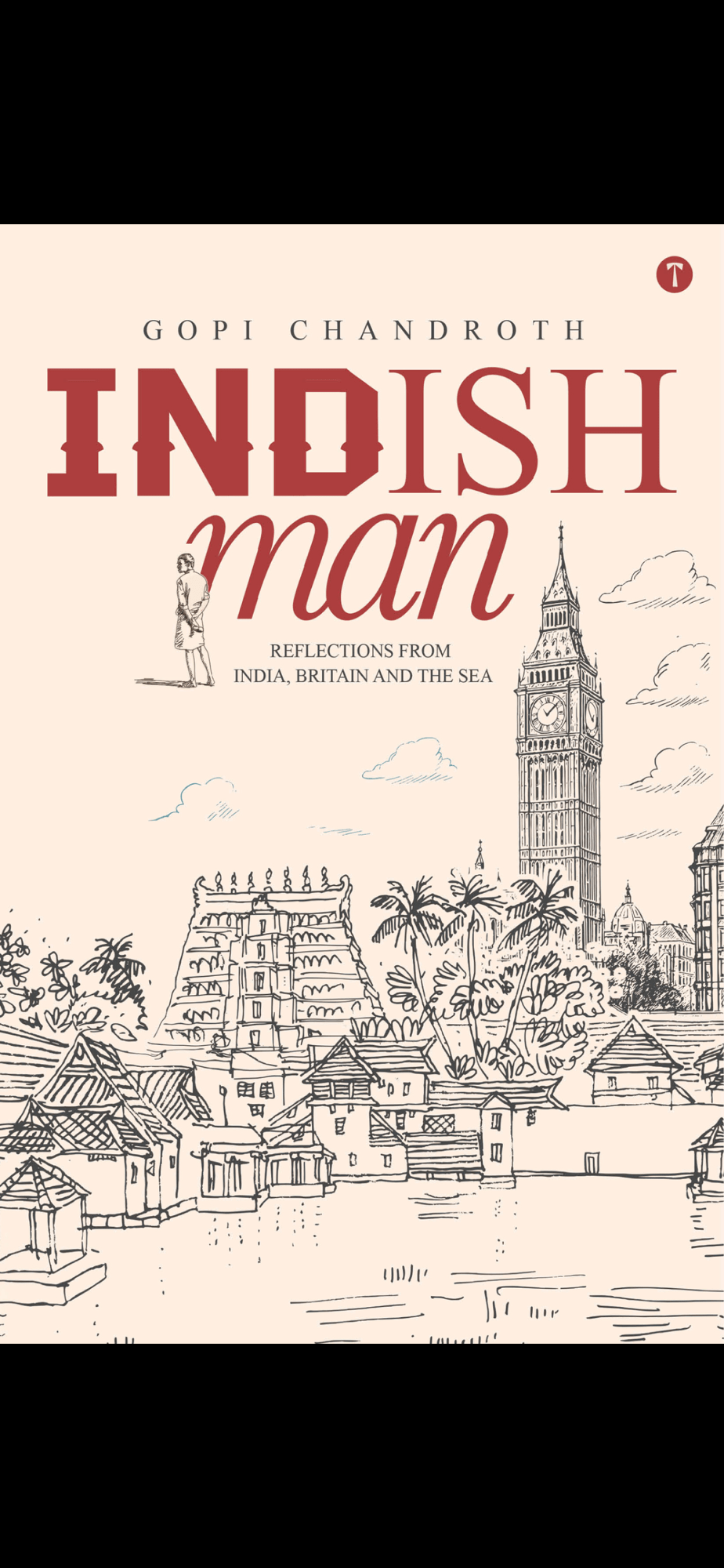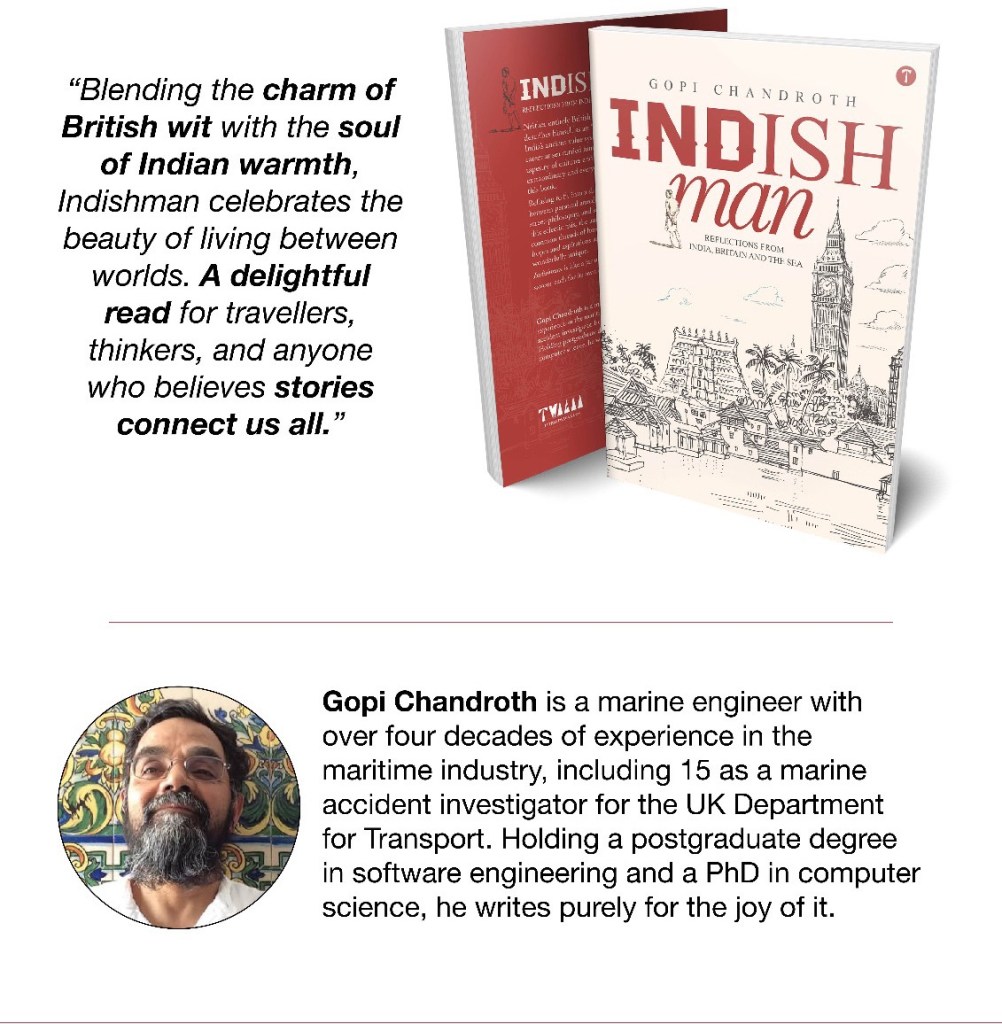
My collection of stories. Now available in paperback and Kindle.
From ships to quiet corners of Britain and India, Gopi Chandroth sees the world in all its hues. Indishman gathers those stories – part memoir, part travelogue, part street philosophy – each told with humour and warmth.
Set sail with Indishman – available now in print and ebook.
Order from Amazon worldwide. Search for INDISHMAN.
Or if you are in India, buy direct from the publisher TWAGAA
We worry when we forget things. Going upstairs to look for something but forgetting what we came up for. Searching for the phone while talking to someone on the very phone. Forgetting appointments despite making diary entries.
‘How come?’ you ask, incredulous. We forget to check our diary.
‘Talk about yourself,’ you complain.
OK, I’ll use first person singular.
I’m not talking about forgetting as in ‘forget and forgive’. The topic here is the pure and honest form of not remembering, or alternatively, remembering things earlier than required – like arriving at a training course a day too soon. Let me demonstrate anecdotally how forgetting can work in your favour.
A colleague and I had visited Oban in Scotland for an accident involving a small fishing trawler. Oban has an out-of-this-world beauty. The lochs and glens viewed from the passenger seat of a car are breathtaking. My colleague, like most of the male colleagues I worked with, preferred to drive. Now, don’t start doubting my driving skills – most of my colleagues were serious alpha males.
Every day, we drove the ten miles from our hotel to the vessel and back. I enjoyed the scenery, untrammelled by the rigours of driving or having to keep my eyes on the road. I simply drank it all in. Each day, the sights held a fresh appeal. On the last day, I said to my colleague,
‘Wow! Just look at the scenery. I have never seen such beauty.’
He looked at me with a slight frown and remarked,
‘Mate, we’ve been driving the exact same route for five days and you talk as if you’re seeing everything for the first time.’
That precisely defines me. Without making a conscious effort, I do see everything as if for the first time. As J Krishnamurthy, the philosopher, has said:
‘Freedom is found in seeing without comparison – without the past interfering.’
A couple of weeks ago, I was asked to do a fasting blood test. I made the appointment at Winchester Hospital using an automated telephone service. The first available appointment was at 3:30 pm on Tuesday. The follow-up appointment with my GP was fixed for Thursday morning. I entered both in my diary, forgetting to note that the blood test required me to fast for 12 hours.
Last week, some writing friends suggested we meet for coffee.
‘How about Thursday morning?’ asked one.
‘Fine,’ I replied without checking my diary.
After the time and venue were decided, I noticed I had a GP appointment at precisely the same time. So, I wrote to my friends.
‘I’m a total idiot, I can’t make it to the coffee. Double-booked. You guys go ahead.’ Grovel, grovel.
On Tuesday, I drove to the hospital for my blood test.
‘Have you fasted?’ asked the nurse. She seemed impressed that I had remained without food for most of the day.
‘No, it’s 3:30 pm. How could I fast so long?’ I responded mildly belligerent. How could she even suggest it?
The nurse told me to go away and return on another day.
‘Don’t forget – you can only have water 12 hours before your blood test.’
I called the GP surgery and apologised – no point seeing the doctor without blood counts. Grovel, grovel. They fixed another blood test and a follow-up appointment for this week. Bless our NHS.
I had an enjoyable morning with my friends, showing off a copy of my book Indishman – Reflections from India, Britain and the Sea.
I personally know someone who has seen Andrew Mountbatten-Windsor naked. They were shipmates in the Navy, freshening up in the changing room after a game of squash – long before the metaphorical stripping of the latter’s royal appurtenances. Talk about foreshadowing.
There has been a tectonic shift in the British perception of the royal family. While politicians are regularly heckled, have eggs, milkshakes and sometimes punches thrown at them, people generally respected the royals. There are also those who don’t care for them. However, they usually stay at home and don’t throng the streets swooning over the anachronistic pomp and pageantry.
Untrue Andrew has dragged the entire clan down to earth from their exalted citadels. People have woken from their dream state and suddenly realised that kings and queens are people too. Remember Albert Camus in The Outsider? His protagonist, a prisoner on death row, talks about the judges who condemned him: 𝐴𝑙𝑙 𝑡ℎ𝑜𝑠𝑒 𝑝𝑒𝑜𝑝𝑙𝑒 (judges) 𝑎𝑟𝑒 𝑗𝑢𝑠𝑡 𝑙𝑖𝑘𝑒 𝑡ℎ𝑒 𝑜𝑡ℎ𝑒𝑟𝑠, 𝑝𝑒𝑜𝑝𝑙𝑒 𝑤ℎ𝑜 𝑎𝑙𝑠𝑜 𝑐ℎ𝑎𝑛𝑔𝑒 𝑡ℎ𝑒𝑖𝑟 𝑢𝑛𝑑𝑒𝑟𝑤𝑒𝑎𝑟.
Perhaps that’s why King Charles III was recently heckled when he visited Lichfield Cathedral in Staffordshire, England.
“How long have you known about Andrew and Epstein?” the protester harangued the King. “Have you asked the police to cover up for Andrew?”
Unthinkable until Untrue Andrew – the favourite son of our late Queen – ruptured the royal chrysalis and demonstrated what a complete prat he really is.
I like Charles, or at least I appreciate his candour on sensitive international issues. I should speak in the past tense, though, because that was when he was Prince of Wales. He has now been effectively silenced after being secured in the king-box. He chose kingship over free speech. Poor man.
Personally, I have been indifferent to the royal family. I know some of my British friends may be fans of the royals, and my intention is not to cause hurt. But when we remember the atrocities committed all over the world in the name of the King or Queen, you will understand why I am not a royalist.
In a sense, Andrew has done us all a favour by his callous and unacceptable behaviour. He has exposed a deep crack in the institution of the monarchy, and we can all look into the royal changing rooms. No patching up will work now – not even if Andrew were investigated and exonerated. Fat chance of that happening, though, because he has already been found guilty by the 𝘷𝘰𝘹 𝘱𝘰𝘱𝘶𝘭𝘪.
All the King’s horses and all the King’s men cannot put Andrew back together again.
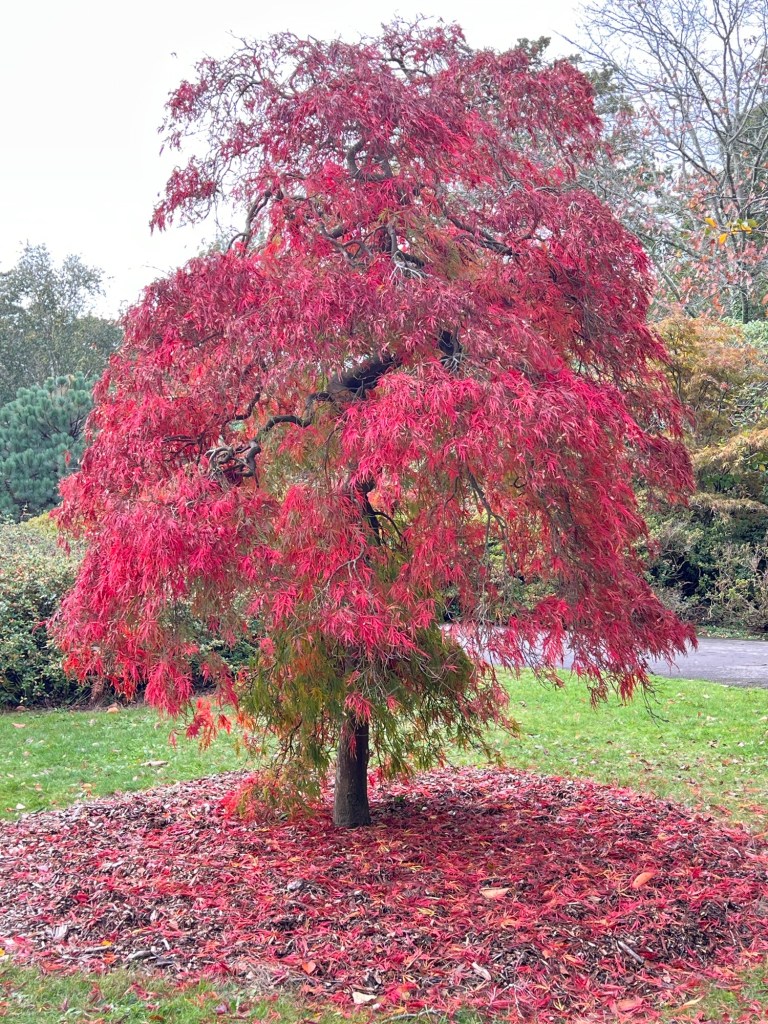
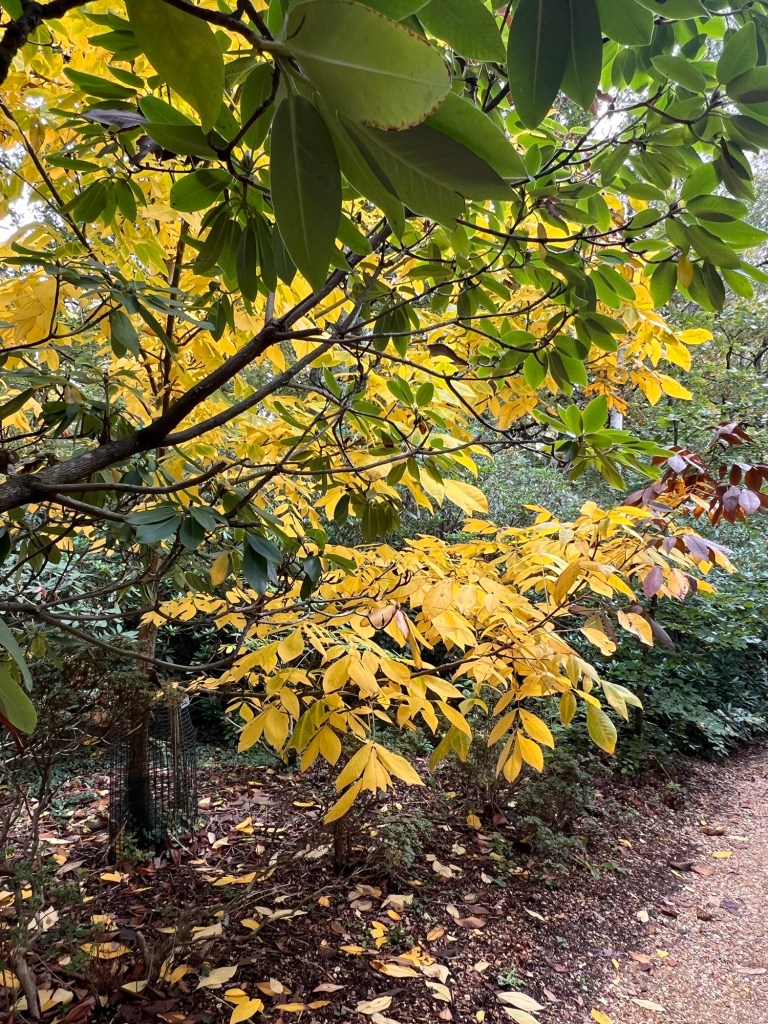
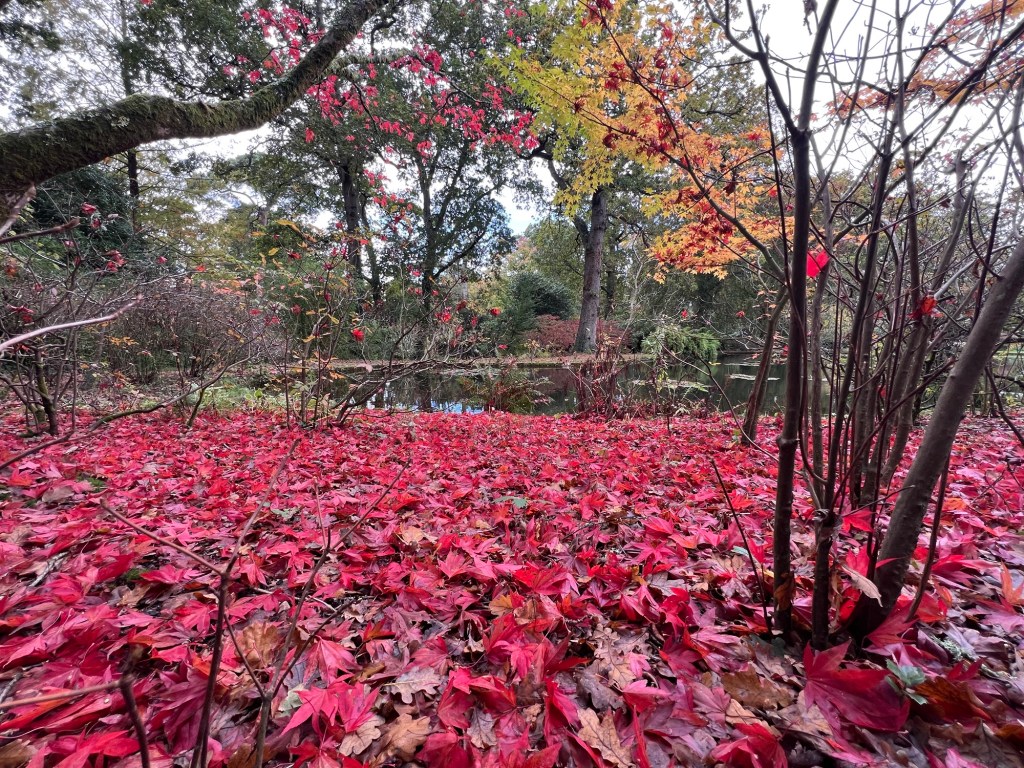
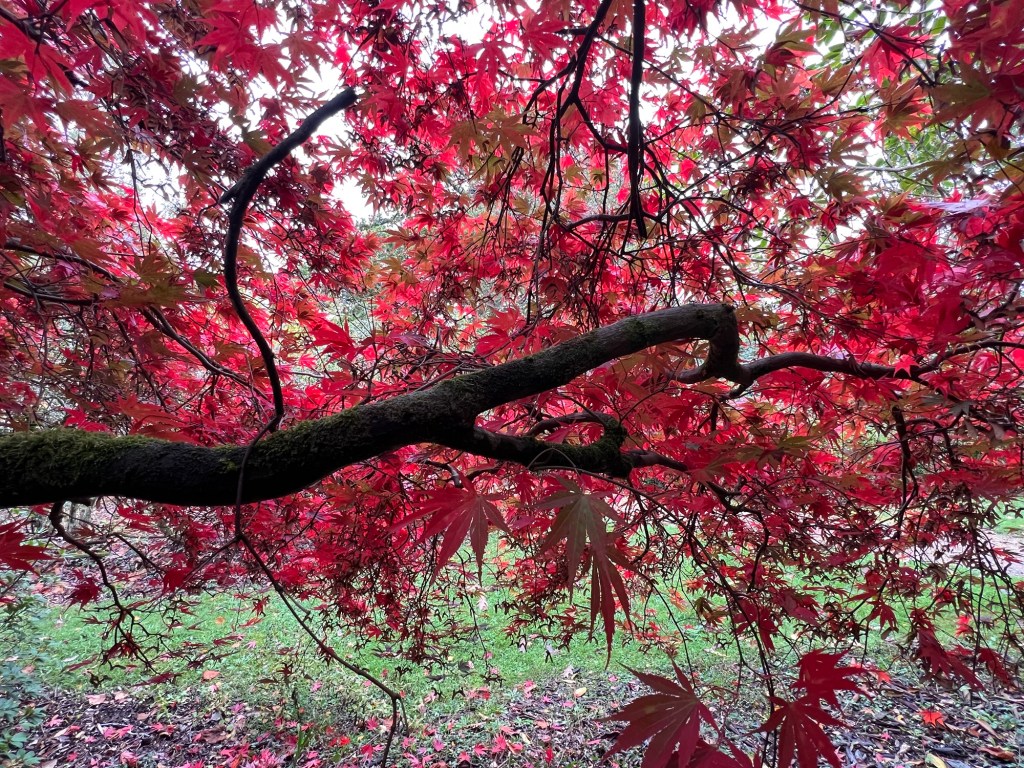
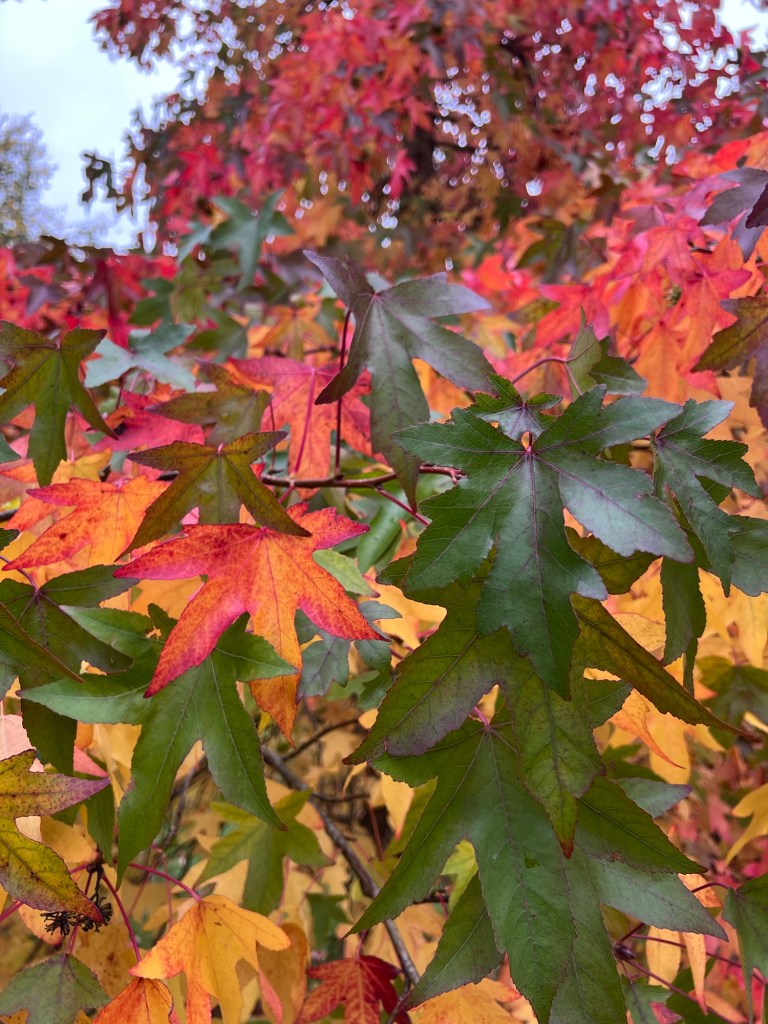
Autumn colours stop me in my tracks. I’m not usually fond of yellows and reds, yet when the leaves turn yellow, I’m captivated, mesmerised, gob-smacked. It’s as if the tree has absorbed all the yellows in the neighbourhood – a pure, blazing yellow, the yellowest of yellows. And when those same leaves deepen to ochre, umber and orange-red, they imbue the air with enchantment.
Every shade appears at once on the same tree – as if some leaves are clinging to the comfort of summer while others bravely embrace winter. Green leaves yet to change, golden intermediates, the final dazzling reds ready to fall with the right flick of wind – I feel I’m witnessing a painting by one of the great masters. For an ephemeral moment, I wonder: am I in the National Gallery savouring a Monet, or in a garden hypnotised by the riotous colours of autumn?
But that’s not the whole picture. I haven’t mentioned sunlight – the quiet protagonist in this drama. It’s not the harsh sun that beats down on the head, but a gliding, warm light that renders the leaves translucent, their surfaces trembling in the gentle breeze.
Ah, would it ever be possible to describe the joy this sight induces, the reassurance it provides – that time gently ushers the seasons along, that what I witness today will soon yield to the strong winds of late autumn, carpet the ground with its munificence, and give way to the starkness of winter, when beauty of a different kind plays out the eternal cycle of seasons.
I can handle almost everything: temper tantrums, grief, mockery… However, I don’t know how to handle insinuation. If anyone has a foolproof method of dealing with this particular form of taunt, please tell me, for I consider it a taunt by someone who does not have the courage to openly accuse me of something but does it anyway. I am unable to respond in any constructive way because the moment I challenge the insinuation, the other party will deny it.
Consider this sentence I found in a Sanskrit study book: खलाः सुरां अपिबन्, which means ‘The wicked drank alcohol.’ Now why am I unhappy? Because the sentence presupposes, without explicitly stating, that only wicked men drink alcohol. I understand this is called presupposition in modern linguistics. It is a loaded sentence that is trying to impose a cultural or moral bias on me. The bias is built into the lexical choice. If it had said ‘only wicked men drink alcohol’, I would have torn up the book. But I can’t do it because all it says is that some wicked men drank alcohol. Insinuation – I hate it.
Another example: I once wrote an accident investigation report while employed at the Marine Accident Investigation Branch. A colleague read it and said to me: ‘It’s an excellent report. Did you write it?’ How was I to respond other than to put on a fake smile and reply, ‘Yes’, while I seethed inside for days after that, imagining several scathing ripostes such as, ‘No, my dog wrote it’ or ‘Yes, but I wrote it with my left hand’ or ‘No ghostwriters were harmed in the making of this report’ or something equally clever. But then one should not jump to conclusions from what’s implied.
Should he have asked me such a question? What was he insinuating?
You are not capable of this. Did you get someone else to write this for you?
I did not realise you could write so well and organise your thoughts so succinctly. I am amazed.
I think my interlocutor meant the second. His existing bias was probably dented a bit. I forgot about the exchange after a few days, but remembered it again today based on the ‘wicked men drinking’ sentence from my Sanskrit book.
On another occasion, I volunteered to talk about the use of AI in a creative writing context. I had informed the chair that although I have a PhD in the subject, I have very little professional experience in the workplace, but that I have a decent theoretical understanding. When he introduced my talk to the members of our writing club, he said, ‘Gopi says he is an AI expert.’ I bristled at this comment but again, I was in no position to challenge him because he only repeated what I said to him minus the accompanying caveats. If he had said, ‘Gopi is an expert,’ I could have graciously lowered the expectations of the crowd, but he said it in a way as if he didn’t really believe what he was saying. It was an innuendo. What to do? I am clueless.
If I had anything to do with law-making, I would write into the statutes that insinuation of all kinds would be punished by severe flogging.
I drink whisky only occasionally. Ten days ago, I knew very little on the subject. I could just about identify a single malt from a blended variety, and that was the limit of my knowledge. Now I can tell my Dalwhinnie from my Balvenie, my Bruichladdich from my Bunnahabhain. I can hold forth on the difference between peated and non-peated whiskies.
Press the right buttons and I will rattle off the names of the officially designated whisky regions: Highlands, Campbeltown, Islay, Lowlands, and Speyside. If you had mentioned Islay to me before, I would have thought it was a fish (Mackerel in Malayalam), blissfully unaware that the place name is pronounced Eye–Luh instead of Ice-Lay; that a whisky sommelier knows the little island hosts nine distilleries, each producing its own style – Ardbeg, Ardnahoe, Bowmore, Bruichladdich, Bunnahabhain, Caol Ila, Kilchoman, Lagavulin, and Laphroaig. I will state with authority that Bruichladdich is particularly versatile, making both unpeated whiskies like Classic Laddie and heavily peated versions like Port Charlotte and Octomore.
I can explain the malting process: barley is steeped in water, tricking it into thinking it is spring, allowed to germinate briefly on temperature-controlled floors, and dried in kilns burning peat. This process produces enzymes. The barley then acquires that wonderfully smoky, peaty flavour – think Laphroaig, Lagavulin, Ardbeg; hot air is used if unpeated, as with Macallan, Glenmorangie, and other “Glens” – the Gaelic word for valleys.
Challenge me, and I’ll describe the next stages: milling, where the malted barley is ground into a coarse flour called grist; and mashing, where the grist is mixed with hot water in a large wooden or stainless-steel vessel called a mash tun. The enzymes activated during malting now convert the starches in the barley into sugars.
Allow me to pontificate some more: the sugary liquid, called wort, is then fed yeast, which converts the sugars into alcohol over a few days. But don’t drink it yet – what you have here is essentially a rough beer, though the brewer’s yeast is a different beast from the distiller’s yeast. The solid waste is removed and used as cattle food and biofuel. We now call the fermented liquid ‘wash’.
Let us continue because I can’t stop now: the wash is sent to the stills, where, when heated, the alcohol vapour rises. It then condenses in traditional shell-and-tube condensers to produce low-strength spirit at roughly 26% ABV (alcohol by volume). The liquid is called ‘low wines’ at this stage and passes through a second or third stage distillation process where the alcohol produced is around 66% ABV.
“What colour now?” you ask. Colourless! None of that golden glow, no halcyon hues of gloaming in the colour of your favourite tipple. Just stark, plain colour of water – simply, no colour.
It would be unfair to leave you there. So let me show you the whisky casks, where the spirit, diluted down to around 64% ABV, is stored for maturation. The casks are ex-sherry or bourbon casks and rarely used for whisky straight away. You still cannot drink it, though you are now thirsty. It must remain in the casks for at least three years to earn the legal designation of whisky. The alcohol gradually evaporates over the years losing around 2% ABV annually. In the industry, they call this loss “Angel’s share”.
Finally, it is bottled, labelled, and sold – to you. A toast to the technology of whisky production, and a toast to you, dear reader, for your forbearance with my childlike display of newly acquired knowledge. Ten days in this beautiful part of the country, visits to over fifteen distilleries and I feel like an expert. But I’m like a four-year-old who thinks he knows everything worth knowing. I have only scratched the surface.
What a difference a whisky pilgrimage makes. When did a wee dram of Caol Ila enthuse me so much that I could enjoy it neat with half a spoon of water (as my cousin and travel companion advises me). How pertinent the name of the distillery becomes when I remember rushing in to escape the rain, only to emerge with the flavour of smoke and the spirit of Scotland lingering on the palate.
I remember visiting the Taj Mahal as a boy. Perhaps the Taj Mahal in my mind was grander than it really was – as I had seen it on posters and calendars. I had imagined the white marble mausoleum melding into the gloaming, bathed in the golden glow of the full moon. But our visit was on a midsummer afternoon. In the sweltering heat, the seventh wonder of the world did not overly impress me. I was, in one word: underwhelmed.
There have been occasions when I have experienced the opposite. Visiting the Vatican in my youth, I was completely overwhelmed. Everything I had pictured was multiplied several times in real life – the grandeur of the Sistine Chapel, the exquisite Michelangelo paintings on its ceiling, the immensity of the grand Piazza San Pietro, where people gather for papal audiences – to cite only from memory, some forty years past.
My recent visit to see Fingal’s Cave on Staffa Island (Scotland) was similar to the Vatican experience – it exceeded my expectations by several orders of magnitude. A cave with a basaltic rock formation at its mouth was all I thought it would be. How could anyone be inspired to compose music by such a venue, I did wonder.
The trouble is, we rarely imagine concurrently with all our senses – instead, we think of a visual picture as in a photograph, deaf to the sounds. We ignore the feel of the sea under our boat, silence the surging waves crashing against the rocks. We do not think of the smell and taste of the salty spray as we take in the enormity of the natural rock formations in front of us, trying not to fall off our boat tossed violently about by the sea. If we could, we need not go anywhere but imagine everything for ourselves.
Perhaps there are people who conjure up such images complete with the five senses, and perhaps other ‘modern’ senses like equilibrioception (sense of orientation and movement) and proprioception (awareness of the location of our body parts). I am not one of them, but Felix Mendelssohn’s classical music composition ‘Fingal’s Cave’ makes me speculate he was one among this gifted ilk.
Mendelssohn composed the Fingal’s Cave Overture (The Hebrides, Opus 26), inspired by the echoes of the waves in the cave. Formed by the cooling and cracking of solidified lava from volcanic eruptions millions of years ago, the hexagonal basalt columns stand like silent sentinels on either side of the cave. They reassure me of the rich provenance of our beautiful planet. Our boat did not land due to the rough seas that prevailed; most tourists on board were seasick, but I was perversely glad not only for my seasoned sea legs but also because I had a reason to revisit Fingal’s Cave at a time when the sea is calmer.
Occasionally one comes across something that compels one to stop and stare in astounded, open-mouthed wonder. The magnolia tree in full bloom at the start of spring is such a sight that catches me every year. But I am in Scotland, on a whisky pilgrimage with my whisky-buff cousin from Singapore. It is the start of autumn. It had rained so heavily yesterday that it reminded me of a tropical deluge, where everything else vanishes except the water gushing down in finger-thick streams – ike one of the forty days of Noah’s rain.
This morning, the weather had turned and the sun was up there, smiling down at us who had survived the torrent the day before. It was such a contrast – almost as if this day was in complete denial of yesterday. ‘Rain, what rain?’ it seemed to ask.
We were driving along a country road in Port Ellen, Islay, between distilleries. At one point I had to stop the car. Breathtaking may sound clichéd, but there is no other phrase to describe it. The sight was not unusual for Scotland. However, the time of day when the light was still mild and slanting, and the sun was out in full and dazzling glory, gave it an other-worldly feel. The azure water in the bay rippled like a soft silken fabric gently fluttering in the breeze. The seaweed lining the shoreline added a lustrous ochre hue while the rocky outcrop contrasted with the softness all around. Seals with pups rested on rocks diving in occasionally. They appeared one with the granite boulders until their little flippers moved. The plaintive sounding cries echoed across the crags. Others nearby responded. In the absence of traffic or other people on the road, their calls – somewhere between the moo of a cow and the growl of a caged lion – lingered in the silence, reinforced the solitude. A lone grey heron stood rock-still, staring at the water in anticipation of its next meal.
Being the driver, I did not take part in the whisky tasting. I was intoxicated, nevertheless, by the perfect pictures that nature painted for me.
A cousin of mine used to say കുഴിയിൽ വീണാൽ കാല് പൊക്കുന്നതും ഒരു കഴിവാ, which literally translates to ‘when you fall into a pit, it’s considered a skill to lift your legs.’ Figuratively, it means, instead of being embarrassed and hoping nobody has seen your little mishap, you announce it to the world to show you’re unfazed. A rough English equivalent is ‘If you can’t hide it, flaunt it.‘
Something happened to me yesterday. I could hide it, but I’ll pass it on for the benefit of other gullible old geezers like me. Furthermore, I never miss the opportunity to tell a tale.
It started with a friend request on FB. I generally ignore friend requests from those without mutual friends. But in this case there was one mutual friend — a golf instructor of mine from the past. This prospective friend was young and looked very striking. I did suspect something, but I thought I should verify her bona fides.
I messaged her: “I have a friend request from you. Could you please tell me why? Sorry to ask you this, but there are too many scamsters these days.“
She replied promptly but with a voice message which went something like:
“I thought your profile is very interesting. I’m sorry if I disturbed you.”
Her accent matched her ethnicity. I was convinced she was genuine. She had also endeared herself to me. At least one person (other than me) thought I was interesting! I accepted the friend request. Jenny Chen (call me Chen) became my latest FB friend.
She sent me more messages on Messenger. She told me a lot about herself. She’s Singaporean (matched her FB profile), she’s living in Paris, she has a garment business in London.
“Your profile picture looks like you’re 45? I can make out you’re a gentleman.“
I’m already liking this gal.
“I’m a lot older.”
“I prefer older people. They have lots of experience.”
I feel the weight of responsibility — what is the best way to deliver the gist of my life experiences to this young woman?
“Some older people are full of themselves and set in their ways.” Subtext: I’m not like those decrepit old gasbags.
“Your writing is full of wisdom.”
At this point, she could’ve asked me to transfer all my money to her and I would’ve gladly done it. Young, gentlemanly, wise! What more do I need?
“What do you do for a living?”
“I have a business, I have investments in the stock markets, cryptocurrency, gold …” Faint alarm bells, dismissed peremptorily. A nice person like her couldn’t be lying. Rich, young, beautiful — she had it all.
“You must be a very busy woman.”
“No, my business partner manages everything. But are you going to tell me your real age? I’m 41.”
This went on for the better part of the afternoon. She extracted (I gave it all willingly) my life story with details of my wife and her career. And my son lives in Bristol, I volunteered. I have this habit of supplying more information than requested: the truth, nothing but the truth, and true answers to all the questions you might yet ask.
She just wouldn’t stop. I was running out of things to say. Luckily, it was time for my old man’s walk.
“I’m sorry Chen, but I have to go for my walk. Stay in touch.”
“Let’s exchange WhatsApp numbers. That way it’s easier to stay in touch.” Big Ben–size alarm bells.
“I’m really sorry to be so rude. But you’ve only met me today. You can contact me on Messenger.”
“My number is +33 123 etc. What’s yours?”
This is when I thought of a solution. I googled myself. There I was for anyone to see: email, phone number, etc. She couldn’t be a scamster. If she were, she would’ve just taken my phone number off the internet.
My number is +44 790 etc.
The next thing I know, I get a WhatsApp message from Chen. But it was a business account set up in August 2025. The business was called Wind! That convinced me. I blocked the number and blocked her on Messenger, but not before explaining in the most decent words why I felt compelled to block her.
Then I received a WhatsApp message from a UK number.
“Why you blocked me? I’m curious.”
“I don’t think you’re real.”
What happens next? I receive a video call from Chen, who looked like Chen and talked like Chen! What am I to do? Did I block an innocent person? Especially at a time when I need more friends who may buy my forthcoming book? How cruel of me!
I did the safe thing. I bought myself time. I apologised to her and grovelled a bit, explaining weakly that in the times we live in, one can’t be too careful. Chen stared at me with doleful eyes – a look of incredulity and hurt. I must have come across as a right bastard, a heartless knave.
“Chen, I’m indeed sorry that I suspected you. Can’t talk right now as I’m walking. Maybe later?”
“Ok. I’ll send you my location in Paris. So you know I’m genuine. Maybe you can visit me.” That did it for me. I’m gullible, but not that gullible. Phrases like honey trap and love bombing popped up in my head.
I walked on listening to Fingal’s Cave. My mind was in a bigger turmoil than the sea that battered the cave inspiring Mendelssohn’s famous orchestral piece. I racked my brain until it hurt. Then I narrated the entire story to ChatGPT, my best friend and agony aunt. This is the crux of its response:
Cease all contact, block on all platforms, review privacy settings — treat this as a likely organised scam, not a lost friendship.
I’ll be preparing to receive more junk mail – easy funeral plans, stair lifts, comfortable care homes. If you see versions of me popping up all over the place, ignore them. There’s only one me.