I stepped out for a café au lait yesterday morning. Even a simple act like that can lead to some complicated situations when one doesn’t speak the local language. I wanted oat milk in my coffee because that’s how I drink my coffee at home. I looked up the word for oat milk – lait d’avoine, pronounced leh dav-wen. The woman at the café didn’t understand my rendition of the word and so I asked her if she spoke any English.
“Yes, yes. Left, right, up, down. Thank you. Bye-bye,”
she replied proudly. That was the limit of her English – comparable to my French, perhaps. Anyway, I managed to establish that she only had regular milk. The coffee hit the spot. I was ready for La Rochelle, our destination for the day.
La Rochelle, literally translating to ‘The Little Rock’, is around 42 km south of Luçon. The town has an interesting but turbulent history. Set up in the 10th century, it grew into a stronghold for the Huguenots (Protestants) by the 16th century, declaring independence from Catholic France. The subsequent siege by the army of King Louis XIII starved and reduced a population of 28,000 to 5,000. Although England sent a contingent to help their Protestant brethren, they were badly defeated.
Protestant political power was thereby broken and La Rochelle became an integral part of France. But enough of history!
Our visit started with lunch at Café de la Paix. I had a large bowl of Moules Marinières (mool mah-ree-nyair), a classic French dish of mussels cooked in white wine, cream, garlic, shallots, parsley, and butter. It was not the easiest dish to tackle. Any semblance of elegance was quickly jettisoned and I tackled the delicious dish with both hands. I’d checked in advance that it’s highly unlikely mussels experience pain, so I enjoyed my lunch without guilt and washed it down with a generous helping of white wine.
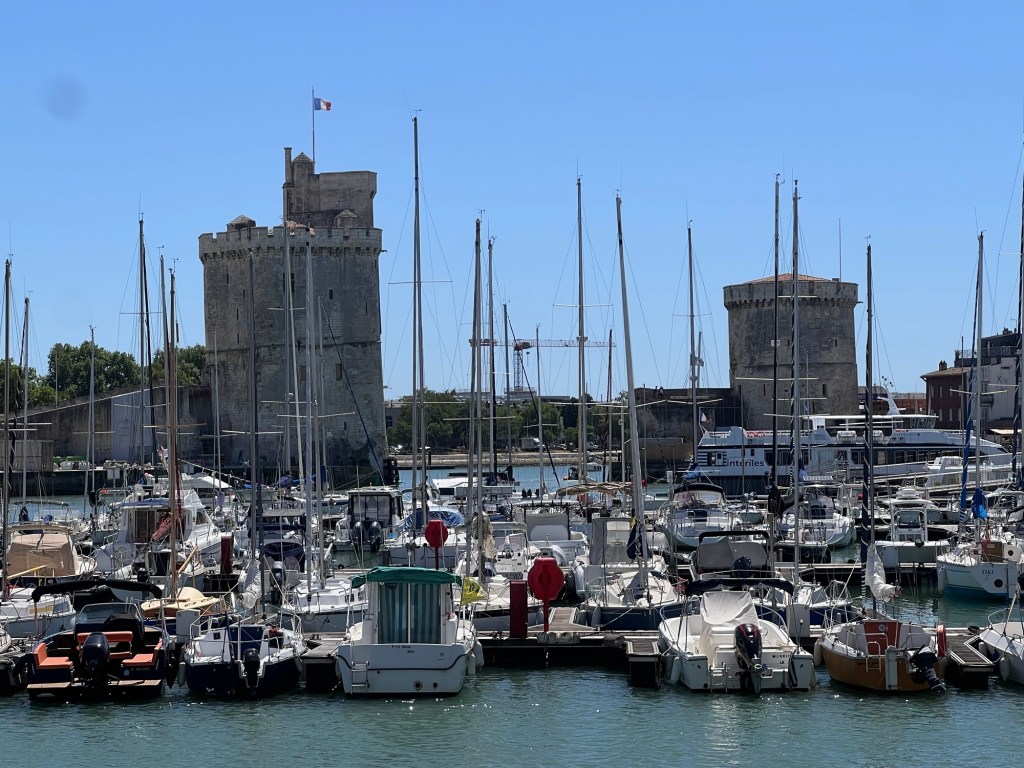
After lunch, we visited the old port protected by twin towers, across which in the olden days chains were stretched to prevent enemy ships from entering. La Rochelle is a bustling city and somehow the old medieval gates and towers lent it an air of authenticity and living history. Squawks of seagulls mingled with the sound of church bells.
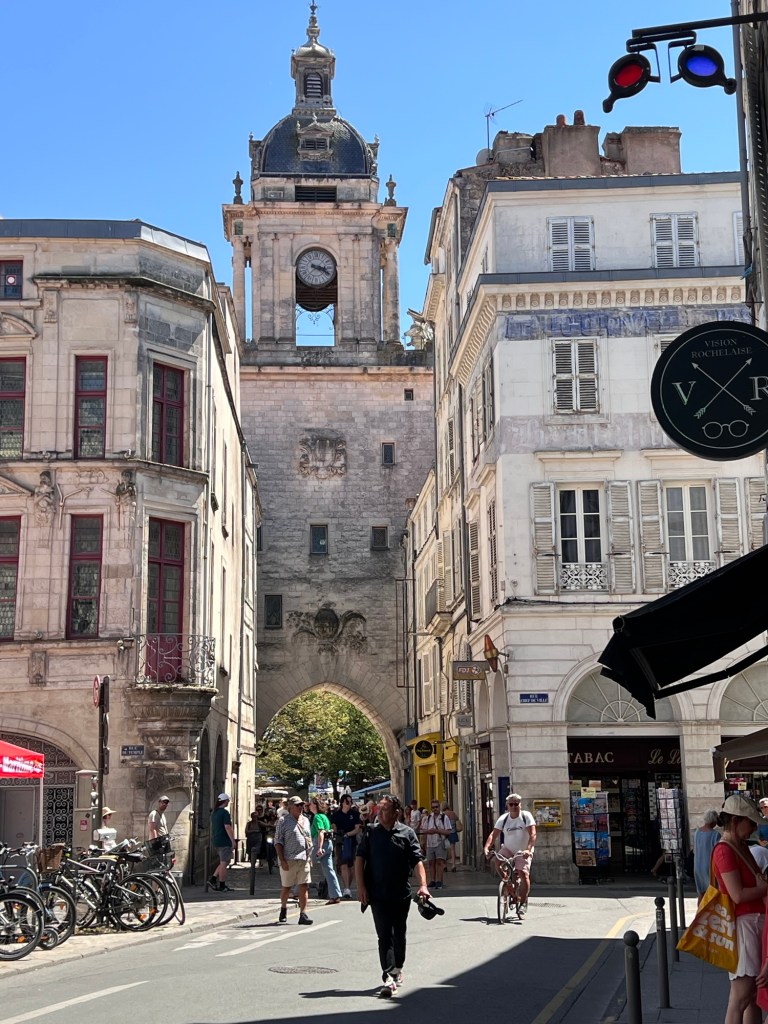
Then I saw signs for Hôtel de ville. I had seen the same sign in Luçon and you can’t blame me for thinking it was a chain of hotels – like Premier Inn! Fortunately, I was informed by my erudite hosts that a hôtel is a large mansion and Hôtel de ville is actually the Town Hall. One lives and learns. La Rochelle’s town hall was established back in the 13th century and the Gothic towers and walls remind one of the town’s fiercely independent past.
We walked into the Saint-Louis Cathedral. A small funeral service was going on. The incantations of the officiating priest rendered the atmosphere sombre. For a brief moment, I partook in the grief of the people gathered near the coffin. The thought that death is the final destination for everyone had a sobering effect. I quickened my pace a bit, almost as if to gain more time to live, until my time is called.
Walking around La Rochelle, I thought of the centuries of trials and tribulations the old town has lived through. In some strange way, I too felt a trace of that history.


 gopistory.com
Leave a comment