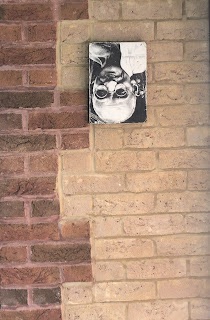
Yesterday, I removed the portrait of Gandhi from my wall and hung it upside down. The black and white photograph was purchased in Lima, Peru, some 25 years ago when I roamed the world as a marine engineer. There is an inscription in Spanish at the bottom of the portrait. It translates to, “The truth must manifest in our words, thoughts and actions”. The implication of upturning the portrait on the wall has turned my life upside down too. Why am I being so dramatic?
Growing up in India, I basked in the God like aura of this great man. He was beyond politics, almost every Indian town has a road named after him, a Gandhi statue is the standard adornment to public squares, and one cannot escape the ubiquitous Gandhi portrait with his trademark glasses smiling beatifically from the walls of every government building. Such is the esteem he is held in that we never mentioned his name without the honorific ‘Mahatma’ or the respectful suffix ‘ji’. It was either Mahatma Gandhi or Gandhiji for us, never Gandhi on its own. When I was 15 years old, my father offered me 100 rupees to read Gandhi’s autobiography, ‘The Story of My Experiments with Truth’. I don’t remember much of it. However, the fundamental beauty of the concepts of truth and ahimsa (non-violence) remained with me. Gandhi was my idol and I strived all my life to follow his principles.
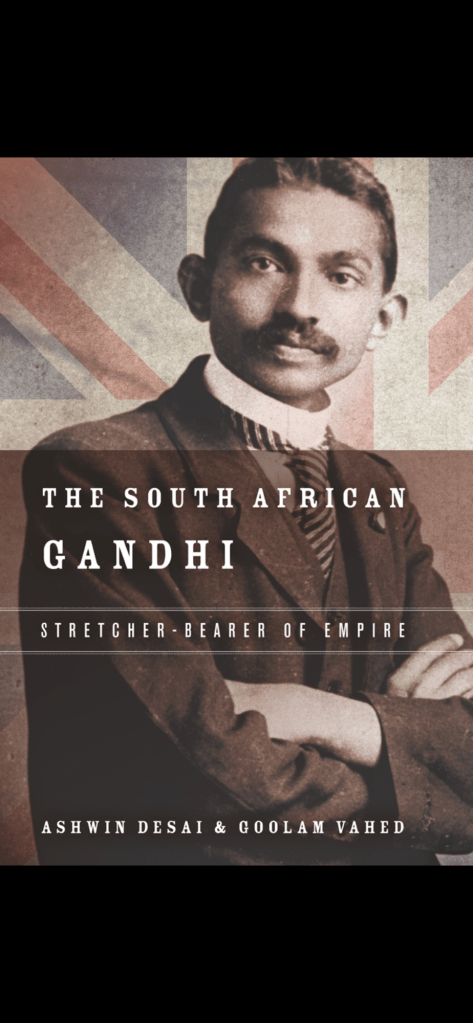
Everything changed for me with the murder of Geroge Floyd and the worldwide agitation that followed. I chanced upon an article on the BBC website, “Was Gandhi a racist?” The article was about a controversial new book[1] by two South African academicians of Indian ethnicity. Reading the book was equivalent to falling into a bottomless chasm. The edifices of my life came tumbling down, Gandhi’s antics in South Africa and his approach to race relations shocked and appalled me. His unrestrained contempt for the native African population left me reeling in disappointment. I had never, even remotely, suspected that Gandhi was a racist. Or was I being too harsh in my 21st century judgement of the value systems of the late 19th and early 20th centuries? I hope to resolve this question here. But before that, let me quote below from the ‘South African Gandhi …’.
… both the English and the Indians spring from a common stock, called the Indo-Aryan … A general belief seems to prevail in the Colony that the Indians are little better, if at all, than savages or the Natives of Africa … the Indian is being dragged down to the position of a raw Kaffir.
The above was his attempt to establish the Indian’s Aryan connection in an open letter to the Natal parliament on 19 December 1893.
I could fill pages with similar quotes. I could write tomes about the slaughter of thousands of Zulus by the British and the atrocities committed by the colonial administration, so much so that even Churchill, who was notorious for his white supremacist views, remarked that the South African government was the hooligan of the Empire. However, I must not digress and will address the question at hand: Was Gandhi a racist? Has he a rightful place on my wall?
It is easy to judge the past through today’s prism. Homosexuality was considered abnormal until recently. Would I be right to criticise someone who lived in the 19th century for their homophobic views? Perhaps not. However, my problem is not with the offensive words that Gandhi used or even his failed attempts to ingratiate himself with the colonialists to secure favoured status for Indians within the Empire. The suffering and disenfranchisement of 85% of the population of South Africa should have appealed to the better sense of a truly great soul, a Mahatma. Instead he dismissed them as sub-human and, for over two decades, never found common cause between the African and the Indian. He also held the indentured Indian labourer to be inferior (ibid “dumb and helpless”) to the more educated traders and other Indian professionals. Essentially, his interests were narrow in scope and his ambit was severely restricted by his prejudiced views. But then, we all evolve and change and I should give him a chance to redeem himself.
Now we examine Gandhi’s life post South Africa – from 1914 until his assassination by Hindu fundamentalists in 1948. Never once, neither in his autobiography nor in any of his prolific writings, did he display any contrition for his antipathy towards the native African. In his autobiography[2], he mentions the Zulu rebellion in passing, and nursing the wounded “ ‘uncivilized’ “ Zulus during the Anglo Zulu wars. I am indeed intrigued by the quotation marks around ‘uncivilized’, as if it was not his own view. A disingenuous Mahatma indeed!
The suffering of the native African was an aspect he never discussed. He did not for once collaborate with them or form a joint opposition to the horrendous crimes committed against both Indians and Africans by the Government of the Union of South Africa. Instead, he left South Africa after 21 years, having achieved a controversial ‘victory’ for the Indian community and secured their status as second-class citizens, marginally better than that of the native African.

I am disappointed to no end that my hero has fallen off his pedestal. I will leave him upturned until (if) he redeems himself through other biographies I am yet to read. I learned from him that the Truth must manifest in my actions. To tell the truth, I’m mighty pissed off with him for now.
 gopistory.com
Leave a comment