The house of my childhood has been demolished. I hear that the staircase, complete, is for sale. It is solid teak, of excellent quality, impervious to termites. Someone said that one of us should buy it.

Buy a staircase? The million times I ran up and down those stairs, chased by siblings, running up to complain to father, running down for dinner. If I buy that staircase, with its brass fixtures and its knurled banisters, will I hear father coming down in his wooden clogs and see the emerald green of his eyes? Will my mother give me refuge from the persecuting siblings? Will I hear the gentle shuffle of her feet?
I see the deer-heads and their disproportionately beautiful antlers, the punkha (fan) and its pulley, mementos of a past without electricity. The day I challenged God to place a bicycle in the punkha room by the next morning, as a condition for continuing to believe in Him. That very room where I permanently lost my faith when bleary eyed and sleepless, I ran in the next morning and saw no shiny new bicycle. Disappointed, I hide my tears in the car shed with its deadly repair pit and challenge the lurking spirits to either get me or leave me forever in peace. Even in my state of defiance, I dared not enter the forbidden woods of Thiyerankunnu with its granite alcoves dedicated to serpents both mythical and real.
The airy portico upstairs where I learned Malayalam and Maths from a tuition master. ‘Draw a loaf of bread’, he would say, ‘now cut it diagonally in half’. I learn how to write Ma of Malayalam while learning about diagonals and the abstraction of three dimensional objects into their orthogonal projections. The cool breeze from the Arabian sea tickle my hair and fill my nostrils with the smell of imminent rain.
Where is the ghost of the old maid Maadu gone? Still whimpering in the dark store room, now devoid of walls? I sense the darkness of the under stairs granary, the hide and seek favourite of the brave amongst us, with its heaps of raw rice and unhusked coconuts. I peep into the prayer room. Where, oh where, will those poor Gods go? Mahavishnu and his serpent bed; Siva in his resplendent leopard skin flaunting the menacing trident; Saraswati and her lute; Mahalakshmi and her lotus.
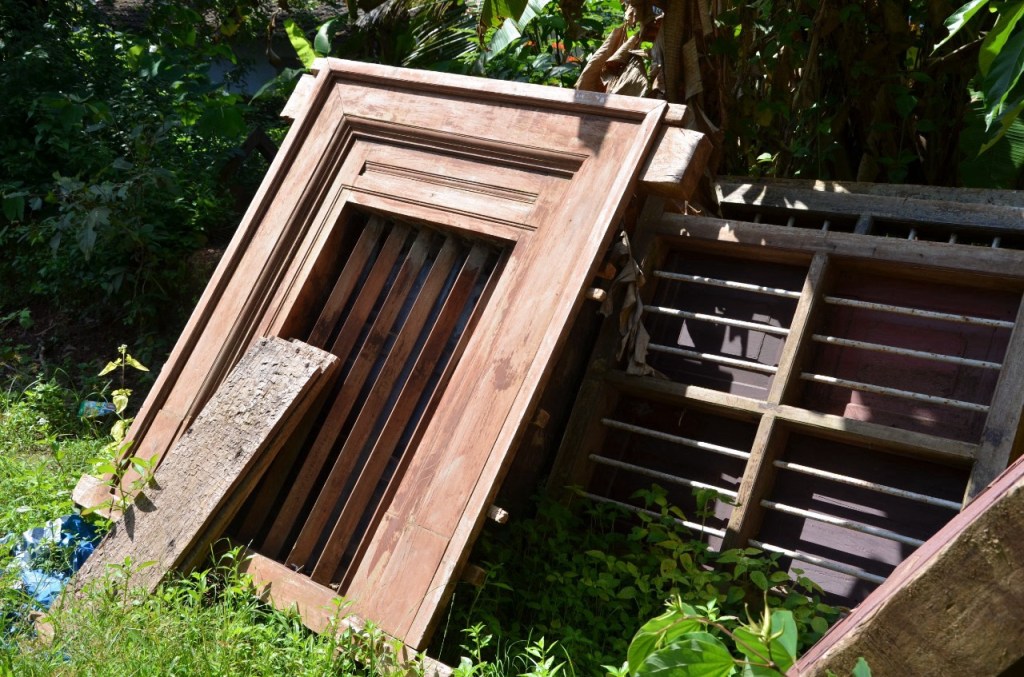
What about the delivery room where countless babies across several generations were born? And yes, the room downstairs with its bed of ebony and rosewood, where my ancestors breathed their last? Now Gods and ghosts, wander lost and untethered. No walls to hang from, no people to spook. I must house them before I am done with this story.
I see the beads of perspiration on my dear aunt’s forehead as she toiled with the smoking wood fire in the kitchen. I hear the rhythmic snort of Kuttappan as he split the hefty logs for firewood, his muscular torso heaving with each downward swing of the axe. I remember with fondness the young boy employed to look after me. Kuttiraman was only a few years older, but his wild stories enthral us while the monsoon rains serenade a magical lullaby outside.
Fast forward some years to the machete wound one of us inflicted on Kuttiraman’s arm while he ground for dosa on the well-worn mortar and pestle. Granite stone turned to marble with decades of grinding. The beads of blood seep out from the muscle just near his elbow, like little dew drops on the grass. He looks murder but exercises serious self-restraint for a hundred different reasons. One of them, perhaps, the helpless poverty he would return to, if he retaliates.
Cricket played with balls woven from coconut tree leaves and bats shaped from the spine of palm frond. Wickets of sticks, on laterite stone, blood colour red dust mixing in with grazed knees and elbows. The evening after school and before dusk, almost every evening, before the sun set. My sisters emerge with oil lamps invoking the Gods. Having lost faith, I smirk silently and wish the dusk wouldn’t interrupt the day which has potential for endless cricket. We had invented a new score, or rather adapted an existing one. It was a century if we could hit the ball over the gate and onto Thiyarankunnu. A full hundred, if one had the strength to hit that shot. And a bonus of 10 for anyone who dared to retrieve it from the temple of snakes.
Was it not on such a cricketing evening that I saw my first white man? Botha van Ingen, coffee planter client, steps out of his Austin, door held open by his driver. Emerging polished brown shoes, khaki trousers, white shirt, smoking pipe, khaki hat with a russet silk rim. We are frozen like still shots from an old documentary film. Father emerges from his office on to the portico and down to the car porch to meet his old friend and client. Botha’s face, I register, is blood red. I hadn’t seen a face like that ever. Redder than the Hibiscus in our garden, and boy the Hibiscus was some red. As he passes me, he pats my head. The spell breaks. Cricket continues.
I blush to remember the curious incident when I was caught fondling another under the piled law books. Indeed, what about the law books and what about the law? What about those countless clients and peons and poor relatives who haunt the office space and its veranda? Or the discreet domestic messages that I carried from mother to father as he lectured his clients on points of jurisprudence? My ears ring as the wooden floor upstairs resonate with the patter of children’s feet. Father’s political speeches echo across town and ricochet in our ears as we prepare to sleep.
Deep and mysterious well, swallower of cricket balls, provider of sweet water, I hear you are still standing. You remember with me, the red tropical frog in the bathroom camouflaged as LifeBouy soap. Smoke from the water-heating stove diffusing and scattering the weak light from a shade-less low wattage bulb. I grab the frog, mistaking it for soap, and it leaps out of my hands, scratching my palms with little claws. I give you my story for safe keeping, for I know you will stand forever.
They broke my house to build a new one in its place. It shouldn’t hurt, but it does. I feel more than pain. I feel the agony of loss. Still, there is no fuss, and there is no resentment. Only a hollow feeling that somehow the ghosts of my past are out in the streets. Where shall I confine them? How shall I fill the void?
The problem has suggested the solution. I have now built a house in my mind and connected it to the well that still stands. All the little memories, the big fears, ghosts, spirits, and bicycle denying Gods now live there, happy and comfortable, in an ever after sort of permanence. And no, I don’t need that staircase. This mind house has only one storey.
 gopistory.com
Leave a comment